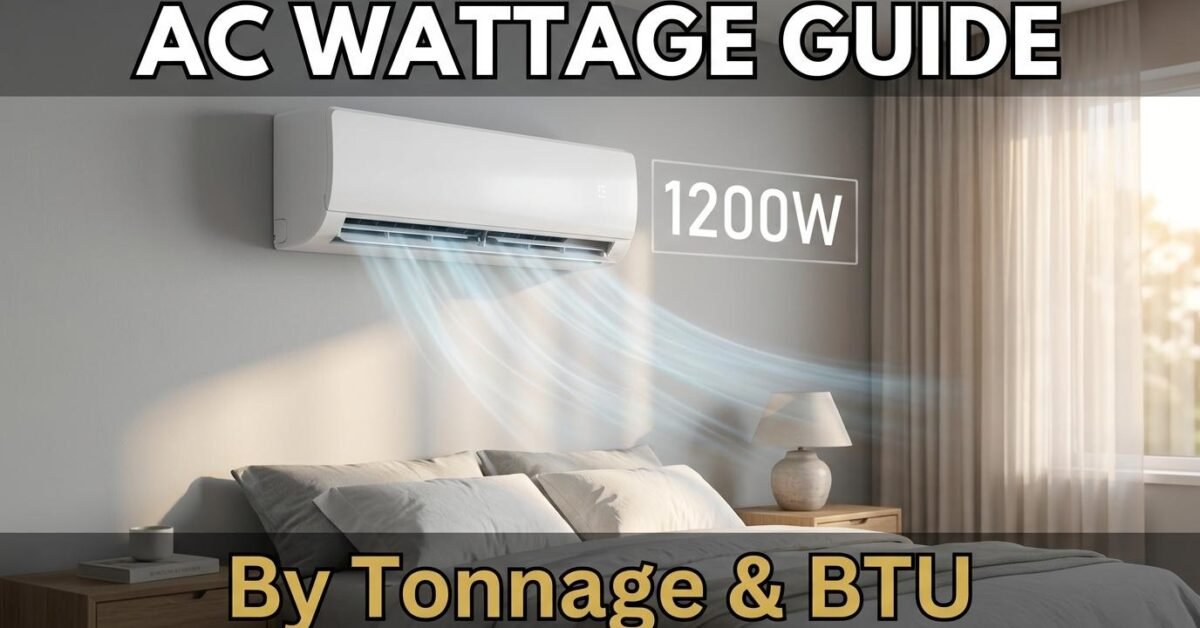
Air conditioners are the single highest-wattage appliance in most homes, and the one that causes the most problems with solar and backup systems. A 1-ton (12,000 BTU) window or split AC uses about 1,200 watts running. A 1.5-ton unit uses 1,800 watts. A 2-ton unit uses 2,400 watts. But these running watts are only half the story — the startup surge is what trips inverters and undersizes backup systems.
AC Wattage by Size (BTU and Tonnage)
Small window unit at 5,000 BTU uses about 500 watts. Medium window unit at 8,000 BTU uses 750 to 900 watts. A 1-ton split or window AC at 12,000 BTU uses 1,000 to 1,200 watts. A 1.5-ton split AC at 18,000 BTU uses 1,500 to 1,800 watts. A 2-ton split AC at 24,000 BTU uses 2,000 to 2,400 watts. A 3-ton central AC at 36,000 BTU uses 3,000 to 3,500 watts. A 5-ton central AC at 60,000 BTU uses 5,000 to 6,000 watts. Inverter AC models are 20 to 40 percent more efficient at steady-state operation, but their startup characteristics depend on the specific model.
The Startup Surge Problem
AC compressors surge at 3 times their running watts at startup. A 1,200-watt AC surges to 3,600 watts for 2 to 5 seconds every time the compressor kicks in. If your inverter is sized only for the running load, the surge will trip the overload protection and shut down the system. This is the number one reason backup systems fail when the AC turns on.
For a home running a 1.5-ton AC (1,800W running, 5,400W surge) plus a refrigerator (150W, 450W surge) plus fans and lights (200W), the continuous load is 2,150 watts but the worst-case surge reaches 5,850 watts. You need at least a 5 kVA inverter, not a 3 kVA. Our Solar System Calculator calculates both continuous and surge requirements with per-appliance surge multipliers so you never undersize your inverter.
Daily Energy Consumption
A 1-ton AC running 6 hours per day consumes about 7.2 kWh. A 1.5-ton running 6 hours uses 10.8 kWh. A 2-ton running 6 hours uses 14.4 kWh. In hot climates where AC runs 10 or more hours per day, these figures can double. Air conditioning is often 40 to 60 percent of a home’s total electricity consumption in summer months, which is why it dominates the solar sizing calculation.
Inverter AC technology reduces this significantly — a good inverter AC uses 30 to 40 percent less energy than a conventional unit because it modulates compressor speed instead of cycling on and off. If you are sizing solar specifically to run AC, an inverter model can save 2 to 3 panels worth of production.
How to Check Your AC’s Actual Wattage
Every air conditioner has a nameplate label showing its rated wattage, amperage, or BTU capacity. For window units, it is on the side panel. For split systems, check the outdoor compressor unit. If the label shows only amps and voltage, multiply them: a unit rated at 5.2 amps at 230 volts uses 1,196 watts. For the most accurate real-world measurement, a clamp meter on the power cable during operation shows actual draw under your specific conditions — which can differ from the nameplate by 10 to 20 percent depending on ambient temperature, thermostat setting, and refrigerant charge level.
When sizing solar or backup for AC, always use the nameplate wattage (not a measured lower figure) because you need the system to handle worst-case conditions — the hottest day when the compressor runs continuously at full power. Using a lower measured figure risks undersizing for exactly the conditions when you need cooling most.
Inverter AC vs Conventional AC: Wattage Difference
Conventional (fixed-speed) air conditioners run the compressor at full power until the room reaches the set temperature, then shut off completely. When the temperature rises again, the compressor restarts at full power with the full surge. This on-off cycling is harsh on inverters and batteries. Inverter air conditioners modulate the compressor speed — running at high power during initial cooling, then slowing to a low-power maintenance level. An inverter AC might use 1,200 watts during initial cooldown but only 400 to 600 watts once the room is at temperature.
For solar and battery systems, inverter ACs are strongly preferred. The reduced steady-state wattage means smaller battery drain, and the soft-start compressor eliminates the harsh 3x surge that trips conventional-AC-powered backup systems. The cost premium of 15 to 25 percent for an inverter AC is recovered quickly in both electricity savings and reduced solar system sizing requirements.
Central AC vs Split AC for Solar
Central air conditioning systems use 3,000 to 6,000 watts and require substantial solar arrays (10 to 20 panels) and large battery banks to operate during outages. Individual split AC units at 1,200 to 1,800 watts per room allow selective cooling — you can run one or two rooms on solar while leaving unused rooms uncooled. For solar sizing, split units offer more control over your load, letting you match cooling to your system’s capacity rather than sizing the system to your cooling maximum.
Running AC on Solar and Battery
Running an air conditioner on solar is absolutely possible but requires proper sizing. For a 1-ton AC running 6 hours daily, you need about 7.2 kWh of daily production from your panels (roughly 4 panels at 585W in a 5 sun-hour region) plus a battery bank large enough to handle the surge. For battery backup of the AC during outages, a 200 Ah LiFePO4 battery at 24V provides about 3.7 kWh usable — enough for about 3 hours of 1-ton AC operation. Two batteries extend this to 6 hours.
AC Tonnage Guide: Which Size for Your Room?
Choosing the right AC size prevents both wasted energy and inadequate cooling. For a room of 150 square feet, a 0.75-ton unit at 800 watts is sufficient. For 200 square feet, a 1-ton at 1,200 watts. For 300 square feet, a 1.5-ton at 1,800 watts. For 400 square feet, a 2-ton at 2,400 watts. Rooms with high ceilings, large windows, or direct sun exposure may need one size larger. Well-insulated or shaded rooms may work with one size smaller.
How to Measure Your AC’s Actual Power Draw
Every air conditioner has a nameplate label showing rated wattage, amperage, or BTU. For window units, check the side panel. For split systems, check the outdoor compressor unit. If only amps are shown, multiply by voltage: 5.2 amps at 230V equals 1,196 watts. A plug-in watt meter or clamp meter gives the most accurate real-world measurement under your specific conditions, which can differ from the nameplate by 10 to 20 percent depending on ambient temperature and thermostat settings. When sizing solar or backup, always use nameplate wattage since you need worst-case coverage on the hottest day.
Use our Appliance Wattage Database to find your exact AC model’s wattage, then plug it into the Solar System Calculator to size the complete system.
AC Tonnage Guide: Which Size for Your Room?
Choosing the right AC size prevents both wasted energy (oversized unit cycling too frequently) and inadequate cooling (undersized unit running nonstop). For a room of 150 square feet, a 0.75-ton or 9,000 BTU unit at about 800 watts is sufficient. For 200 square feet, a 1-ton unit at 1,200 watts. For 300 square feet, a 1.5-ton at 1,800 watts. For 400 square feet, a 2-ton at 2,400 watts. Rooms with high ceilings, large windows, or direct afternoon sun exposure may need one size up. Rooms that are well-insulated or shaded may work with one size down.
When calculating your solar requirements, use the wattage for the actual AC size your room needs — not the largest unit available. An oversized AC in a small room wastes both cooling capacity and solar investment. Our Solar System Calculator includes AC as a one-tap preset with the correct wattage and surge multiplier, so you can quickly compare how different AC sizes affect your total system.
Browse all appliance wattages →