Disclosure: This article contains affiliate links. If you buy through them, SolarEvaluator earns a small commission at no extra cost to you. We only recommend equipment we would size into our own systems.
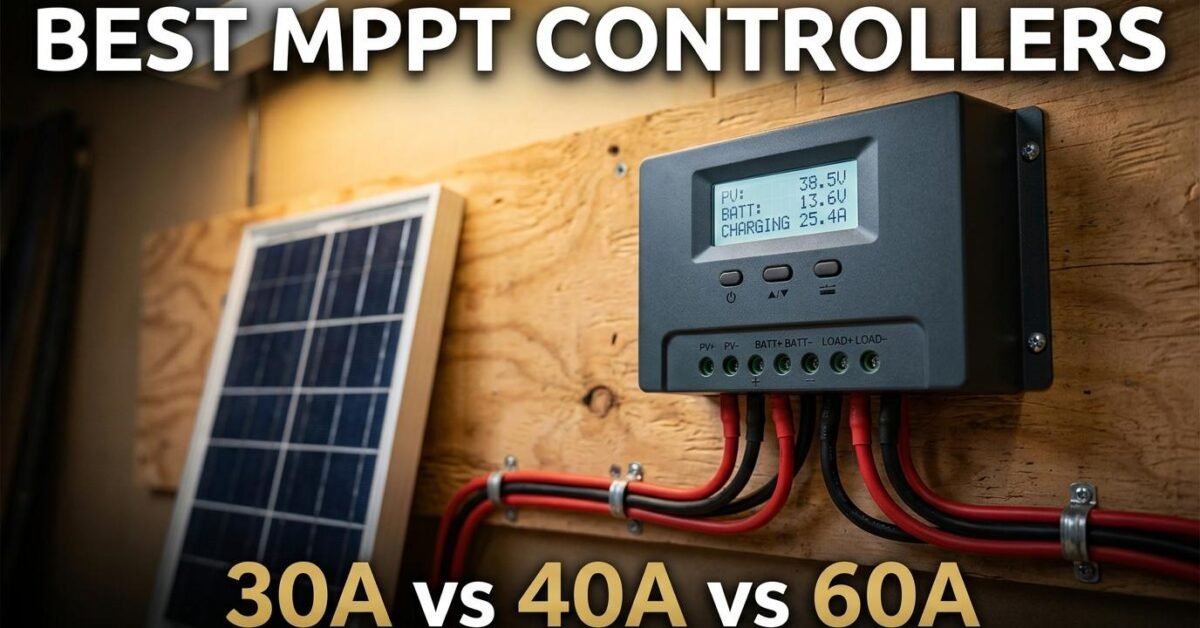
The charge controller is the least glamorous purchase in a solar build and the one that quietly decides how much of your panel investment actually reaches your batteries. A quality MPPT controller harvests up to 30 percent more energy than a PWM unit from the same panels — in winter and cloudy conditions, when you need every watt, the gap is largest. After sizing controllers for every system configuration our Solar System Calculator supports, these are the four I keep recommending.
Quick Picks
| Controller | Rating | Max PV Input | Best For |
|---|---|---|---|
| Victron SmartSolar 100/30 (top pick) | 30A | 100V | Quality-first builds up to ~400W (12V) |
| Renogy Rover 40A (best value) | 40A | 100V | Most systems, 12V/24V, ~520W-1040W |
| Victron SmartSolar 150/60 | 60A | 150V | Large 24V/48V arrays |
| EPEver Tracer 30A AN (budget) | 30A | 100V | Tight budgets, smaller arrays |
1. Victron SmartSolar MPPT 100/30 — Best Overall
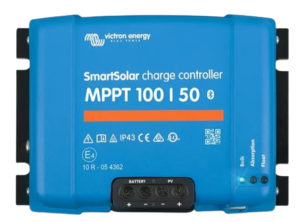
Victron is what installers buy for their own systems, and the reasons are boringly practical: peak conversion efficiency around 98 percent, an MPPT tracking algorithm that reacts to cloud edges in under a second, built-in Bluetooth with the best monitoring app in the industry, and a five-year warranty the company actually honors. The 100/30 handles up to 100V of panel input at 30A of charge current — about 400 W of panels on a 12V bank or 800 W on 24V. Set your battery chemistry once in the VictronConnect app and it manages absorption and float correctly forever.
Pros: Class-leading efficiency and tracking speed, superb app, five-year warranty, silent (no fan).
Cons: Costs more than the Renogy; no display on the unit itself (the app is the display).
Check Current Price — Victron 100/30 →
2. Renogy Rover 40A — Best Value
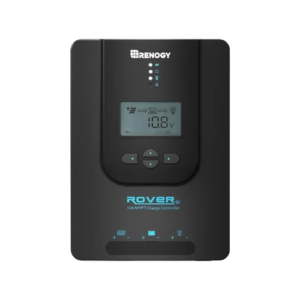
The Rover 40A is the controller in more DIY builds than any other, and the value math explains why: 40A of charge current at a price close to Victron’s 30A unit, auto-detection of 12V and 24V banks, a proper LCD display on the unit, and support for every mainstream chemistry including LiFePO4. Tracking efficiency is a step behind Victron — figure 1 to 3 percent less harvest — but you bought 33 percent more amperage for the same money. On a 24V bank it comfortably manages a 1,000 W array, which covers the majority of systems our calculator sizes.
Pros: Outstanding amps-per-dollar, on-unit display, wide chemistry support, optional Bluetooth module.
Cons: Slightly lower tracking efficiency; Bluetooth costs extra; fan is audible at full load.
Check Current Price — Renogy Rover 40A →
3. Victron SmartSolar MPPT 150/60 — For Large Systems
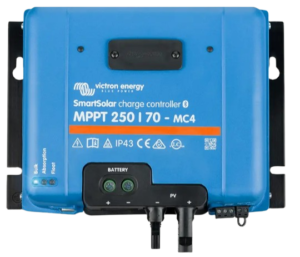
Once your array passes 1,500 W you either parallel multiple small controllers or step up to one serious unit. The 150/60 accepts 150V of PV input — meaning longer panel strings, thinner wire, and lower voltage-drop losses (verify your run with our Wire Gauge Calculator) — and delivers 60A of charge current, which is roughly 1,700 W into a 24V bank or 3,400 W into 48V. Same 98 percent efficiency, same app, same warranty as its smaller sibling. This is the controller for cabins and small off-grid homes.
Pros: High string voltage saves copper cost, handles serious arrays, Victron ecosystem integration.
Cons: Premium price; oversized for systems under 1 kW.
Check Current Price — Victron 150/60 →
4. EPEver Tracer 30A AN — Budget Pick
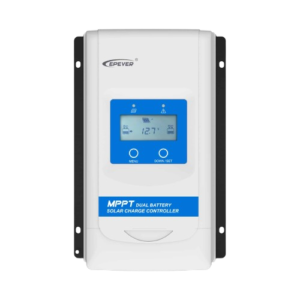
EPEver’s Tracer AN series is the honest budget MPPT: real maximum power point tracking (beware the fake “MPPT” units under $40 — they are PWM boards in MPPT clothing), a clear display, and reliable operation documented across years of forum builds. Efficiency and build quality sit a tier below Renogy, and the terminals accept thinner wire than I would like. But if the alternative is a PWM controller or a counterfeit, the Tracer is the correct budget answer for arrays up to about 400 W on 12V.
Pros: Genuine MPPT at the lowest credible price, decent display, proven in thousands of builds.
Cons: Lower efficiency, smaller terminals, warranty support is slow.
Check Current Price — EPEver Tracer 30A →
How to Size Your Controller
The sizing rule is simple: controller amps = array watts divided by battery bank voltage, plus 25 percent headroom. A 800 W array on a 24V bank needs 800 / 24 = 33A, so a 40A controller. The same array on 12V needs 67A — which is why larger arrays should run higher bank voltages. Also check the voltage side: your panel string’s open-circuit voltage on the coldest morning of the year must stay under the controller’s PV input limit (100V or 150V above), because cold panels produce higher voltage and controllers die from overvoltage, not overcurrent.
Our Solar System Calculator outputs the exact controller amperage for your load and array — run it first, then come back and pick the unit above that clears your number with headroom. If you are still choosing between kit brands, the Rover pairs naturally with Renogy panels and the Victron units play well with everything.