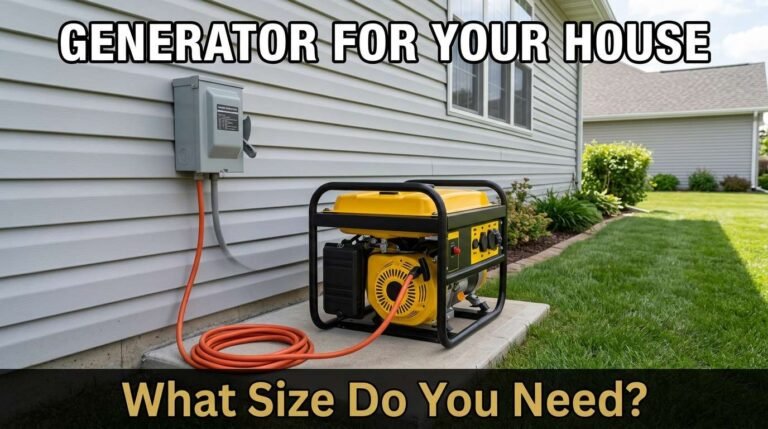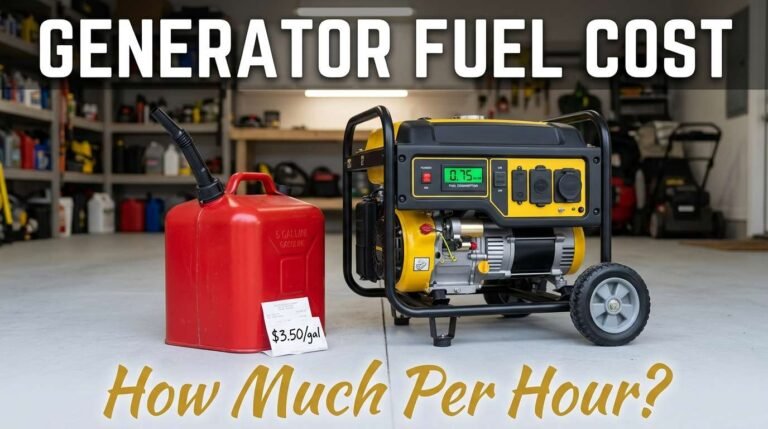
Generator runtime depends on three factors: the fuel tank size, the generator’s consumption rate, and the load percentage. A typical 5 kW portable generator with a 6.5-gallon tank runs 8 to 12 hours at 50 percent load. At full load, runtime drops to 5 to 7 hours. Our Generator Sizing Calculator estimates runtime at your specific load.
Generator Runtime by Size (at 50% Load)
| Generator | Typical Tank | 50% Load Runtime | 75% Load Runtime | 100% Load Runtime |
|---|---|---|---|---|
| 2 kW inverter | 1.0 gal | 4-6 hours | 3-4 hours | 2-3 hours |
| 3.5 kW portable | 4.0 gal | 9-12 hours | 7-9 hours | 5-7 hours |
| 5 kW portable | 6.5 gal | 10-13 hours | 8-10 hours | 6-8 hours |
| 7.5 kW portable | 8.0 gal | 9-11 hours | 7-9 hours | 5-7 hours |
| 10 kW standby | Propane tank | 24-48 hours* | 18-36 hours* | 12-24 hours* |
| 20 kW standby | Propane tank | 16-32 hours* | 12-24 hours* | 8-16 hours* |
*Standby generators on propane: runtime depends on tank size (100-500 gallon tanks are common). A 100-gallon propane tank runs a 10 kW generator at 50 percent load for approximately 62 hours.
The Runtime Formula
Runtime (hours) = Tank size (gallons) ÷ Fuel consumption rate (gal/hr). The consumption rate varies with load. At 50 percent load, a gasoline generator consumes roughly 0.12 gallons per kW per hour. A 5 kW generator: 0.12 × 5 = 0.6 gal/hr. With a 6.5-gallon tank: 6.5 ÷ 0.6 = 10.8 hours. At full load, consumption rises to about 0.18 gal/kW/hr: 0.18 × 5 = 0.9 gal/hr, giving 6.5 ÷ 0.9 = 7.2 hours.
How to Extend Generator Runtime
There are five practical ways to extend runtime on a single tank. First, reduce the load — turn off non-essential appliances when the generator is running. Every 100W you eliminate extends runtime by roughly 20 to 30 minutes on a 5 kW generator. Second, use a larger external fuel tank connected via a fuel line extension. Third, run the generator intermittently — 2 hours on, 1 hour off. A closed fridge maintains safe temperature for 4 hours without power, so cycling the generator extends total coverage dramatically. Fourth, supplement with a battery and inverter — charge the battery while the generator runs, then run critical loads from the battery while the generator rests. Fifth, switch to a more fuel-efficient generator — inverter generators are 20 to 40 percent more fuel-efficient than conventional generators at partial load because they adjust engine speed to match the load.
Generator + Solar: The Best of Both Worlds
The most fuel-efficient backup strategy combines a generator with solar panels and a battery. During daylight, solar charges the battery and powers loads directly — the generator stays off. At night or during heavy loads, the generator runs to supplement. This hybrid approach can reduce fuel consumption by 50 to 70 percent compared to running the generator alone. Size your solar supplement in our Solar System Calculator and compare total costs in the Solar vs Generator Calculator.
Generator Safety: Carbon Monoxide
Generators produce carbon monoxide (CO) — a colorless, odorless killer gas. Never run a generator indoors, in a garage, or in any enclosed space. Place it at least 20 feet from the house with exhaust pointed away from windows. Install battery-powered CO detectors on every floor. More people die from generator CO poisoning during outages than from the outages themselves.
Transfer Switch Requirements
Never backfeed a generator into a wall outlet — this electrocutes utility workers. Use a manual transfer switch ($200-500 installed) or interlock kit ($100-200) to safely connect to your home panel. Standby generators include automatic transfer switches. Our Generator Sizing Calculator sizes both the generator and transfer switch.
Fuel Storage Tips
Gasoline lasts 3-6 months (12 with stabilizer). Diesel lasts 12 months. Propane stores indefinitely. For emergency-only generators that sit idle between outages, propane is the best fuel choice — no degradation, no spill risk, and refillable tanks are available at most hardware stores.
Energy Cost Impact
Monthly cost formula: (Watts × hours per day × 30) ÷ 1,000 × electricity rate. At the US average of $0.16/kWh, a 1,500W appliance running 2 hours daily costs $14.40/month. A 100W device running 8 hours costs $3.84/month. Even small wattage reductions compound over a year — saving 50W over 8 daily hours saves $23 annually. Calculate all your appliances combined in our Electricity Bill Calculator.
Measuring Your Actual Consumption
Published wattage ranges are approximations. Your specific model may draw more or less depending on age, settings, and condition. For exact numbers, use a plug-in watt meter (Kill A Watt P4400 or Poniie PN2000, both under $25) between the appliance and the wall for 24 hours. The meter captures running watts, peak surge, and total kWh consumed — the precise values for sizing solar panels, batteries, or generators. Look up typical values first in our Appliance Wattage Database with 140+ devices.
Sizing Solar Panels and Battery Backup
Use the average wattage for energy calculations (how many panels you need) and the startup surge for inverter and generator sizing (how big the inverter must be to handle the peak). Our Solar System Calculator handles both — enter all your appliances and get the complete system specification. For battery backup runtime, use our Battery Backup Calculator. For generator sizing, use our Generator Sizing Calculator which accounts for motor startup surge automatically.
Reducing Energy Consumption
The cheapest watt is the one you never use. Before sizing a solar system or generator, consider whether you can reduce consumption first. Upgrading to Energy Star rated appliances typically reduces consumption by 20 to 50 percent. Using timers and smart plugs eliminates standby power draw (which accounts for 5 to 10 percent of total home electricity use). Switching from incandescent or halogen to LED lighting reduces lighting consumption by 75 percent. Every watt you eliminate from your load reduces the solar panel count, battery size, and inverter capacity — saving thousands of dollars on the system.