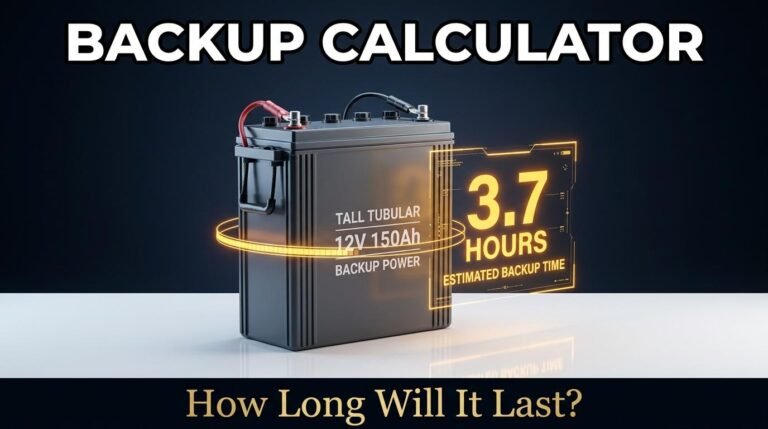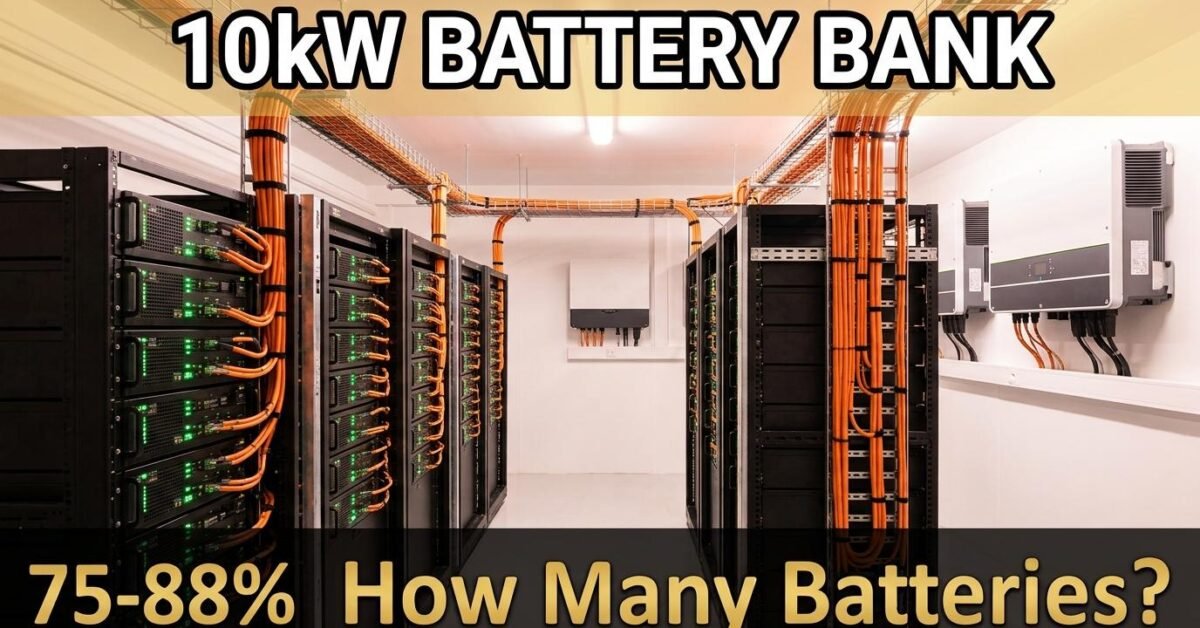
A 10kW solar system is a substantial residential or small commercial installation. It generates roughly 40 to 55 kWh per day depending on your location, which is enough to power a large home with air conditioning, a pool pump, or a small workshop. But how many batteries does a 10kW solar system actually need? The answer depends on your backup duration, battery chemistry, system voltage, and which loads you want the batteries to cover.
First: What Does a 10kW System Produce?
A 10 kW array in the US Southwest with 6 peak sun hours and 20 percent losses produces about 48 kWh per day. In the US Midwest with 4.5 sun hours, the same array produces about 36 kWh. In the UK with 4 hours, about 32 kWh. Australia at 5.5 hours gets roughly 44 kWh. These numbers set the baseline for battery sizing — your battery bank needs to store enough energy to cover the gap between what the panels produce and when you actually use the power.
Battery Count by Chemistry (8-Hour Backup)
For a realistic residential scenario, assume 15 kWh of essential loads need battery backup for 8 hours overnight (not the entire 40+ kWh daily production — essentials only). Using standard 200 Ah 12-volt batteries on a 48-volt system (4 batteries in series per string), here is the count by chemistry.
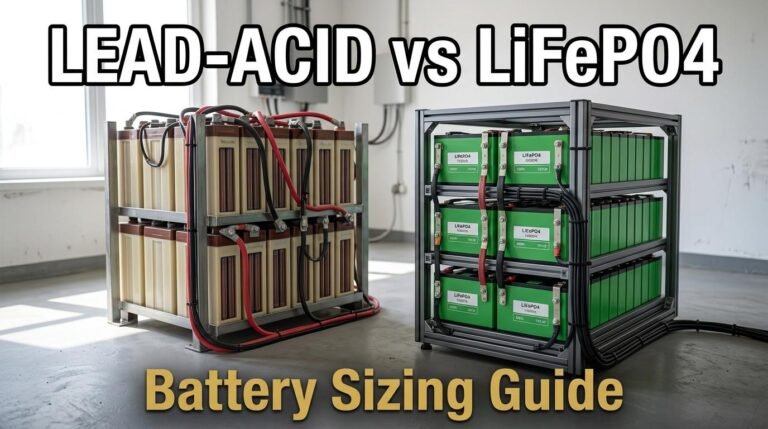
Lead-acid at 50 percent depth of discharge and 85 percent system efficiency needs about 14.7 kWh of rated capacity: 8 batteries (2 strings of 4). AGM at the same depth of discharge needs the same count: 8 batteries. Lithium-ion at 80 percent depth of discharge needs about 9.2 kWh rated: 4 batteries (1 string of 4). LiFePO4 at 90 percent depth of discharge needs about 8.2 kWh rated: 4 batteries (1 string of 4).
The gap is stark: lead-acid needs double the batteries that LiFePO4 does for the same backup duration, because half of every lead-acid battery’s capacity is unusable.
Full Off-Grid: 1-Day Autonomy
If you need the battery bank to run the entire home for a full day without any solar input (true off-grid autonomy), the numbers scale up significantly. At 40 kWh daily consumption with lead-acid: you need about 94 kWh of rated capacity, which is 20 batteries at 200 Ah on a 48V system. With LiFePO4: about 52 kWh rated, or 12 batteries. Two-day autonomy doubles these counts — 40 lead-acid or 24 LiFePO4 batteries — which is why most off-grid designers recommend LiFePO4 for systems of this size.
System Voltage Matters
A 10 kW system should use a 48-volt battery bank. At 48 volts, the current flowing through cables and the charge controller is half of what it would be at 24 volts for the same power. This means thinner cables, smaller charge controllers, lower resistive losses, and a safer installation. Each 48-volt string uses four 12-volt batteries in series. Additional strings are added in parallel to increase capacity.
Using Higher-Capacity Batteries
The 200 Ah figure is a common residential reference, but batteries come in many sizes. With 280 Ah LiFePO4 cells (the current mainstream lithium size), the count drops further: the same 8.2 kWh requirement needs only 4 cells configured as a single 48-volt string. With the newer 314 Ah cells, 4 units still suffice with more headroom. Larger batteries reduce the number of connections and simplify the installation.
Matching Your Charge Controller
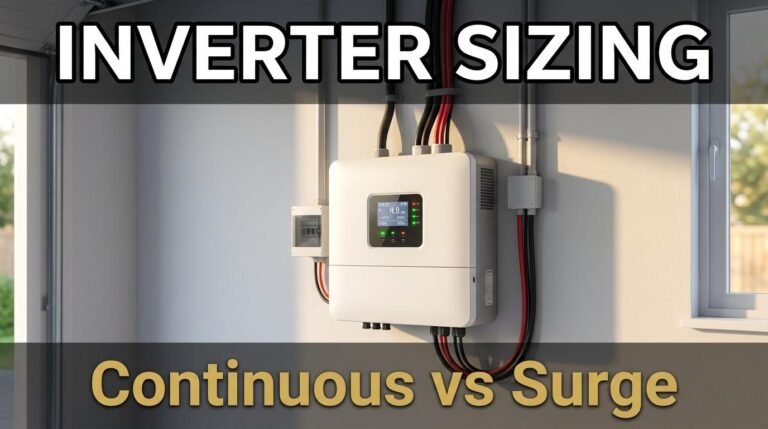
A 10 kW array on a 48-volt system requires a charge controller rated for at least (10,000 ÷ 48) × 1.25 = 260 amps. That is a large controller — many installations at this scale split the array across two controllers (130 amps each) or use a hybrid inverter with an integrated MPPT controller rated for the full array. Our Solar System Calculator sizes the controller alongside the battery bank so the components match.
Cost Comparison for a 10kW System
At current 2026 prices, the battery component of a 10 kW system with 8-hour essential backup costs roughly 1,200 to 1,600 dollars with lead-acid (8 batteries) or 4,000 to 5,500 dollars with LiFePO4 (4 batteries). Over 10 years including replacements, lead-acid totals 3,600 to 4,800 dollars while LiFePO4 stays at the original cost. The full system — panels, inverter, controller, batteries, and wiring — typically runs 14,000 to 22,000 dollars for hardware depending on component quality and battery chemistry.
Size Your 10kW Battery Bank Now
These are reference numbers for a typical 10 kW system. Your actual battery count depends on your specific loads, your backup duration, and your local prices. The Solar System Calculator lets you build your real appliance list, choose your backup mode (hours or days, essentials or whole load), and see the exact battery count across all four chemistries — sized to your system, not to a generic table.
Size your 10kW battery bank in the Solar System Calculator →