Quick Answer
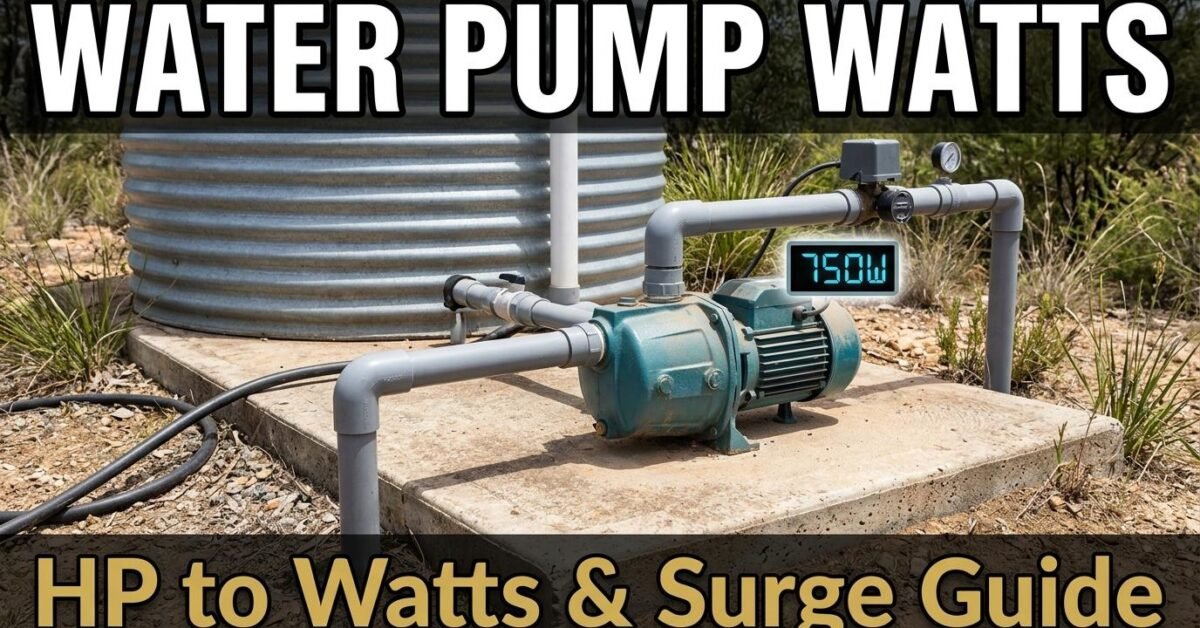
A water pump uses 250 to 2,000 watts depending on type and HP. A 0.5 HP surface pump uses 250-400W. A 0.5 HP submersible uses 370-500W. A 1 HP submersible well pump uses 750-1,000W. A 2 HP submersible uses 1,500-2,000W. Startup surge is 3-4x running watts.
| Pump | Running Watts | Startup Surge |
|---|---|---|
| 0.5 HP surface pump | 250 – 400W | 750 – 1,200W |
| 0.5 HP submersible | 370 – 500W | 1,000 – 1,500W |
| 1 HP submersible | 750 – 1,000W | 2,250 – 3,000W |
| 1.5 HP submersible | 1,100 – 1,500W | 3,300 – 4,500W |
| 2 HP submersible | 1,500 – 2,000W | 4,500 – 6,000W |
| Sump pump (0.33-0.5 HP) | 250 – 600W | 750 – 1,800W |
| 12V DC pump (RV/marine) | 30 – 60W | 60 – 120W |
Water pumps are one of the most critical loads for off-grid and rural solar systems — and one of the trickiest to size because of their high startup surge. A 0.5 HP water pump uses about 375 watts running, but surges to 1,125 to 1,500 watts at startup. A 1 HP pump uses 750 watts running with a surge to 2,250 to 3,000 watts. A 2 HP pump uses 1,500 watts running with a surge up to 6,000 watts. Getting the inverter sizing wrong means the pump will not start.
Water Pump Wattage by HP Rating
A 0.25 HP pump uses about 200 watts running with a 3 to 4x surge. A 0.5 HP surface pump uses 375 watts running, 1,125 to 1,500 watts surge. A 0.5 HP submersible pump uses 400 to 500 watts running, 1,200 to 2,000 watts surge (submersibles surge higher due to the water column). A 1 HP pump uses 750 watts running, 2,250 to 3,000 watts surge. A 1.5 HP pump uses 1,100 watts running, 3,300 to 4,400 watts surge. A 2 HP pump uses 1,500 watts running, 4,500 to 6,000 watts surge.
The surge multiplier for water pumps is higher than most other motors — typically 3 to 4 times running watts compared to 2 to 3 times for fans and washing machines. This is because pumps start under load (pushing water) while fans start with no resistance. Some pumps equipped with soft-start modules reduce the surge to 1.5 to 2 times running watts, which can significantly reduce your inverter requirement.
Daily Energy Consumption
Water pump daily energy depends entirely on how long it runs per day. A 0.5 HP pump running 1 hour per day uses 0.375 kWh. Running 2 hours uses 0.75 kWh. A 1 HP pump running 1 hour uses 0.75 kWh. These are modest energy figures — the challenge with pumps is not daily energy but the peak surge that determines inverter sizing.
For homes with pressure tank systems, the pump runs in short bursts (5 to 15 minutes) triggered by pressure drops. The total daily runtime might be only 30 to 60 minutes, but each startup produces the full surge. If the pump cycles 10 times per day, the inverter must handle 10 surges — reliability under repeated surging is critical.
Submersible vs Surface Pumps
Surface pumps sit above ground and draw water through suction. They are limited to about 8 meters of suction lift and are typically used for overhead tanks, irrigation, and pressure boosting. Submersible pumps are installed inside the well or borehole and push water up. They can push water from 30 to 200 meters deep but draw more power than equivalent surface pumps because they must overcome the full water column height. A 0.5 HP submersible at 30 meters depth draws about 500 watts versus 375 watts for a surface pump — and the surge is higher because the pump starts against full water pressure.
Soft-Start and Variable-Speed Pump Controllers
The single best upgrade for running a water pump on solar or battery backup is a soft-start module. Standard motor starters apply full voltage instantly, causing the 3 to 4x surge. A soft-start ramps voltage gradually over 2 to 5 seconds, reducing the surge to 1.5 to 2x running watts. For a 1 HP pump, this drops the surge from 3,000 watts to about 1,500 watts — potentially allowing you to use a 2 kVA inverter instead of a 5 kVA unit. Soft-start modules cost 50 to 150 dollars and are one of the highest-value additions to any pump installation.
Variable-speed (VFD/inverter-driven) pump controllers go further, adjusting pump speed to match demand. They virtually eliminate startup surge and reduce energy consumption by 20 to 40 percent compared to fixed-speed operation. They cost 200 to 500 dollars but pay for themselves quickly in both inverter savings and reduced battery drain.
Sizing Solar and Battery for a Water Pump
The inverter is the critical component for water pump loads. A 0.5 HP pump needs a minimum 2 kVA inverter (1,500W surge capacity). A 1 HP pump needs at least 3 to 5 kVA. Running a pump alongside other loads like a refrigerator and lights pushes inverter requirements higher — our Solar System Calculator calculates both continuous and surge totals with per-appliance multipliers so you get the right inverter size.
For battery backup, a water pump is typically a short-duration load. A 0.5 HP pump running for 1 hour needs only 0.375 kWh from the battery — a single 200 Ah LiFePO4 battery at 12V can run it for nearly 5 hours. The battery bank sizing is usually determined by other loads (refrigerator, lights) rather than the pump itself. Use our Battery Backup Calculator for exact runtime with your pump’s wattage.
Browse all appliance wattages in the database →
Frequently Asked Questions
How many watts does a 0.5 HP water pump use?
A 0.5 HP surface pump (jet pump) uses 250 to 400 watts while running. A 0.5 HP submersible well pump uses 370 to 500 watts because it works against more head pressure lifting water from underground. Both types surge to 3-4 times running watts (750-1,500W) at startup for 1-3 seconds. Size your inverter or generator for the surge, not just the running watts.
How many watts does a submersible well pump use?
A submersible well pump uses 370 to 2,000 watts depending on horsepower and well depth. A 0.5 HP submersible uses 370-500W, a 1 HP uses 750-1,000W, and a 2 HP uses 1,500-2,000W. Deeper wells require more power because the pump must overcome greater head pressure to push water to the surface. A pump in a 100-foot well uses roughly 15-20 percent more power than the same pump in a 50-foot well.
How many watts does a 240V well pump use?
A 240V well pump uses the same wattage as a 120V pump of the same HP — watts are watts regardless of voltage. A 1 HP 240V well pump uses 750-1,000W, the same as a 1 HP 120V model. The difference is in the current: a 240V pump draws half the amps (750W ÷ 240V = 3.1A vs 750W ÷ 120V = 6.3A), which allows thinner wiring and longer cable runs from the panel to the pump.
How much energy does a water pump use per day?
A typical household well pump runs 1 to 3 hours per day in total (cycling on and off). A 1 HP pump running 2 hours daily uses approximately 750W × 2 hours = 1,500 Wh (1.5 kWh). At an electricity rate of $0.15/kWh, that costs about $0.23 per day or roughly $7 per month. A smaller 0.5 HP pump running 1.5 hours uses about 600 Wh (0.6 kWh) per day — roughly $3 per month.
Can I run a water pump on solar panels?
Yes. A 0.5 HP pump using 600 Wh daily needs approximately 200W of solar panels and a 100Ah battery. A 1 HP pump using 1,500 Wh daily needs 400-500W of panels and a 200Ah battery. The key challenge is the startup surge — the inverter must handle 3-4x the running watts for the first few seconds. Use our Battery Charge & Discharge Calculator to size the complete system including panels, battery, MPPT controller, and inverter.
What size generator do I need for a water pump?
Your generator must handle the startup surge, not just the running watts. A 0.5 HP pump surging to 1,200W needs at least a 2,000W (2 kW) generator. A 1 HP pump surging to 2,250W needs at least a 3,500W generator. A 2 HP pump surging to 6,000W needs a 7,500W or larger generator. Always size the generator for 1.5x the maximum surge to avoid overload trips during startup.
What size inverter do I need for a water pump?
The inverter must handle the motor startup surge. A 0.5 HP pump needs at least a 1.5 kVA inverter (handles the 1,200W surge). A 1 HP pump needs a 3 kVA inverter (handles the 2,250W surge). A 1.5 HP pump needs a 5 kVA inverter. Consider adding a soft starter to reduce the surge by 60-70%, which allows a smaller, cheaper inverter. Use our inverter sizing guide for detailed recommendations.