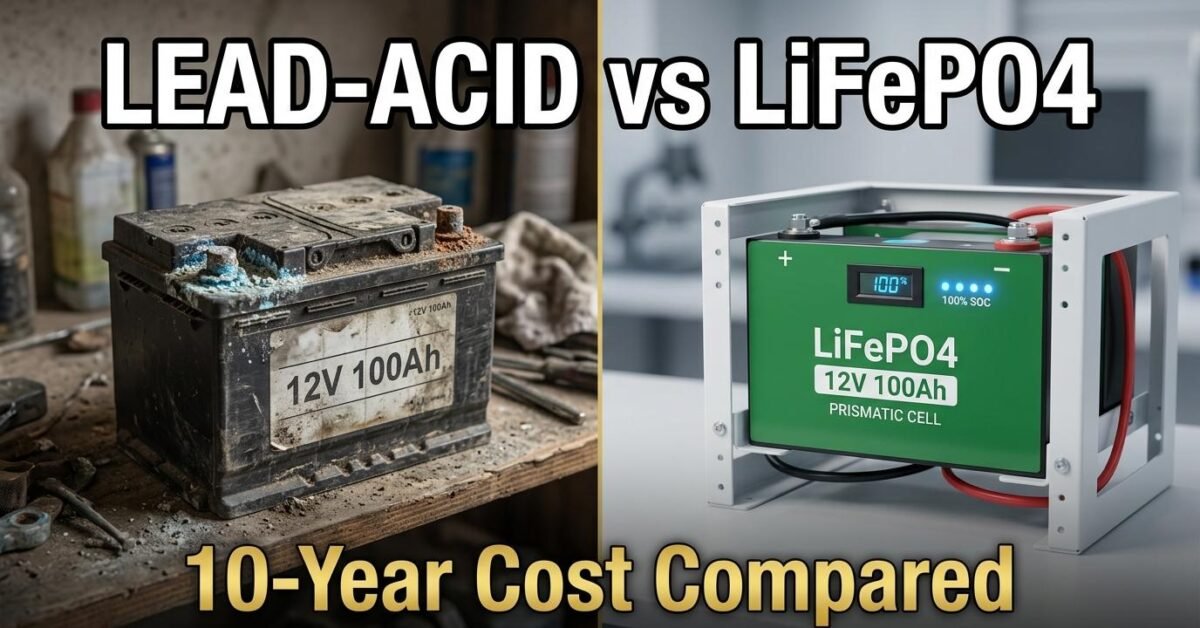
The lead acid vs lithium battery solar debate is the single most consequential decision in any off-grid or hybrid system. Lead-acid wins on sticker price every time. LiFePO4 wins on 10-year cost almost every time. This guide breaks down exactly why, with real numbers for depth of discharge, round-trip efficiency, replacement cycles, and total cost of ownership — so you can pick the right chemistry with your eyes open.
Upfront Cost: Lead-Acid Wins (On Paper)
Lead-acid batteries cost roughly 100 to 200 dollars per kWh of rated capacity. LiFePO4 batteries cost 400 to 600 dollars per kWh. For a system needing 10 kWh of rated battery capacity, lead-acid costs about 1,500 to 2,000 dollars while LiFePO4 costs 4,000 to 6,000 dollars. If you stop the comparison here, lead-acid looks like an obvious choice. But rated capacity is not usable capacity, and that is where the numbers start to flip.
Depth of Discharge: The Hidden Multiplier
Depth of discharge is the percentage of a battery’s rated capacity you can actually use without damaging it. Lead-acid batteries should not be discharged below 50 percent — go deeper regularly and a battery rated for 4 years might fail in 18 months. AGM batteries share the same 50 percent limit. LiFePO4 batteries can safely discharge to 90 percent of their rating, cycle after cycle, for over a decade.
This means a 200 Ah lead-acid battery delivers only 100 Ah of usable energy. A 200 Ah LiFePO4 battery delivers 180 Ah. You need roughly 80 percent more lead-acid capacity to store the same usable energy as LiFePO4. That gap alone closes much of the upfront price difference.
Round-Trip Efficiency: Energy You Lose
Every battery loses some energy during the charge and discharge cycle. Lead-acid batteries have a round-trip efficiency of about 80 to 85 percent — for every 100 Wh you put in, you get 80 to 85 Wh out. LiFePO4 batteries achieve 95 to 98 percent round-trip efficiency. Over a year of daily cycling, that 10 to 15 percent efficiency gap means your panels need to produce more energy to keep lead-acid batteries charged. In practical terms, a lead-acid system needs a slightly larger solar array to deliver the same usable energy as a LiFePO4 system.
Cycle Life: Where LiFePO4 Pulls Away
Lead-acid batteries in daily solar cycling typically last 800 to 1,200 cycles at 50 percent depth of discharge, which translates to roughly 3 to 4 years. AGM batteries are similar, sometimes reaching 4 to 5 years with careful management. LiFePO4 batteries are rated for 3,000 to 6,000 cycles at 80 to 90 percent depth of discharge. At one cycle per day, that is 8 to 16 years. Most quality LiFePO4 batteries carry a 10-year warranty.
This lifespan difference is what makes the 10-year cost comparison so decisive.
The 10-Year Cost Comparison
Consider a home system needing 10 kWh of usable battery capacity. With lead-acid at 50 percent depth of discharge, you need 20 kWh of rated capacity. At 150 dollars per kWh, the upfront battery cost is 3,000 dollars. Over 10 years with replacements every 3.5 years, you buy three sets: 9,000 dollars in batteries alone. Add the labor and disposal cost of two swap-outs and the real total is closer to 10,000 dollars.
With LiFePO4 at 90 percent depth of discharge, you need 11.1 kWh of rated capacity. At 500 dollars per kWh, the upfront cost is 5,550 dollars. Over 10 years, there is no replacement — the batteries are still running. Total 10-year cost: 5,550 dollars. That is 45 percent less than lead-acid despite costing nearly double on day one.
Our Solar System Calculator runs this exact comparison in Step 5 with editable prices for your local market, showing both upfront and 10-year totals side by side.
Maintenance and Practicality
Flooded lead-acid batteries require regular maintenance — checking water levels, cleaning terminals, and equalizing charges monthly. Neglect any of these and battery life drops further. AGM batteries are sealed and maintenance-free but share the same depth and lifespan limits. LiFePO4 batteries are completely maintenance-free. Install them, connect them, and they run for a decade with no intervention. For remote off-grid installations where regular maintenance is difficult, this alone can justify the higher upfront cost.
Weight and Space
Lead-acid batteries are heavy — a 200 Ah 12-volt unit weighs roughly 50 to 60 kilograms. A LiFePO4 battery with the same rating weighs about 25 kilograms. Since you also need fewer LiFePO4 units for the same usable capacity, the total weight and floor space of a LiFePO4 bank can be one-third of a lead-acid bank. This matters for rooftop installations, mobile setups, and any location where structural load capacity is a concern.
When Lead-Acid Still Makes Sense
Lead-acid is not wrong in every scenario. If you have a very tight upfront budget and cannot finance the LiFePO4 purchase, lead-acid gets you running today. If the system is temporary or seasonal — a construction site, a short-term off-grid stay, or a backup you rarely cycle — the shorter lifespan matters less. And in extremely cold environments where batteries are not sheltered, lead-acid tolerates cold charging slightly better than some LiFePO4 models without low-temperature protection.
Make the Comparison With Your Numbers
Generic tables cannot account for your local battery prices, your energy use, or your backup requirements. The Solar System Calculator sizes your battery bank across all four chemistries (lead-acid, AGM, lithium-ion, and LiFePO4), then shows the upfront and 10-year cost with editable prices. Enter your local market costs and see which chemistry actually saves money in your situation.
Compare lead-acid vs LiFePO4 in the Solar System Calculator →