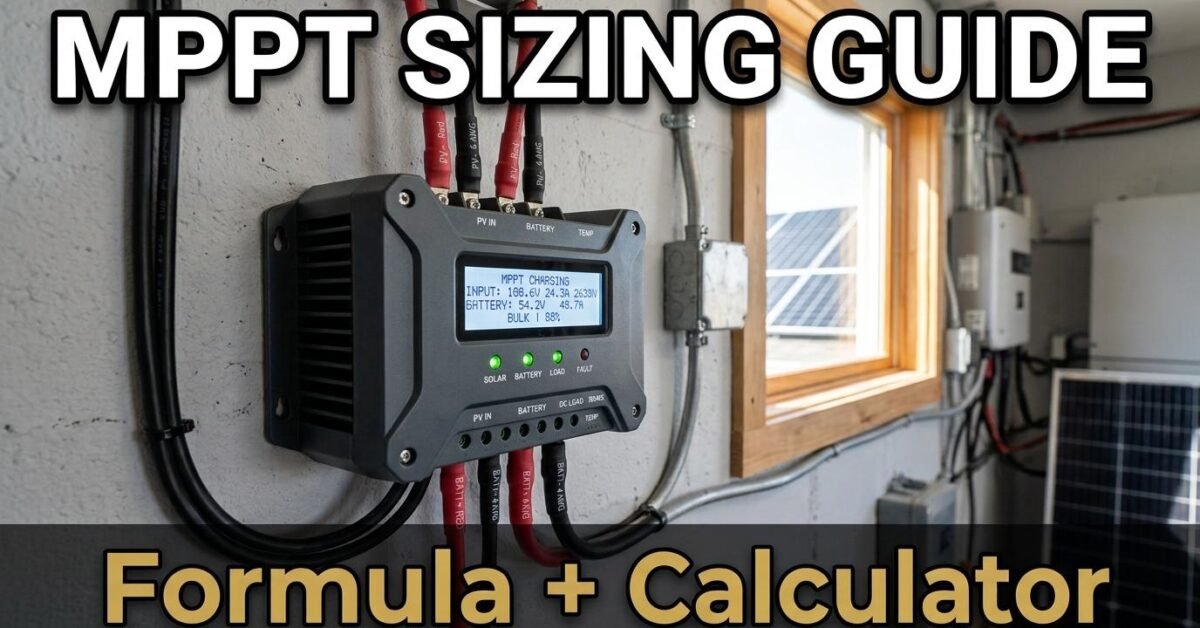
The charge controller sits between your solar panels and your batteries, regulating the charging current to protect your battery bank from overcharging. Getting MPPT charge controller sizing wrong means either wasting panel output (controller too small) or overspending on a controller you will never fully use (too large). This guide covers the sizing formula, the safety factor, standard sizes, and when MPPT beats PWM — then shows you how our calculator sizes it automatically.
MPPT vs PWM: Which Do You Need?
There are two types of solar charge controllers. PWM (Pulse Width Modulation) is simpler and cheaper but wastes energy — it essentially clips the panel voltage down to battery voltage, losing 15 to 30 percent of potential output. MPPT (Maximum Power Point Tracking) converts the higher panel voltage to the optimal battery-charging voltage and current, capturing 95 to 99 percent of available energy. For any system above 200 watts, MPPT is the standard. The efficiency gain pays for the price difference within the first year of operation.
The MPPT Charge Controller Sizing Formula
The calculation is straightforward. Divide your total solar array wattage by your battery bank voltage, then multiply by 1.25 for a 25 percent safety margin. This safety factor accounts for cold-weather panel output spikes (panels produce more voltage in cold air) and meets electrical code requirements in most jurisdictions.
Controller amps = (Array watts ÷ Battery voltage) × 1.25
For a 3.5 kW array on a 24-volt battery system: (3,500 ÷ 24) × 1.25 = 182.3 amps. Round up to the next standard size: 200 amps. For a smaller 1.17 kW system on 24 volts: (1,170 ÷ 24) × 1.25 = 61 amps. Round up to an 80-amp controller.
Standard MPPT Controller Sizes
MPPT controllers come in standard ratings: 10, 20, 30, 40, 60, 80, and 100 amps for residential, with 150, 200, and 250 amps available for larger systems. Always round up to the next available size — never round down. An undersized controller limits your array output and can overheat under sustained full-power conditions.
If your calculated requirement falls between two sizes, choose the larger one. The cost difference between a 60-amp and an 80-amp controller is typically 30 to 80 dollars, which is insignificant compared to the cost of replacing an overloaded unit or losing 20 percent of your panel investment to clipping.
System Voltage Affects Controller Size
The same array requires different controller ratings at different system voltages. A 3 kW array needs 156 amps at 24 volts but only 78 amps at 48 volts. Higher system voltage means lower current for the same power, which means a smaller and cheaper controller. This is one of the practical reasons larger systems use 48-volt battery banks — the controller sizing alone can save hundreds of dollars compared to a 24-volt configuration.
Maximum Input Voltage: The Other Spec
Every MPPT controller has a maximum input voltage rating, typically 100V, 150V, or 250V. Your solar array’s open-circuit voltage (Voc) — found on the panel datasheet — multiplied by the number of panels in series must not exceed this limit. If your array Voc exceeds the controller’s maximum input voltage, the controller can be permanently damaged. In cold weather, Voc increases, so apply a 10 percent cold-weather correction: effective Voc = datasheet Voc × 1.10.
This is why string configuration matters. A 4-panel string of 585-watt panels with a Voc of 51 volts gives a string Voc of 204 volts (224V with cold correction). You need a controller rated for at least 250V input. Two parallel strings of 2 panels each would give 102 volts (112V corrected), compatible with a cheaper 150V-rated controller.
Quality Brands and What to Look For
Victron Energy, Epever, Growatt, and Renogy are well-established residential MPPT brands. For larger systems, Schneider Electric, Outback Power, and Morningstar offer industrial-grade controllers. Key specs to compare beyond amp rating are maximum input voltage, maximum PV input wattage, Bluetooth or Wi-Fi monitoring capability, and whether the controller supports lithium battery charging profiles (essential if you are using LiFePO4 batteries).
Multiple Controllers for Large Arrays
When your calculated controller requirement exceeds 100 amps, splitting the array across two or more controllers is often more practical and cost-effective than a single oversized unit. Each controller handles its own panel string independently, which also provides redundancy — if one controller fails, half your array keeps charging. Many hybrid inverters now include dual MPPT inputs rated at 80 to 150 amps each, effectively giving you two controllers in one enclosure. For a 10 kW array on a 48-volt system needing 260 amps, two 150-amp MPPT inputs handle it cleanly with headroom to spare.
Let the Calculator Size Your Controller
Our Solar System Calculator sizes your MPPT charge controller automatically in Step 4. It takes your array wattage from Step 2 and your system voltage from Step 3, applies the 1.25 safety factor, and recommends the next standard controller size. No manual math, no guessing, and the result updates live as you change your panel or battery configuration.
Size your charge controller in the Solar System Calculator →