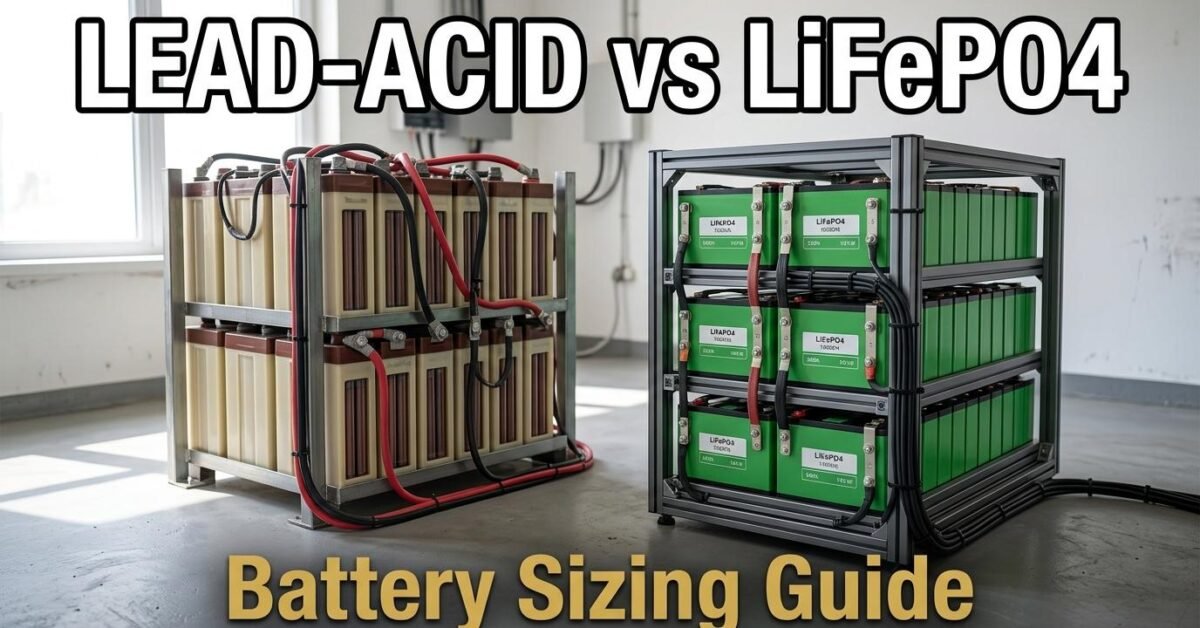
Getting solar battery bank sizing right is the difference between a system that runs all night and one that dies at 2 AM. Size too small and you lose power when you need it most. Size too large and you waste money on capacity you never use. This guide explains the math, compares four battery chemistries side by side, and shows you how to size your bank in minutes using our Solar System Calculator.
The Solar Battery Bank Sizing Formula
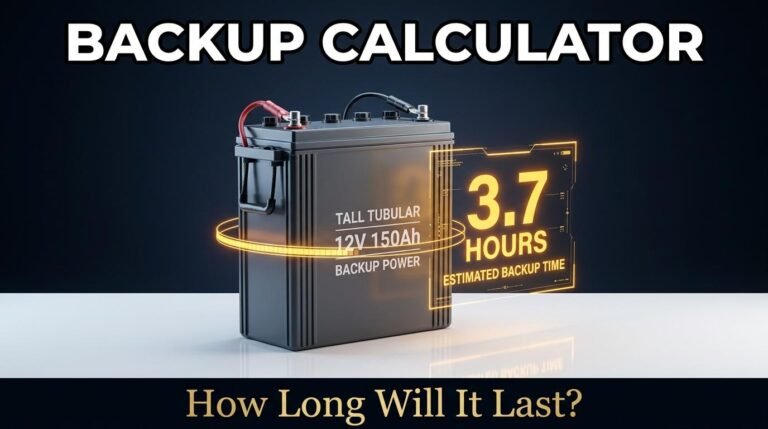
The core calculation is: Required capacity = (Daily energy × Backup days or hours) ÷ (Depth of discharge × System efficiency). Every term matters. Daily energy is how many kWh your loads consume. Backup duration is how long the bank must run with no solar input. Depth of discharge is how much of the battery’s rated capacity you can safely use. And system efficiency accounts for real-world losses in the battery and inverter — typically around 85 percent combined.
For example, if your essential loads consume 5 kWh per day and you want 8 hours of overnight backup, the energy needed is 5 × (8÷24) = 1.67 kWh. With lead-acid batteries at 50 percent depth of discharge and 85 percent efficiency: 1.67 ÷ (0.50 × 0.85) = 3.92 kWh of rated battery capacity. With LiFePO4 at 90 percent depth of discharge: 1.67 ÷ (0.90 × 0.85) = 2.18 kWh — nearly half the capacity needed.
Why Depth of Discharge Changes Everything
Depth of discharge is why lithium batteries need fewer units than lead-acid. A lead-acid battery rated at 200 Ah can only safely deliver 100 Ah before its lifespan drops dramatically. Go below 50 percent regularly and a lead-acid battery that should last 4 years might fail in 18 months. An AGM battery has similar constraints.
LiFePO4 batteries, by contrast, can safely discharge to 90 percent of their rating — 180 Ah from a 200 Ah battery. That single difference means you need roughly 40 to 45 percent fewer LiFePO4 batteries than lead-acid for the same backup duration.
Comparing Four Battery Chemistries
There are four common solar battery types, each with distinct characteristics. Flooded lead-acid batteries are the cheapest upfront at roughly 150 dollars per kWh, but they require regular maintenance (topping up water), have a 50 percent usable depth, and last about 3 to 4 years in daily cycling. AGM (absorbed glass mat) batteries are maintenance-free but have the same 50 percent depth limit and cost slightly more. Standard lithium-ion batteries offer 80 percent usable depth and last longer, but LiFePO4 (lithium iron phosphate) is the clear winner for solar — 90 percent usable depth, over 3,000 charge cycles, no maintenance, and a lifespan exceeding 10 years.
Our Solar System Calculator shows all four chemistries side by side in Step 3, with the exact battery count for each — so you can see the tradeoff instantly rather than doing the math four times.
Essentials vs Whole-Load Backup
A critical sizing decision most guides skip is what the battery actually needs to cover. Sizing your bank on your entire daily load is the off-grid approach, but if you have grid access and just want backup during outages, you only need to cover your essentials — refrigerator, lights, internet router, and a few outlets. This typically cuts your backup energy requirement by 50 to 70 percent compared to whole-load sizing.
Our calculator handles this with a per-appliance backup checkbox. Tick your essentials, switch to “Essentials only” mode, and the battery bank sizes on what you actually need during a power cut — not your air conditioner and water heater.
Hours vs Days of Backup
The traditional off-grid approach sizes batteries in days of autonomy — typically 1 to 3 sunless days. But for grid-connected backup, thinking in hours makes more sense. An 8-hour overnight backup or a 12-hour extended-outage cover is realistic and affordable. Sizing for 3 full days of whole-load autonomy can triple your battery cost with diminishing returns.
The 10-Year Cost Reality
Lead-acid batteries win on upfront cost. LiFePO4 wins on 10-year cost — and it is not close. A lead-acid bank needs replacement every 3 to 4 years, meaning two full replacements over a decade. A LiFePO4 bank installed today will likely still be running in 2036 with no replacement needed. For a typical home system, the 10-year total with lead-acid often exceeds the LiFePO4 total by 30 to 50 percent, despite the higher initial investment.
Our calculator breaks this down in Step 5 with editable prices for your local market, showing both upfront and 10-year totals side by side.
Size Your Battery Bank Now
Stop guessing and run the real numbers. The Solar System Calculator walks you through battery bank sizing with your actual loads, your chosen backup duration (hours or days), and all four chemistries compared — including the 10-year cost that reveals which option truly saves money.