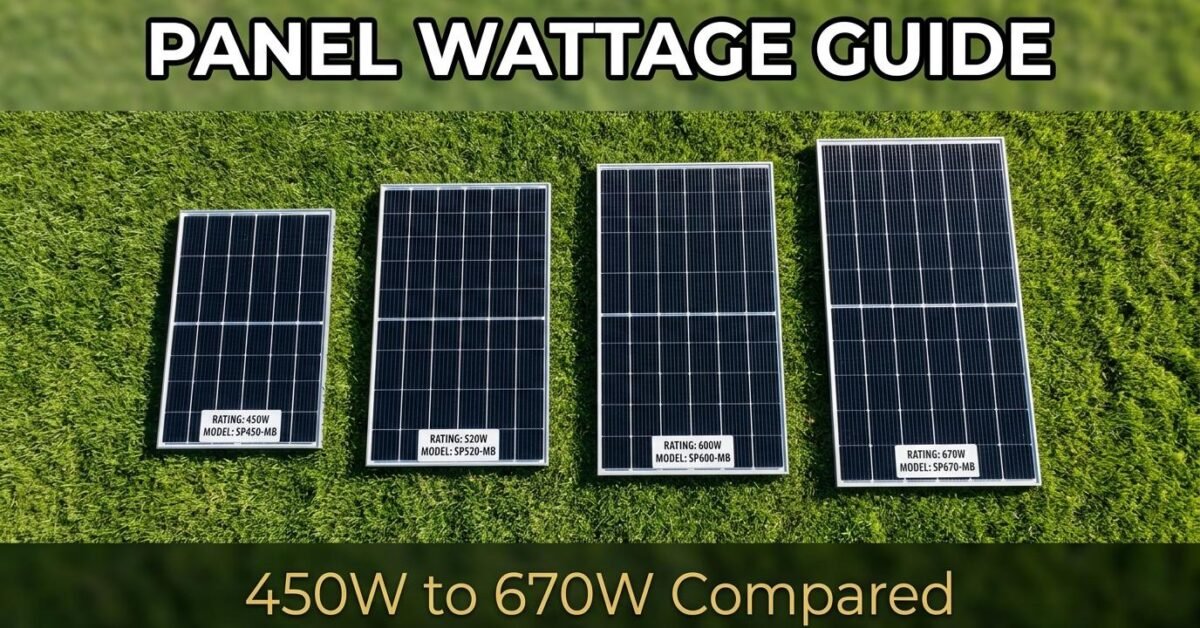
Solar panel wattage has climbed rapidly. Just a few years ago, 330-watt panels were standard residential. In 2026, mainstream residential panels ship at 450 to 585 watts, with premium models at 610 to 670 watts and commercial panels reaching 795 watts. But higher wattage does not always mean better value. This solar panel wattage comparison breaks down what the numbers actually mean for your system size, roof space, and cost.
What Panel Wattage Actually Means
A panel’s wattage rating — properly called its peak power or Pmax — is the maximum electricity it produces under standard test conditions: 1,000 watts per square meter of sunlight at 25 degrees Celsius. In real-world conditions, actual output is lower due to temperature, angle, shading, and dust. The wattage rating is a comparison tool, not a guarantee. A 585-watt panel will always produce more than a 450-watt panel under the same conditions — the ratio holds even as absolute output varies.
Side-by-Side: How Wattage Affects Your System
Consider a home using 20 kWh per day in a region with 5 peak sun hours and a 20 percent system loss buffer. The number of panels and roof space changes dramatically by wattage. At 450 watts you need 11 panels covering about 29 square meters of roof. At 550 watts you need 9 panels using about 24 square meters. At 585 watts you need 9 panels at 23 square meters. At 610 watts you need 8 panels at 21 square meters. And at 670 watts you need just 7 panels at 19 square meters.
The jump from 450 to 585 watts saves 2 panels and 6 square meters of roof space — a meaningful difference on a constrained roof. Going from 585 to 670 saves one more panel and 4 more square meters. Each step up in wattage has diminishing returns in panel count, which is why cost per watt matters as much as raw wattage.
Cost Per Watt: Where Value Lives
Panel pricing is quoted per watt, and the sweet spot in 2026 is the 450 to 585 watt range. Standard 450-watt panels run about 0.25 to 0.35 dollars per watt. The newer 585-watt panels cost 0.30 to 0.40 dollars per watt — slightly more per watt, but fewer panels means less mounting hardware, fewer connections, and faster installation. Premium 670-watt panels cost 0.40 to 0.55 dollars per watt, making them harder to justify unless roof space is genuinely tight.
The real savings from higher-wattage panels come not from the panels themselves but from the reduced balance-of-system costs: fewer rails, fewer clamps, fewer connectors, less wiring, and less installation labor. For a system of 8 panels versus 11, that can save 300 to 600 dollars in hardware and labor.
Technology Behind the Wattage Jump
The leap from 450 to 585 watts is driven primarily by two changes. First, the shift from P-type to N-type silicon cells — N-type cells are more efficient and degrade more slowly over time. Second, larger wafer sizes (182mm and 210mm) that pack more cell area into the same physical frame. Brands like LONGi, Jinko, Canadian Solar, and Trina all ship N-type panels in the 580 to 610 watt class. The 670-watt panels use the largest 210mm wafers with advanced cell architectures like TOPCon or heterojunction.
Panel Size and Weight Considerations
Higher-wattage panels are physically larger and heavier. A 450-watt panel typically measures about 1.7 by 1.1 meters and weighs around 22 kilograms. A 585-watt panel is roughly 2.3 by 1.1 meters at about 30 kilograms. A 670-watt panel can reach 2.4 by 1.3 meters at 35 kilograms. Before choosing the highest wattage available, confirm your roof structure can handle the increased load per panel, and that your mounting rails accommodate the larger frame dimensions.
Which Wattage Should You Choose?
For most residential installations in 2026, the 585-watt class hits the best balance of price per watt, panel count, and availability. It is the new mainstream. Go with 450 watts if budget is the primary constraint and roof space is ample. Choose 610 to 670 watts if roof space is limited and you need maximum output per panel. And the 720 to 795 watt range is primarily for commercial and ground-mount installations where the larger frame size is not a constraint.
Our Solar System Calculator includes every wattage from 100 to 795 watts plus a custom input, so you can compare panel counts and roof area instantly as you switch between options.
Compare Panel Wattages With Your Load
The right panel wattage depends on your specific load, your roof, and your budget — not a generic recommendation. The Solar System Calculator lets you toggle between panel sizes and see how the panel count, array size, roof area, and daily generation change in real time. Try 585 watts as your baseline, then see whether stepping up to 610 or down to 450 changes the picture enough to matter for your situation.