The real cost of a solar system is not what you pay on day one — it is what you pay over 10 years. A system that looks cheap upfront can cost significantly more over a decade when battery replacements, maintenance, and efficiency losses are factored in. This guide breaks down every component of solar system cost in 2026 and shows you how to compare lead-acid and lithium builds side by side.
Solar System Cost Breakdown by Component
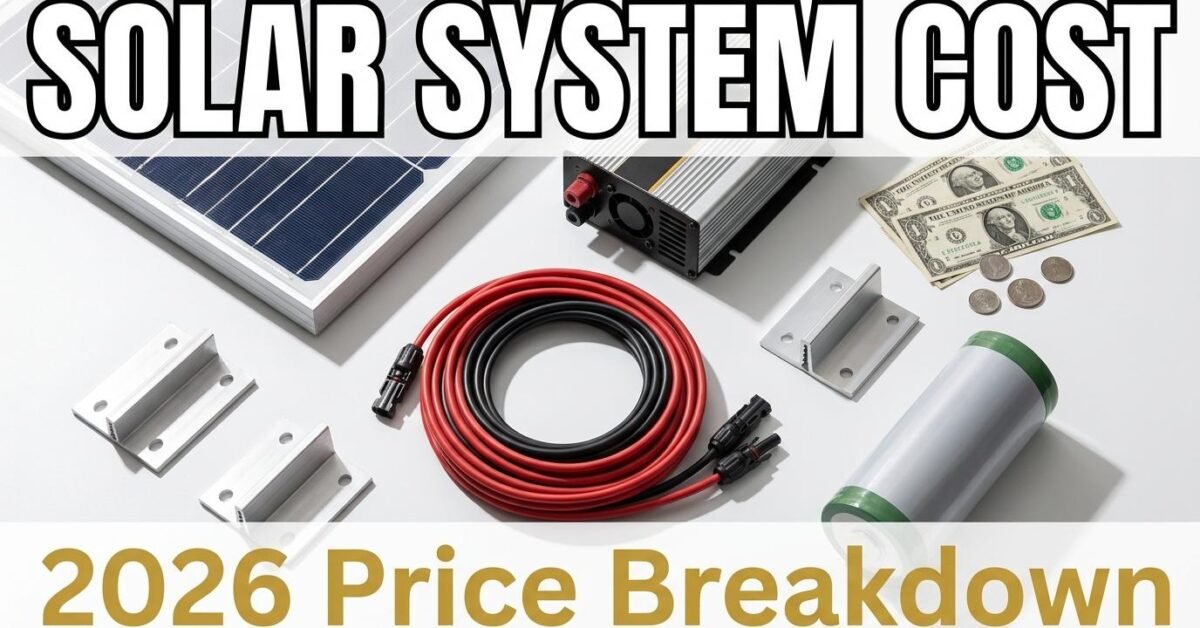
A complete off-grid or hybrid solar system has five cost layers. Panels are priced per watt and currently range from 0.25 to 0.50 dollars per watt for standard residential modules (450 to 585 watts). A 3 kW residential array at 0.35 dollars per watt costs roughly 1,050 dollars for the panels alone. A 10 kW commercial array costs about 3,500 dollars.
Inverters are priced per kVA. A quality 5 kVA hybrid inverter costs roughly 800 to 1,200 dollars. MPPT charge controllers range from 1 to 3 dollars per amp — a 60-amp controller runs about 90 to 180 dollars. Wiring, mounting hardware, combiner boxes, breakers, and installation labor typically add 10 to 20 percent on top of the hardware costs.
Battery Cost: The Biggest Variable
Batteries are typically the single most expensive component, and the chemistry you choose determines both the upfront price and the long-term cost. Lead-acid batteries currently cost about 100 to 200 dollars per kWh of rated capacity. LiFePO4 batteries cost 400 to 600 dollars per kWh. At first glance, lead-acid looks like the obvious winner — but rated capacity is not usable capacity.
A lead-acid battery only safely delivers 50 percent of its rating. A LiFePO4 battery delivers 90 percent. So the effective cost per usable kWh is much closer: lead-acid at roughly 200 to 400 dollars per usable kWh versus LiFePO4 at 440 to 670 dollars. And that is before replacement cycles are considered.
The 10-Year Cost That Changes the Decision
Lead-acid batteries in daily solar cycling last 3 to 4 years. Over a 10-year period, you will buy the original bank plus two full replacements — three sets of batteries total. LiFePO4 batteries last over 10 years with 3,000 or more charge cycles. You buy them once.
For a typical home system needing 10 kWh of usable battery capacity: the lead-acid upfront battery cost might be 2,000 dollars, but the 10-year battery cost is 6,000 dollars after two replacements. The LiFePO4 upfront cost might be 5,500 dollars — but the 10-year cost stays at 5,500 dollars. LiFePO4 is cheaper over a decade despite costing more than twice as much on day one.
Our Solar System Calculator shows both upfront and 10-year totals side by side with fully editable prices, so you can enter your local market costs and see exactly which option saves money in your situation.
Sample System Costs in 2026
A small off-grid cabin system with a 1.5 kW array, 5 kWh lead-acid battery bank, and a 1.5 kVA inverter might cost 2,500 to 3,500 dollars for hardware. A mid-size residential system with a 5 kW array, 10 kWh LiFePO4 bank, and 5 kVA hybrid inverter typically runs 8,000 to 12,000 dollars for hardware before installation. A large residential or small commercial system at 10 kW with a 20 kWh LiFePO4 bank and 10 kVA inverter might reach 16,000 to 22,000 dollars.
These figures are hardware only. Professional installation adds 2,000 to 5,000 dollars depending on complexity and location. In the US, the federal Investment Tax Credit (ITC) currently covers 30 percent of the total installed cost, bringing a 15,000-dollar system down to an effective cost of 10,500 dollars.
How Currency and Location Affect Cost
Solar equipment prices vary significantly by market. Panels manufactured in China and Southeast Asia are generally cheapest when purchased locally in those regions. Shipping, import duties, and local dealer margins add cost in Western markets. Our calculator lets you set any currency symbol and adjust every component price to match your local market — whether you are buying in US dollars, British pounds, Australian dollars, or any other currency.
Hidden Costs to Budget For
Beyond the core hardware, several costs catch first-time buyers off guard. Electrical permits and inspections range from 200 to 500 dollars in most US jurisdictions. A concrete pad or ground-mount frame for batteries adds 300 to 800 dollars if batteries are not wall-mounted indoors. Cable runs over 15 meters may require thicker gauge wire to avoid voltage drop — add 100 to 300 dollars for longer runs. And if your roof needs structural reinforcement for a large array, that can add 1,000 dollars or more. Our calculator includes a wiring and mounting percentage to capture these extras as a proportion of hardware cost.
Calculate Your System Cost
Generic cost tables cannot account for your specific loads, your battery choice, or your local prices. The Solar System Calculator sizes every component from your actual energy use, then prices the complete system with editable per-unit costs — panels, inverter, controller, lead-acid batteries, and LiFePO4 batteries — plus a wiring and mounting percentage. You see both the upfront total and the 10-year reality in one view.