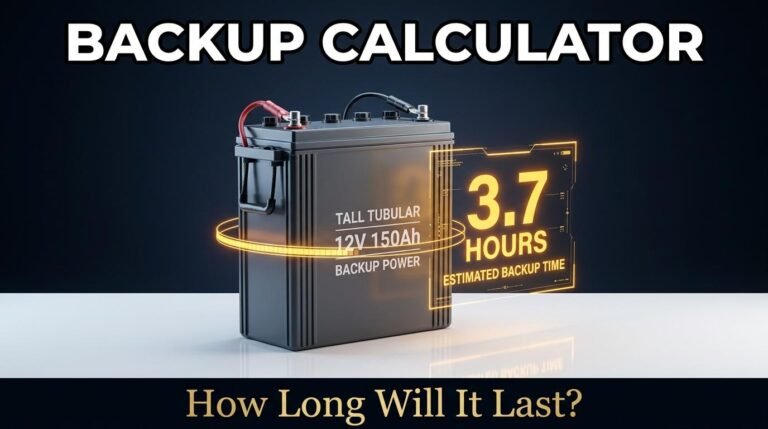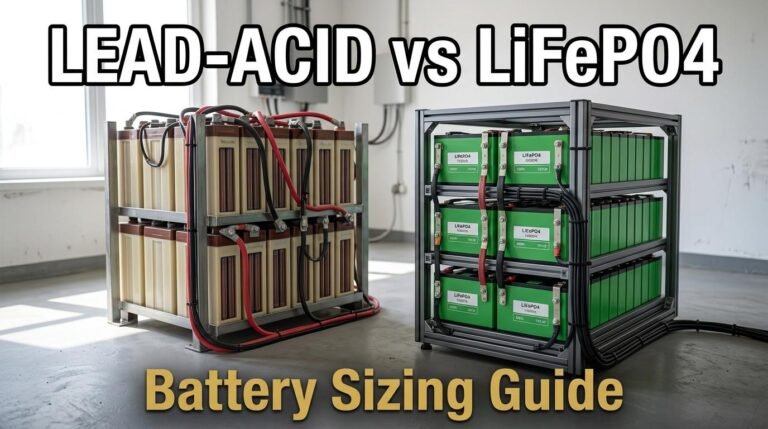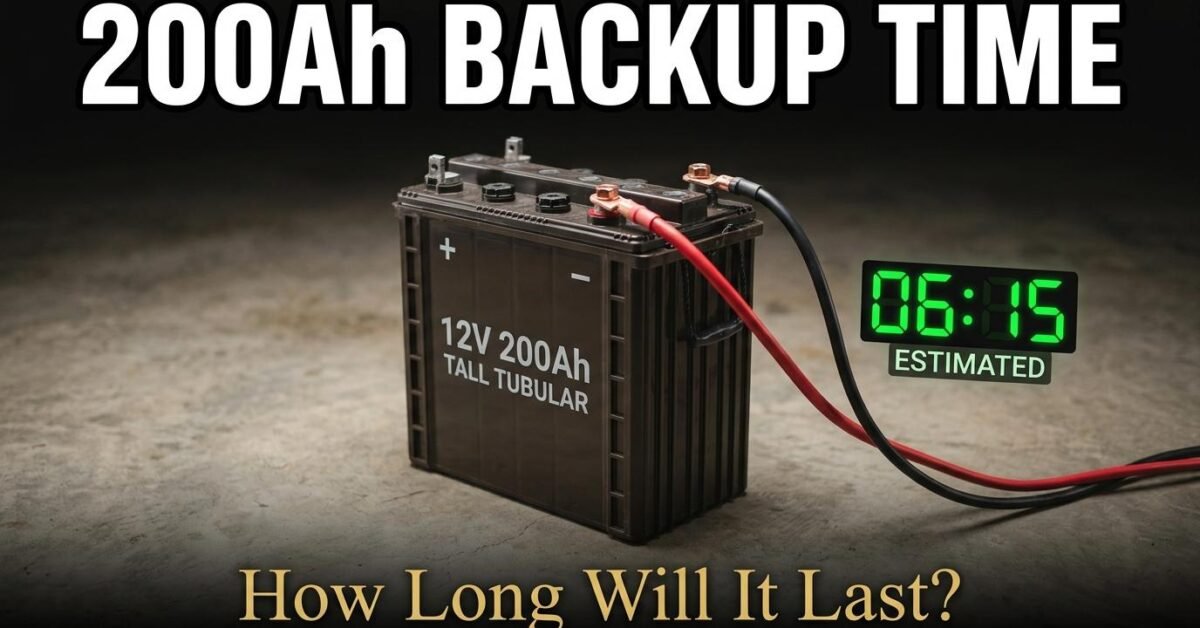
How long does a 200Ah battery last? It is one of the most searched battery questions, and the answer most websites give — just divide Ah by your load — is wrong. It ignores the two factors that cut real-world runtime in half: depth of discharge and inverter efficiency. This guide gives you the real formula with worked examples for lead-acid and LiFePO4, then shows you how to calculate backup time for any load instantly.
What a 200Ah Battery Actually Stores
A 200 Ah battery rated at 12 volts stores 200 × 12 = 2,400 watt-hours, or 2.4 kWh. That is the rated or nameplate capacity — the total energy the cells contain. But you cannot use all of it. Depth of discharge limits how much you can safely extract, and inverter losses consume a portion of what you do extract.
With a lead-acid 200 Ah battery at 50 percent depth of discharge and 85 percent system efficiency (inverter plus cable losses), the usable energy is: 2.4 × 0.50 × 0.85 = 1.02 kWh. With a LiFePO4 200 Ah battery at 90 percent depth of discharge: 2.4 × 0.90 × 0.85 = 1.84 kWh. The LiFePO4 battery delivers 80 percent more usable energy from the same 200 Ah rating.
The Real Backup Time Formula
Backup hours = (Battery Ah × Battery voltage × Depth of discharge × Efficiency) ÷ Load in watts
This is the formula that accounts for everything. The simplified version — just Ah × V ÷ watts — overstates runtime by 40 to 50 percent for lead-acid and 15 to 20 percent for lithium. Always use the full formula.
200Ah Backup Time by Load (Worked Examples)
Here are real backup times for a single 12V 200Ah battery at common household loads.
A 100-watt load (two ceiling fans): lead-acid lasts 10.2 hours, LiFePO4 lasts 18.4 hours. A 200-watt load (fans plus LED lighting): lead-acid lasts 5.1 hours, LiFePO4 lasts 9.2 hours. A 400-watt load (fans, lights, TV, router): lead-acid lasts 2.6 hours, LiFePO4 lasts 4.6 hours. A 750-watt load (adding a small refrigerator): lead-acid lasts 1.4 hours, LiFePO4 lasts 2.5 hours. A 1,200-watt load (adding a 1-ton air conditioner): lead-acid lasts just 51 minutes, LiFePO4 lasts 92 minutes.
The pattern is clear: backup time drops fast as load increases, and lead-acid delivers roughly half the runtime of LiFePO4 at every load level. This is exactly why battery bank sizing matters — a single 200 Ah battery is only enough for light loads or short durations.
Multiple Batteries: Scaling Backup Time
Adding batteries in parallel multiplies your capacity and runtime proportionally. Two 200 Ah batteries in parallel give 400 Ah total — double the backup time at any load. Four batteries give 800 Ah and quadruple the time. Batteries in series (to increase system voltage from 12V to 24V or 48V) do not increase backup time — they increase voltage while keeping Ah the same. You need parallel connections for more runtime and series connections for higher voltage.
For a 24-volt system, you connect two 12V batteries in series (giving 24V at 200 Ah), then add more series pairs in parallel for capacity. For a 48-volt system, four batteries go in series. Our Solar System Calculator handles this automatically — it shows the total battery count needed for your chosen backup duration across all four chemistries.
200Ah in kWh: The Conversion
Converting Ah to kWh is simple: Ah × Voltage ÷ 1,000 = kWh. A 12V 200Ah battery = 2.4 kWh rated. A 12V 150Ah = 1.8 kWh. A 12V 230Ah = 2.76 kWh. But always apply depth of discharge to get usable kWh — that is the number that determines your actual backup time. Our calculator shows both rated and usable kWh per battery in the inline “Units stored” readout on the battery step.
Temperature and Age Effects
Battery capacity drops in cold weather. A lead-acid battery at 0 degrees Celsius delivers about 80 percent of its rated capacity. At minus 20 degrees, it drops to roughly 50 percent. LiFePO4 batteries handle cold better but most units disable charging below 0 degrees Celsius for safety. Heat accelerates degradation in both chemistries — batteries stored or operated above 35 degrees Celsius lose capacity faster over time. Age also reduces capacity: expect a lead-acid battery to retain about 80 percent of its original capacity after 2 years of daily cycling, while LiFePO4 retains 90 percent or more after 5 years.
Calculate Your Backup Time Now
The examples above cover a single 200 Ah battery. Your actual system may use different Ah ratings (from 5 Ah bike batteries to 314 Ah lithium cells), different voltages, and different load combinations. The Solar System Calculator lets you select any battery size, set your backup duration in hours or days, and see the exact battery count needed — with the usable kWh shown per battery so you know exactly what each unit delivers.