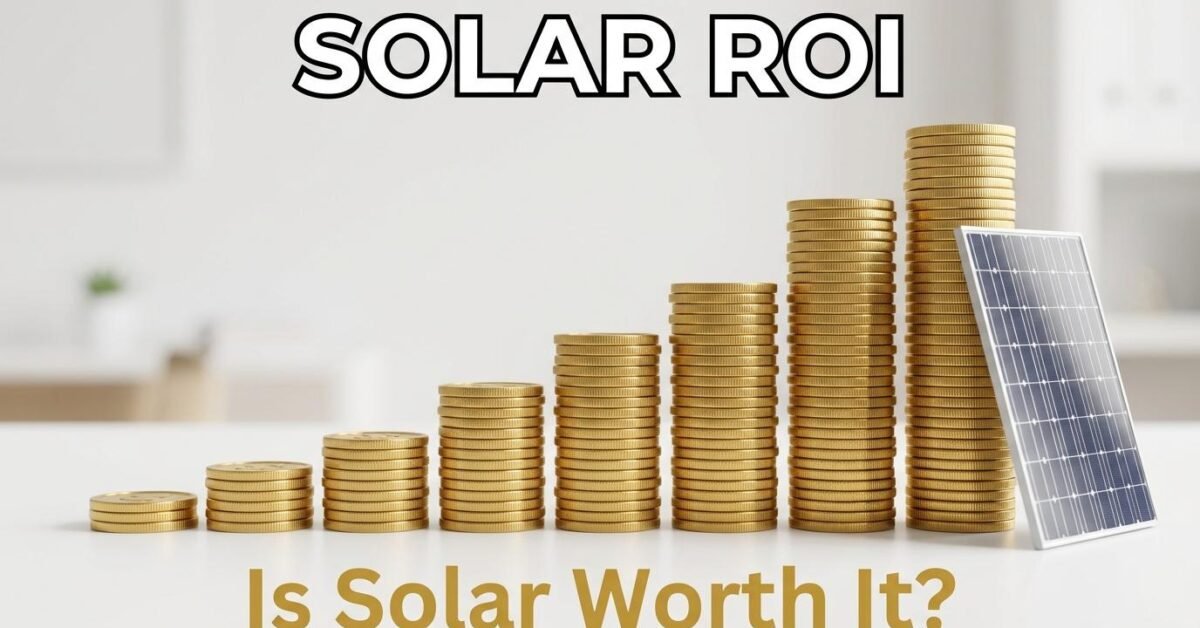
Is solar worth the investment? The answer for most homeowners in 2026 is a resounding yes — but “most” is not “all,” and the specific ROI depends on your electricity rate, system cost, available incentives, and how long you plan to stay in your home. This guide explains how solar ROI works, what returns to realistically expect, and how to calculate your personal return with our Solar Savings Calculator.
How Solar ROI Is Calculated
Solar return on investment measures how much money your system earns you over its lifetime relative to what you paid. The formula is: ROI = (Lifetime savings minus Net system cost) divided by Net system cost, times 100. Net system cost is the installed price minus any tax credits or rebates. Lifetime savings are the total electricity costs you avoid over 25 years, accounting for annual rate increases and panel degradation.
For a concrete example: a system costing 12,000 dollars with a 30 percent federal tax credit has a net cost of 8,400 dollars. If it generates 65,000 dollars in cumulative electricity savings over 25 years, the ROI is (65,000 minus 8,400) divided by 8,400 times 100 = 674 percent. That means for every dollar you invested, you got back 6.74 dollars — an extraordinary return compared to virtually any other home improvement or conservative financial investment.
Typical Solar ROI by Scenario
Solar ROI varies widely depending on inputs, but here are realistic ranges for common scenarios. A high-rate state like California or Connecticut with rates above 0.25 dollars per kWh, the 30 percent federal ITC, and 5 percent annual rate increases typically sees 600 to 900 percent ROI over 25 years with a payback period of 3 to 5 years.
A moderate-rate state like Texas or Florida at 0.13 to 0.16 dollars per kWh with the same incentives sees 300 to 500 percent ROI with a payback of 5 to 8 years. A UK installation at 0.28 pounds per kWh with available grants sees 200 to 400 percent ROI. An Australian installation at 0.30 Australian dollars per kWh with state rebates sees 400 to 700 percent ROI, benefiting from excellent sun hours.
Solar vs Other Investments
To put solar ROI in context: the S&P 500 has returned about 10 percent annually over the long term, or roughly 250 percent over 25 years with compounding. A high-yield savings account returns about 100 to 125 percent over 25 years. Real estate appreciation varies but averages 150 to 200 percent over 25 years in most US markets. Solar at 400 to 700 percent ROI with zero ongoing effort significantly outperforms all of these — and the “returns” are tax-free since avoided costs are not taxable income.
The one caveat: solar ROI assumes you stay in the home long enough to capture the returns. If you sell before payback, you may not recoup the full investment, though studies show homes with solar sell for a premium of 3 to 4 percent, which partially offsets early departure. Systems that have already paid back add pure value to the home sale price.
What Hurts Solar ROI
Low electricity rates are the biggest ROI reducer — if you pay less than 0.08 dollars per kWh, the savings per kWh generated may not justify the system cost, especially without strong incentives. Overpaying for the system (inflated installer quotes or unnecessary premium equipment) increases the net cost and extends payback. Poor roof orientation or heavy shading reduces production and extends payback. And areas with no net metering and no battery storage waste excess daytime production, reducing the effective offset percentage.
What Boosts Solar ROI
High and rising electricity rates are the single biggest ROI booster. Strong incentives (the US 30 percent ITC, state rebates, or UK grants) directly reduce the denominator in the ROI equation. Efficient system design — properly sized panels, modern high-wattage modules that minimize mounting costs, and a well-matched inverter — maximizes production relative to cost. And self-consumption via battery storage or time-of-use optimization captures more value from each kWh generated.
When Solar Is NOT Worth the Investment
Solar is not universally the right choice. If you rent your home and your landlord will not approve the installation, the investment makes no sense. If you plan to move within 2 to 3 years and your market does not value solar homes at a premium, you may not recoup enough before selling. If your electricity rate is extremely low (below 0.08 dollars per kWh) and there are no significant incentives, the payback period may extend beyond 12 years, weakening the financial case. And if your roof needs replacement within the next 5 years, do the roof first — removing and reinstalling panels adds unnecessary cost. In all other scenarios, the math overwhelmingly favors solar.
Calculate Your Solar ROI Now
Our Solar Savings Calculator calculates your exact ROI, payback period, and 25-year net savings with your real numbers. Enter your monthly bill, electricity rate, annual rate increase, system cost, and tax credit percentage. The tool models every year with inflation and degradation, showing you whether solar is worth the investment for your specific situation — not a generic average.
If you also need to know what system size to install, our Solar System Calculator sizes everything from your appliance list, and our Solar vs Generator Calculator shows how solar compares to running a generator if you are currently off-grid or in a load-shedding area.