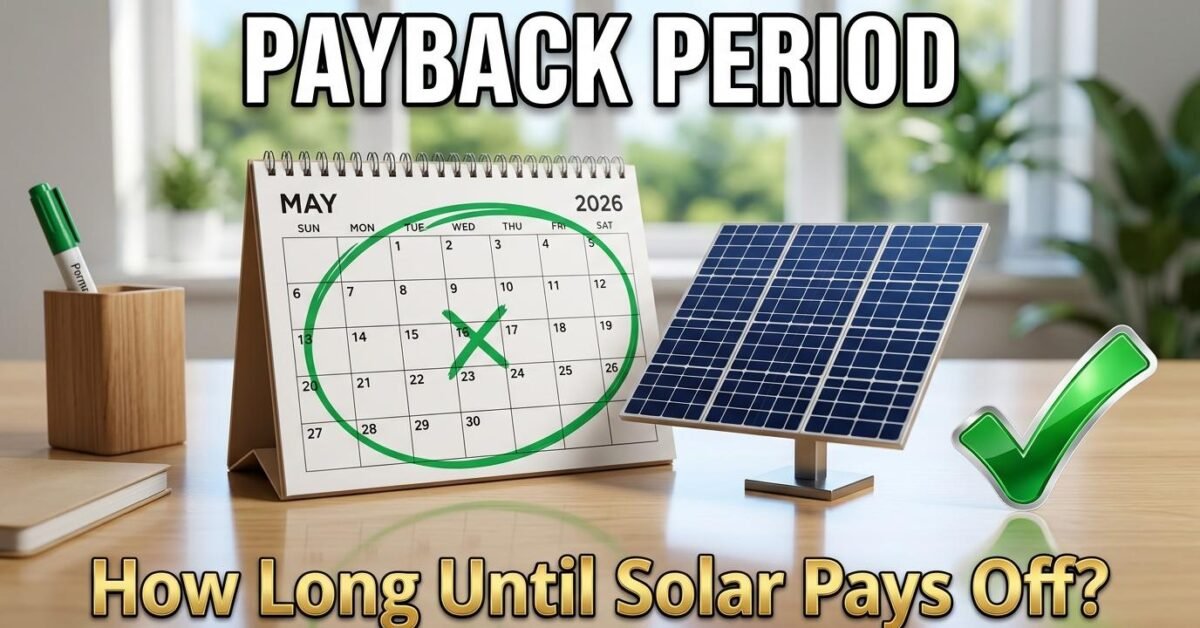
The solar payback period is the number of months or years until your cumulative electricity savings equal the net cost of your solar system. After that point, every dollar saved is pure profit for the remaining life of the system. Understanding your payback period is the single most important financial metric when deciding whether to go solar.
Average Solar Payback Periods in 2026
In the United States, the average solar payback period is 5 to 8 years, depending on your state’s electricity rate and available incentives. High-rate states like California, New York, and Massachusetts see payback in 4 to 6 years. Moderate-rate states like Florida, Texas, and Georgia see 6 to 9 years. The 30 percent federal ITC is the single biggest factor shortening payback — without it, add roughly 3 years to every estimate.
In the United Kingdom, payback periods are typically 7 to 12 years due to lower sun hours, though rising electricity rates have shortened this significantly since 2022. In Australia, payback periods are among the shortest in the world at 3 to 6 years, thanks to excellent sunlight and strong state rebates.
What Determines Your Payback Period
Three factors control the payback calculation. Your net system cost (total installed cost minus tax credits and rebates) is the numerator — the amount you need to recoup. Your annual electricity savings (monthly bill times 12 times solar offset percentage) is the denominator — the rate at which you recoup it. And the annual electricity rate increase acts as an accelerator — each year’s savings are slightly higher than the previous year, which shortens the payback compared to a flat-rate assumption.
The formula accounting for rate inflation is not a simple division — it requires a year-by-year model that accumulates savings until they cross the net cost threshold. Our Solar Savings Calculator runs this model automatically and shows the exact payback month, plus a year-by-year table so you can see how the savings accumulate.
Payback Period vs Total Savings
A short payback period is attractive, but total 25-year savings are what determine the real financial value. A system with a 5-year payback generates free electricity for 20 more years. A system with an 8-year payback still generates 17 years of free electricity. In most cases, even an 8-year payback produces a 25-year ROI above 300 percent — far better than almost any other home investment.
Do not reject solar solely because the payback period is 7 or 8 years instead of 4. The 25-year savings with a 7-year payback can still exceed 50,000 dollars. The payback period tells you when you break even; the total savings tell you how much you profit.
How to Shorten Your Payback Period
Maximize your incentives — the US ITC, state rebates, and local utility incentives all reduce the net cost directly. Get multiple installer quotes to ensure competitive pricing — system costs vary by 20 to 40 percent between installers for the same equipment. Choose the right system size — oversizing beyond your consumption adds cost without proportional savings unless you have favorable net metering. And consider financing terms — a zero-percent or low-interest solar loan lets you start saving immediately while spreading the cost, effectively creating a negative payback period where monthly savings exceed loan payments from month one.
Payback Period by System Size
Larger systems do not necessarily have longer payback periods. A 5 kW system costing 10,000 dollars might save 1,200 dollars per year with a payback of about 7 years after incentives. A 10 kW system costing 18,000 dollars might save 2,400 dollars per year with a similar payback of about 6.3 years after incentives, because the per-watt installation cost decreases at scale. The marginal cost of adding panels is lower than the first few panels because the inverter, wiring, permits, and labor are partially shared. This economy of scale means that sizing up to cover 100 percent of your bill often shortens the payback period compared to a conservative partial system.
Impact of Financing on Payback
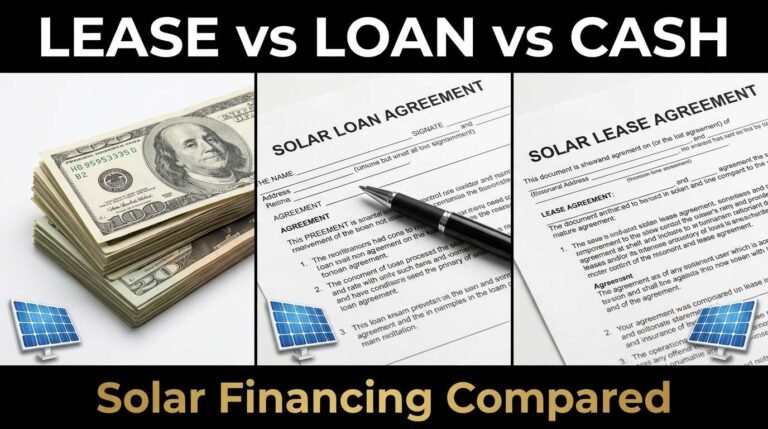
Cash purchases have the shortest true payback because there are no interest payments diluting the savings. Solar loans extend the financial payback by the interest cost but create immediate positive cash flow if structured correctly — you pay less per month on the loan than you save on electricity. Solar leases and power purchase agreements have no upfront cost and no traditional payback period, but the long-term savings are significantly lower because the leasing company captures most of the value. For maximum lifetime savings and shortest payback, cash or a low-interest loan is optimal. For zero upfront cost with reduced but immediate savings, a lease or PPA works.
Calculate Your Payback Period
Our Solar Savings Calculator calculates your exact payback period with rate inflation and panel degradation modeled year by year. Enter your monthly bill, electricity rate, system cost, and tax credit — see the payback month and a full 25-year breakdown. For system sizing, our Solar System Calculator tells you exactly what you need.