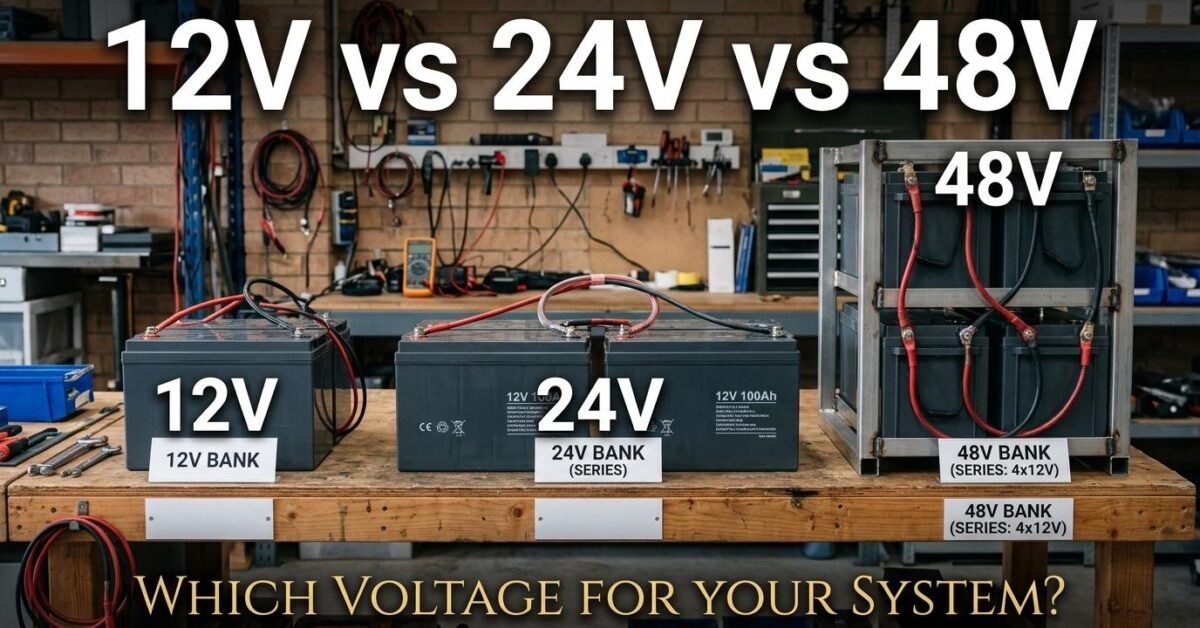
The voltage of your battery bank is not a preference — it is an engineering decision that affects your wire sizes, your equipment options, your efficiency, and your budget. Choosing wrong means oversized cables, undersized controllers, or equipment that does not exist at your chosen voltage. Here is the straightforward rule: 12V for systems under 1 kW, 24V for 1 to 3 kW, and 48V for anything larger. The reasoning follows.
Why Voltage Matters: The Current Problem
Power equals voltage times current. A 2,400W load on a 12V system draws 200 amps. The same load on a 24V system draws 100 amps. On 48V, it draws 50 amps. Higher current requires thicker (more expensive) cables, larger (more expensive) fuses and breakers, and creates more heat loss in every wire run. A 200-amp cable run of 3 meters costs several times more than a 50-amp run of the same length — and the voltage drop at 200 amps can waste 5 to 10 percent of your energy before it reaches the inverter. Our Wire Gauge Calculator shows exactly how cable size and cost scale with current.
12V Systems: Small and Simple
A 12V system makes sense for loads under about 1,000 watts: RV setups, small cabins, camping trailers, boats, and single-circuit backup for essentials (lights, router, phone charging, laptop). The advantages are simplicity — a single 12V battery, direct compatibility with 12V DC appliances (LED lights, USB chargers, car accessories), and the widest selection of small charge controllers and inverters. The disadvantage is current: even at 1,000 watts you draw 83 amps, which demands heavy cabling and a robust fuse box.
24V Systems: The Sweet Spot
Most residential off-grid and backup systems between 1 kW and 3 kW should run at 24V. The current at any given load is half what it would be at 12V, which halves your cable cost and cuts voltage-drop losses. Equipment availability is excellent — virtually all quality MPPT controllers and inverters in the 2 to 5 kVA range support 24V. Two 12V batteries in series create a 24V bank, or you can buy native 24V batteries. If our Solar System Calculator sizes your system between 1 kW and 3 kW of panel array, 24V is almost certainly the right choice.
48V Systems: Maximum Efficiency
Systems above 3 kW of array or above 5 kVA of inverter capacity should run at 48V. The current is one-quarter of 12V, enabling reasonable cable sizes even for 5,000 to 10,000 watt loads. Most hybrid inverters above 5 kVA are 48V-only — there is no choice to make. Server-rack LiFePO4 batteries (like the EG4 LL-S) are native 48V, simplifying the bank to a single unit per 5 kWh. The disadvantage is that 48V systems have fewer budget equipment options and no direct compatibility with 12V DC appliances — everything runs through the inverter to AC.
The Decision Table
| System Size | Recommended Voltage | Typical Use Case |
|---|---|---|
| Under 500W | 12V | RV, boat, small shed, camping |
| 500W – 1,000W | 12V or 24V | Small cabin, essential backup |
| 1,000W – 3,000W | 24V | Residential partial/full backup |
| 3,000W – 6,000W | 48V | Whole-home off-grid or hybrid |
| Above 6,000W | 48V | Large home, small commercial |
Cost Implications by Voltage
Cable cost is the hidden variable. A 12V system running 2,000 watts needs 167 amps of DC cabling — thick, expensive, and heavy. The same system at 48V needs only 42 amps, which uses cable one-quarter the copper cross-section. On a 3-meter run, the cable cost difference alone can be 100 to 300 dollars. Fuses, breakers, and battery disconnects are also rated by amperage — higher-amp components cost more. The battery cost per kWh is roughly the same at any voltage (a 100Ah 48V battery costs about four times a 100Ah 12V battery, but stores four times the energy), so the real savings from higher voltage come from the balance-of-system components, not the batteries themselves.
Upgrading Voltage Later
Changing your system voltage after installation is expensive and disruptive — the inverter, charge controller, and all DC wiring must be replaced. The batteries can often be reconfigured (series for higher voltage), but everything connected to them cannot. This is why getting the voltage right at design time matters: it is a permanent architectural choice, not a setting you adjust later. When in doubt, go one voltage tier higher than your current load suggests, especially if you expect to add loads (electric vehicle charging, workshop tools, additional rooms) within the next few years.
Mixing Voltages: What Not to Do
Every component in the DC side of your system must match your bank voltage: batteries, charge controller output, inverter DC input, and DC loads. You cannot connect a 12V battery to a 24V inverter or feed a 48V controller from a 24V panel string (though the reverse — higher panel voltage into a lower bank voltage — is how MPPT controllers work, within their input limits). Mismatched voltages damage equipment instantly and create fire risk.
If you already own 12V batteries and want to scale up, you can wire them in series to create 24V or 48V — two 12V batteries in series = 24V, four in series = 48V. All batteries in a series string must be the same capacity, chemistry, and ideally the same age. Our Battery Backup Calculator lets you model different voltage and battery-count configurations to find the optimal setup for your load.