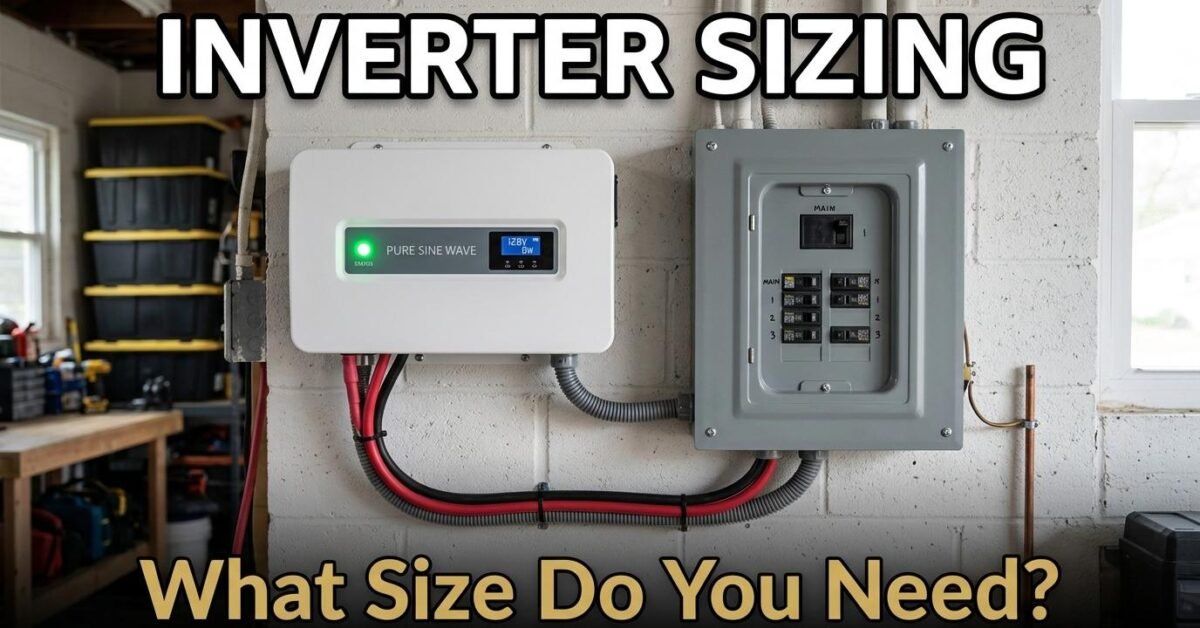
An undersized inverter trips every time the fridge kicks in. An oversized inverter wastes money and draws more standby power than it needs to. Getting the size right requires two numbers: your continuous running load and your worst-case surge — and the surge is the one most people forget until their system shuts down at 2 AM.
The Two-Number Sizing Rule
Number 1 — Continuous watts. Add up the running wattage of every appliance that will run simultaneously from the inverter. Not everything you own — just the items running at the same moment. A typical evening load might be: refrigerator (150W) + LED lights (60W) + TV (70W) + Wi-Fi router (15W) + phone charging (25W) = 320W. Add 25 percent safety margin: 320 × 1.25 = 400W continuous. Our Appliance Wattage Database lists the running watts for 140+ appliances — use it to build your real list.
Number 2 — Surge watts. Motor-driven appliances draw 2 to 4 times their running watts for the first 1 to 3 seconds at startup. A refrigerator at 150W surges to 450W. A 1-ton AC at 1,200W surges to 3,600W. A water pump at 750W surges to 2,250 to 3,000W. Your inverter must handle the largest single motor surge PLUS the continuous load of everything else running at that moment. If the fridge is the largest motor: 450W surge + 170W (everything else) = 620W peak. If you also run an AC: 3,600W surge + 320W = 3,920W peak.
The formula: Inverter size = whichever is larger: (continuous × 1.25) or (largest motor surge + other running loads). Our Battery Charge & Discharge Calculator computes both numbers and recommends the standard inverter size in kVA.
Standard Inverter Sizes and What They Handle
| Inverter Size | Continuous | Surge | Typical Use |
|---|---|---|---|
| 1 kVA | 800W | 1,500W | Lights, fans, TV, router, phone charging |
| 1.5 kVA | 1,200W | 2,200W | Above + refrigerator |
| 2 kVA | 1,600W | 3,000W | Above + washing machine or small pump |
| 3 kVA | 2,400W | 4,500W | Above + microwave or multiple motors |
| 5 kVA | 4,000W | 7,500W | 1-ton AC + full house loads |
| 8 kVA | 6,400W | 12,000W | 1.5-ton AC + full house |
| 10 kVA | 8,000W | 15,000W | 2-ton AC or multiple large motors |
Why Surge Matters More Than Continuous
Most people size their inverter for the continuous load and get blindsided by the surge. Here is a real scenario: a homeowner adds up all running loads at 800W, buys a 1 kVA inverter, and everything works perfectly — until 3 AM when the refrigerator compressor kicks in. The 450W surge on top of the 650W baseline momentarily hits 1,100W. The inverter’s surge tolerance is 1,500W, so it handles it. But if that same homeowner also runs a window AC at 500W, the baseline is now 1,150W, the fridge surge pushes it to 1,600W, and the inverter trips. The fix is a 2 kVA inverter — not because the continuous load requires it, but because the surge does.
If the surge from a single appliance is forcing you to buy an inverter two sizes larger, consider a soft starter for that motor. A soft starter on a 1-ton AC reduces the 3,600W surge to roughly 1,200W — often enough to drop from a 5 kVA to a 3 kVA inverter, saving more than the soft starter costs.
Pure Sine Wave vs Modified Sine Wave
Always buy a pure sine wave inverter for a permanent installation. Modified sine wave inverters cost less but produce a choppy AC waveform that causes audible buzzing in fans and audio equipment, interference in electronics, inaccurate readings in digital clocks and timers, overheating in motor windings, and outright failure in some sensitive devices (CPAP machines, laser printers, variable-speed tools). The price difference has shrunk to 15 to 25 percent — pure sine wave is the only defensible choice for home solar.
Inverter Sizing for Different System Voltages
The inverter’s DC input voltage must match your battery bank voltage — a 12V inverter on a 24V bank will destroy itself immediately. Higher battery voltage means lower DC current for the same AC output, which means thinner cables and less heat loss. A 3 kVA inverter at 12V draws 250 amps from the battery — requiring extremely thick and expensive DC cabling. The same inverter at 48V draws only 63 amps. This is why inverters above 3 kVA are almost exclusively 24V or 48V — the 12V current would be impractical. Use our Wire Gauge Calculator to check the cable requirements at your chosen voltage before committing.
Size Your Inverter Now
Our Battery Charge & Discharge Calculator sizes the inverter as part of a complete battery system analysis — enter your load, your largest motor, and your battery specs, and it outputs the recommended inverter kVA alongside the charger, MPPT controller, and solar panel requirements. Or use the Solar System Calculator to size everything from your appliance list with surge multipliers applied automatically.