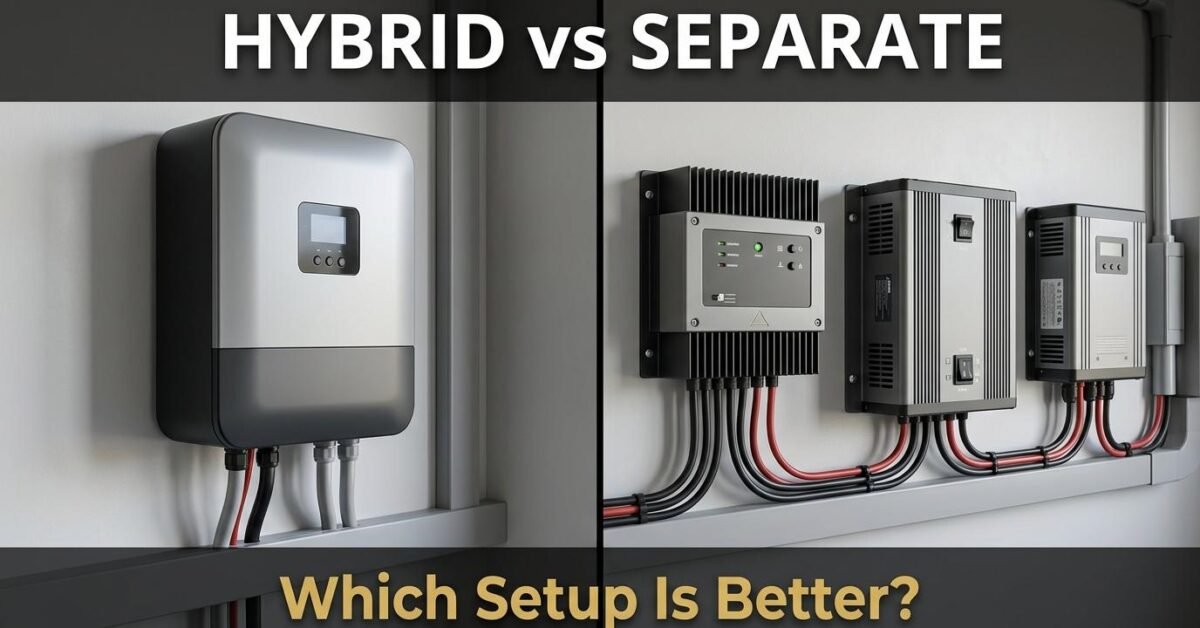
Every solar system needs three core functions: a charge controller to manage solar-to-battery charging, an inverter to convert DC battery power to AC, and a charger to refill the battery from the grid or a generator when solar is not enough. You can buy these as one device (hybrid inverter) or as separate components. The right choice depends entirely on your system size, budget, and how much you plan to expand.
What a Hybrid Inverter Actually Contains
A hybrid inverter — also called an all-in-one or multi-function inverter — packs a solar MPPT charge controller, a battery inverter, a grid/generator charger, and transfer switching into a single enclosure. When the grid is up, it charges the battery from solar and optionally from the grid. When the grid fails, it switches to battery power seamlessly (some units in under 10 milliseconds — fast enough that your computer does not reboot). The user sees one box on the wall with one set of cables instead of three separate devices.
Major brands in this category include Growatt (SPF and SPH series), Deye (5kW and 8kW hybrid), Sol-Ark (15K), Victron MultiPlus-II, and EG4 (18kPV). Prices range from 500 to 4,000 dollars depending on capacity and features.
When a Hybrid Is the Right Choice
Systems under 3 kW of solar and under 5 kVA of inverter capacity. At this scale, a hybrid inverter costs less than buying a separate MPPT controller, inverter, and charger individually. A Growatt 3 kVA hybrid with 80A MPPT input costs roughly the same as a Victron SmartSolar 100/50 controller plus a separate 3 kVA inverter-charger — but takes half the wall space, uses half the cables, and has one point of configuration instead of three. For a residential backup system or a small off-grid cabin, hybrid is the pragmatic choice.
Our Battery Charge & Discharge Calculator makes this recommendation automatically when it sizes your system — if your array is under 3 kW and your load is under 5 kVA, it suggests a hybrid with the exact specifications to look for.
When Separate Components Win
Systems above 3 kW of solar or above 5 kVA of inverter capacity. At this scale, separate components become more practical for three reasons. First, expandability: you can add a second MPPT controller when you add more panels, without replacing the inverter. A hybrid’s built-in MPPT has a fixed capacity — when you outgrow it, you either waste the excess panels or replace the entire unit. Second, serviceability: if the MPPT section of a hybrid fails, the whole unit goes down. With separates, one failed component is swapped while the others keep running. Third, performance: dedicated components from specialist manufacturers (Victron controllers, Schneider inverters) often outperform the integrated versions in all-in-one units where each function is a cost-optimized compromise.
Expandable systems. If you plan to add panels, batteries, or loads in phases over years, separate components give you flexibility. Buy a 5 kVA inverter today for your current loads, add a second MPPT controller next year when you double the array, and add a second inverter in parallel when you add an air conditioner. With a hybrid, each expansion may mean replacing the entire unit because the MPPT or charger capacity is fixed.
Critical backup systems. Medical equipment, security systems, server rooms, and commercial operations benefit from the redundancy of separate components. Two independent MPPT controllers mean one failure does not stop all solar charging. A separate inverter can be replaced in an hour while the battery still powers loads through a second inverter or a direct DC feed.
Cost Comparison
| Component | Separate Cost | Hybrid Equivalent |
|---|---|---|
| MPPT controller (50A) | $200-400 | $500-1,200 for a 3 kVA hybrid with 80A MPPT |
| Inverter-charger (3 kVA) | $400-800 | |
| Total for separates | $600-1,200 | |
| MPPT controller (80A) | $400-600 | $1,500-3,500 for a 5-8 kVA hybrid with 100A+ MPPT |
| Inverter-charger (5-8 kVA) | $800-2,000 | |
| Total for separates | $1,200-2,600 |
At 3 kVA and below, hybrids generally match or beat the cost of separates. Above 5 kVA, separates often cost less because you buy exactly the capacity you need for each function instead of paying for a fully integrated unit where every component is sized to the highest common denominator.
The Practical Decision
If your system fits inside a single hybrid unit’s ratings — your array under its MPPT capacity, your loads under its inverter rating, your battery under its charger output — and you do not plan significant expansion, buy the hybrid. It is cleaner, cheaper, and simpler to install and configure.
If any of these are true — your array exceeds one MPPT controller’s capacity, you plan to double the system within two years, you need component-level redundancy, or you want best-in-class performance from each function — buy separates and accept the extra cabling and configuration complexity as the price of flexibility.
Our Battery Charge & Discharge Calculator analyzes your specific battery, load, and array to recommend hybrid or separate — with the exact specs either way. And our MPPT charge controller guide reviews the best standalone controllers if you go the separate route.