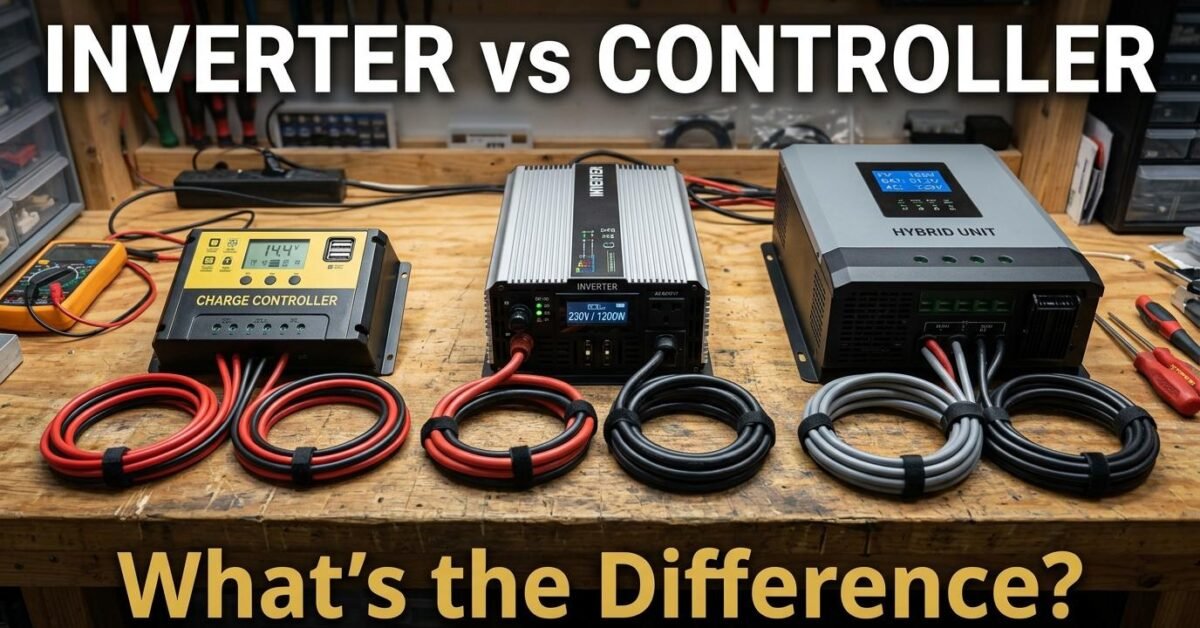
If you are new to solar, the terminology is the first wall. Three devices appear in every system diagram — inverter, charge controller, MPPT — and they sound like they might do the same thing. They do not. Each handles a completely different step in the energy flow, and understanding what each one does is the difference between sizing a system correctly and buying the wrong equipment.
The Energy Flow: Panels → Controller → Battery → Inverter → Appliances
A solar power system moves energy through four stages. Solar panels generate DC electricity. The charge controller takes that DC and feeds it into the battery at the correct voltage and current. The battery stores the energy. The inverter converts the stored DC energy into AC electricity that your appliances use. Each device sits at one stage of this chain. Remove any one and the system does not work.
Charge Controller: Panels to Battery
The charge controller is a DC-to-DC converter that sits between the solar panels and the battery. Its job is to regulate the voltage and current flowing into the battery so it charges safely — at the right voltage for the battery’s chemistry, at a current the battery can accept, and with the correct charge stages (bulk, absorption, float) to maximize battery life. Without a charge controller, the panels would push unregulated voltage into the battery, overcharging it, boiling electrolyte in lead-acid, and potentially causing thermal runaway in lithium.
The charge controller also prevents reverse current flow at night — without it, the battery would discharge backward through the panels in the dark, wasting the energy you stored during the day.
PWM vs MPPT: Two Types of Charge Controller
PWM (Pulse Width Modulation) is the basic type. It essentially connects the panel to the battery and chops the connection on and off rapidly to control the average voltage. The panel is forced to operate at the battery’s voltage — typically 12 to 14V — even though the panel’s optimal operating point is usually 17 to 20V for a “12V panel” and 30 to 40V for a larger panel. This mismatch wastes 15 to 30 percent of the panel’s potential energy, especially in cold or cloudy conditions when the voltage gap is widest.
MPPT (Maximum Power Point Tracking) is the advanced type. It continuously finds the panel’s optimal voltage — the point where voltage times current equals maximum power — and converts that voltage down to the battery’s charge voltage while increasing the current proportionally. The power stays the same (minus about 3 percent conversion loss), but the battery receives significantly more charge current than a PWM controller would deliver from the same panel. MPPT is not a separate device from a charge controller — it IS a charge controller, just the smart version. When someone says “MPPT,” they mean an MPPT charge controller.
For any system above 200W, MPPT is the correct choice. The extra harvest pays for the price difference within months. Our MPPT controller comparison reviews the best options at each size.
Inverter: Battery to Appliances
The inverter is a DC-to-AC converter that sits between the battery and your appliances. Your battery stores DC power at 12V, 24V, or 48V. Your refrigerator, TV, lights, and every other household appliance runs on AC power at 120V (US) or 230V (most of the world). The inverter makes this conversion — taking low-voltage DC from the battery and producing high-voltage AC for your loads.
The inverter is sized by two specifications: continuous watts (the total load it can serve indefinitely) and surge watts (the peak it can handle for a few seconds during motor startup). A 3 kVA inverter handles about 2,400W continuous and 4,500W surge. Size it using the formula in our Battery Charge & Discharge Calculator or the Solar System Calculator.
Inverter-Charger: Two-Way Device
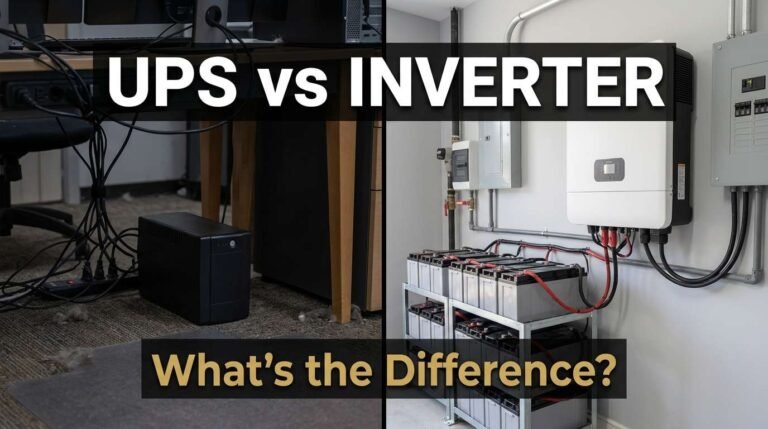
An inverter-charger adds a reverse function: when grid or generator power is available, it charges the battery (AC-to-DC). When the grid fails, it inverts from the battery (DC-to-AC). It also handles the transfer switching between grid and battery power. An inverter-charger replaces two separate devices — a standalone inverter and a standalone battery charger — in one enclosure.
Hybrid Inverter: Three-in-One
A hybrid inverter combines all three functions: solar charge controller (usually MPPT), battery inverter, and grid/generator charger. Solar panels connect directly to the hybrid unit, batteries connect to it, and your loads connect to it. One box does everything. This is the most common configuration for new residential solar installations in 2026 because it simplifies wiring, reduces cost at small to medium scale, and provides a single point of monitoring and control.
How They Connect: The Complete Diagram
Separate components: Solar panels connect to the MPPT charge controller. The controller connects to the battery bank. The battery connects to the inverter (or inverter-charger). The inverter connects to your home’s distribution board. If using an inverter-charger, the grid also connects to it for battery charging and automatic transfer.
Hybrid (all-in-one): Solar panels connect to the hybrid inverter’s PV input. The battery connects to the hybrid’s battery terminals. The grid connects to the hybrid’s AC input. Your loads connect to the hybrid’s AC output. Everything flows through one device.
Which Do You Need?
| Your Situation | What You Need |
|---|---|
| Small off-grid (RV, shed, camping) | MPPT charge controller + small inverter (separate) |
| Home backup under 5 kVA | Hybrid inverter (all-in-one) |
| Large off-grid home | Separate MPPT controller(s) + inverter-charger |
| Grid-tied (selling back to utility) | Grid-tie inverter (no battery, no controller) |
| Grid-tied with battery backup | Hybrid inverter with grid-tie capability |
Not sure which applies to you? Our Battery Charge & Discharge Calculator analyzes your battery, load, and solar array, then recommends whether a hybrid or separate components are the better fit — with exact specifications for each component. Start there, and every purchase decision downstream becomes clear.