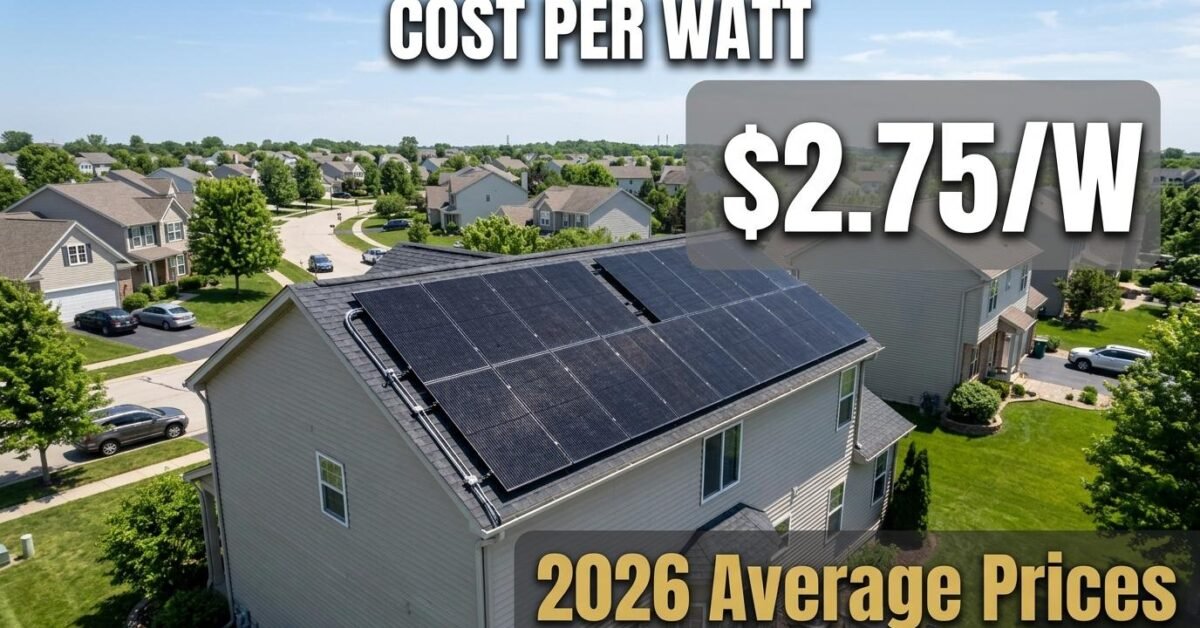
The average installed cost of residential solar in the United States in 2026 is 2.50 to 3.25 dollars per watt before incentives. After the 30 percent federal Investment Tax Credit, the net cost drops to 1.75 to 2.28 dollars per watt. This is the all-in price including panels, inverter, racking, wiring, labor, permits, and interconnection. Our Solar Installation Cost Calculator estimates your total cost at any price per watt with incentives applied automatically.
Cost Per Watt by State
| State/Region | Cost Per Watt | 8 kW System (Gross) | 8 kW System (After ITC) |
|---|---|---|---|
| Texas, Florida, Arizona | $2.20 – $2.60 | $17,600 – $20,800 | $12,320 – $14,560 |
| Colorado, NC, Georgia | $2.50 – $2.90 | $20,000 – $23,200 | $14,000 – $16,240 |
| Midwest, Mid-Atlantic | $2.60 – $3.00 | $20,800 – $24,000 | $14,560 – $16,800 |
| California | $2.90 – $3.50 | $23,200 – $28,000 | $16,240 – $19,600 |
| New York, Massachusetts | $3.00 – $3.80 | $24,000 – $30,400 | $16,800 – $21,280 |
What Makes Up the Cost Per Watt
Of every dollar per watt you pay, roughly 25 to 35 cents goes to the solar panels themselves. Inverter hardware adds 15 to 35 cents per watt. Racking and mounting hardware adds 10 to 20 cents. Balance of system (wiring, conduit, breakers, monitoring) adds 10 to 15 cents. Labor accounts for 50 to 80 cents. And soft costs — permitting, design, sales commission, overhead, and profit — make up the remaining 60 to 100 cents per watt. Soft costs are where the biggest variation between quotes occurs and where negotiation has the most impact.
Cost Per Watt by System Size
Larger systems have a lower cost per watt due to economies of scale. A 4 kW system might cost 3.00 to 3.50 dollars per watt because the fixed costs (permitting, truck roll, equipment setup) are spread over fewer panels. A 10 kW system might cost 2.40 to 2.80 per watt. Commercial systems above 50 kW often achieve 1.50 to 2.00 per watt. If you are deciding between a slightly larger and a slightly smaller system, the larger system almost always delivers better value per watt installed.
How Cost Per Watt Has Declined
Solar cost per watt has fallen approximately 70 percent over the past decade. In 2015, the average was about 3.50 dollars per watt. By 2020 it was 2.80. In 2026 it is 2.50 to 3.25 depending on location. The decline is driven primarily by panel manufacturing costs (now under 0.30 per watt for tier-one modules) and increasing installer competition. The cost reduction has slowed compared to the steep drops of 2015 to 2020, but incremental improvements in panel efficiency (now exceeding 22 percent for standard residential panels) mean each watt-dollar buys more energy production than ever.
Does Higher Cost Per Watt Mean Better Quality?
Not necessarily. A higher cost per watt can reflect premium equipment (higher-efficiency panels, a better inverter brand, extended workmanship warranty), but it can also reflect higher installer overhead, larger sales commissions, or inefficient operations. The way to tell the difference: compare the equipment specifications side by side. Two quotes at 2.70 and 3.10 per watt using the same panels and inverter differ only in soft costs — choose the cheaper one. Two quotes at 2.70 (Tier-2 panels, 10-year workmanship warranty) and 3.10 (Tier-1 panels, 25-year workmanship warranty) differ in meaningful ways — the extra 40 cents per watt may deliver better lifetime value.
International Solar Costs Per Watt
Solar pricing varies dramatically globally. In India and Pakistan, installed costs range from 0.80 to 1.50 dollars per watt for residential systems — roughly half the US price — driven by lower labor costs and fewer permitting requirements. In Australia, costs range from 1.50 to 2.50 AUD per watt (1.00 to 1.70 USD) with strong government rebates. In the UK and Germany, costs range from 1.50 to 2.50 euros per watt (1.60 to 2.70 USD) with lower solar resources but higher electricity rates that still produce acceptable payback periods. Our Solar Savings Calculator works with any currency and any electricity rate to model the payback at your local cost per watt.
Using Cost Per Watt to Compare Quotes
Cost per watt is the single most useful number for comparing installer quotes. Quote A for $22,000 on a 7.5 kW system costs 2.93 per watt. Quote B for $24,000 on a 9 kW system costs 2.67 per watt. Quote B is the better deal despite the higher total price because you get more capacity per dollar. Always calculate: total price divided by system size in watts. Then check equipment specifications — a lower cost per watt means nothing if the quote uses lower-efficiency panels or a shorter warranty. Our Installation Cost Calculator lets you model any price per watt with your incentives to see the net cost.
Calculate your installed cost →
☀️ Get Free Solar Quotes
Tell us about your home — get matched with qualified solar installers in your area. Free, no obligation.
By submitting you consent to being contacted by solar professionals regarding your inquiry. See our privacy policy.
⚡ Free Solar Sizing Cheat Sheet
Get our one-page guide to sizing panels, batteries and inverters — plus weekly solar tips. No spam, unsubscribe anytime.
By subscribing you agree to our privacy policy. We'll email your guide and occasional solar tips — never spam.