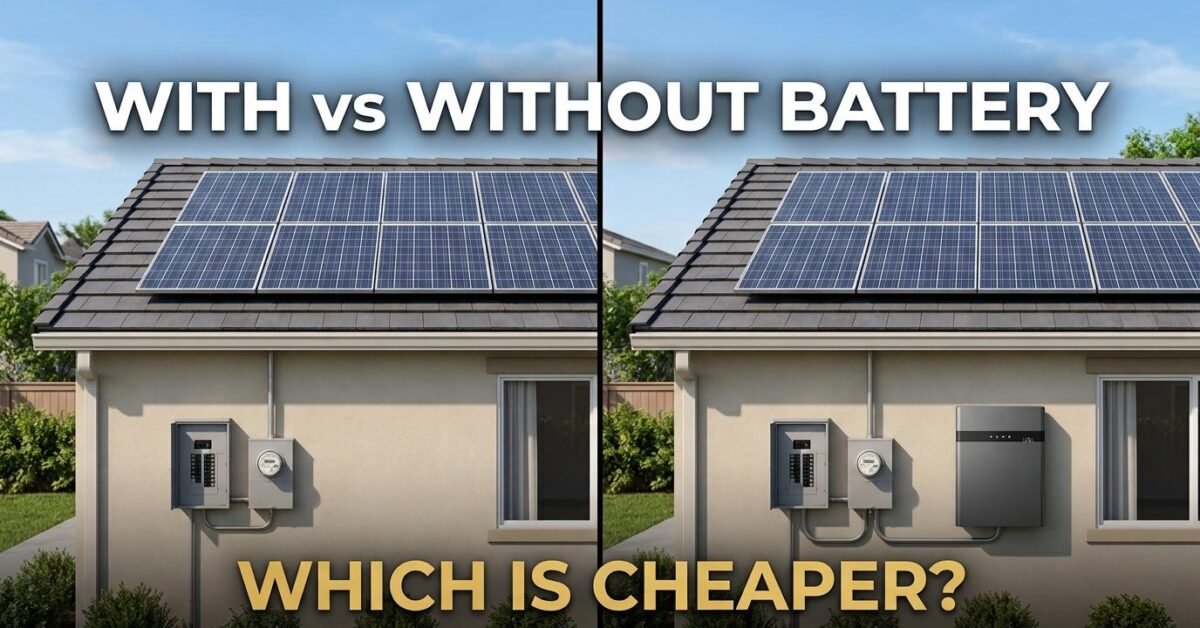
Solar without battery storage is significantly cheaper upfront — a typical 8 kW grid-tied system costs 14,000 to 18,000 dollars net (after the 30 percent ITC), while adding a 10 kWh battery pack adds 7,000 to 10,000 dollars. The financial question is whether the battery earns back that extra cost. The answer depends almost entirely on two factors: your utility’s net metering policy and how often your power goes out.
Cost Comparison: With vs Without
| Configuration | Gross Cost | Net Cost (After 30% ITC) |
|---|---|---|
| 8 kW solar, no battery | $20,000 – $26,000 | $14,000 – $18,200 |
| 8 kW solar + 5 kWh battery | $25,000 – $31,000 | $17,500 – $21,700 |
| 8 kW solar + 10 kWh battery | $30,000 – $36,000 | $21,000 – $25,200 |
| 8 kW solar + 20 kWh battery | $40,000 – $46,000 | $28,000 – $32,200 |
The federal ITC applies to the battery when installed with solar, which reduces the battery’s net cost by 30 percent. A 10,000 dollar battery effectively costs 7,000 after the credit. Use our Installation Cost Calculator to model any combination.
When Batteries Make Financial Sense
Time-of-use rates. If your utility charges higher rates during evening peak hours (6 to 9 PM) and lower rates during the day, a battery stores cheap daytime solar and uses it during expensive peak hours. The savings per cycle depend on the rate spread — a 15 to 25 cent per kWh spread generates meaningful savings; a 5 cent spread does not justify the battery cost.
Weak or no net metering. If your utility pays wholesale rates (3 to 5 cents per kWh) for exported solar instead of full retail credit, every kWh you export is worth 70 to 90 percent less than a kWh you consume yourself. A battery captures the excess daytime production and shifts it to nighttime use, keeping the value at full retail.
Frequent outages. If your area experiences multiple outages per year — whether from storms, grid instability, or rolling blackouts — the battery provides continuous power during outages. Grid-tied solar without a battery shuts off during outages (required by code to prevent feeding power into lines being repaired by workers). The battery provides genuine energy independence that solar alone does not.
When Batteries Don’t Make Sense (Yet)
Strong 1:1 net metering. If your utility credits every exported kWh at full retail rate with rollover, the grid is effectively your battery — and it is free, unlimited, and never degrades. In this scenario, a physical battery adds cost without adding value unless you need outage protection.
Tight budget. If budget is fixed, more panels without a battery produce a faster payback and higher lifetime ROI than fewer panels with a battery. The battery adds cost and complexity without generating revenue — it only shifts when you use the solar energy you produce. Panels generate the energy; the battery just stores it. Prioritize generation over storage when dollars are limited.
Battery Technology Is Improving — Should You Wait?
Battery prices have dropped approximately 50 percent over the past five years and are projected to decline another 20 to 30 percent by 2030. If you do not need outage protection today and your net metering is strong, installing solar now without battery and adding storage in 2 to 3 years when prices drop further is a valid strategy. The solar panels start generating savings immediately, and the battery can be added later without re-installing the panels. Most hybrid inverters are “battery-ready” — they have the battery connections and software built in, waiting for a battery to be connected. Buying a battery-ready inverter now costs only 100 to 200 dollars more than a non-battery inverter and keeps the upgrade path open.
The Non-Financial Value of Battery
Not everything reduces to payback math. A battery provides peace of mind during storms, medical equipment continuity for health-dependent household members, food preservation during extended outages, and the ability to use solar power around the clock instead of only during daylight. For some homeowners, these benefits justify the extra cost regardless of the financial payback period. If outage protection is a primary motivator, size the battery using our Battery Backup Calculator — enter your essential loads and desired backup hours to find the minimum battery size that covers your needs.
The Payback Comparison
Solar without battery typically pays back in 5 to 8 years. Solar with a 10 kWh battery pays back in 8 to 12 years — the battery extends the payback by 2 to 4 years but then provides 13 to 17 years of combined value (free electricity plus outage protection). Whether the extended payback is acceptable depends on your priorities. Run both scenarios through our Solar Savings Calculator to compare the 25-year financials side by side.