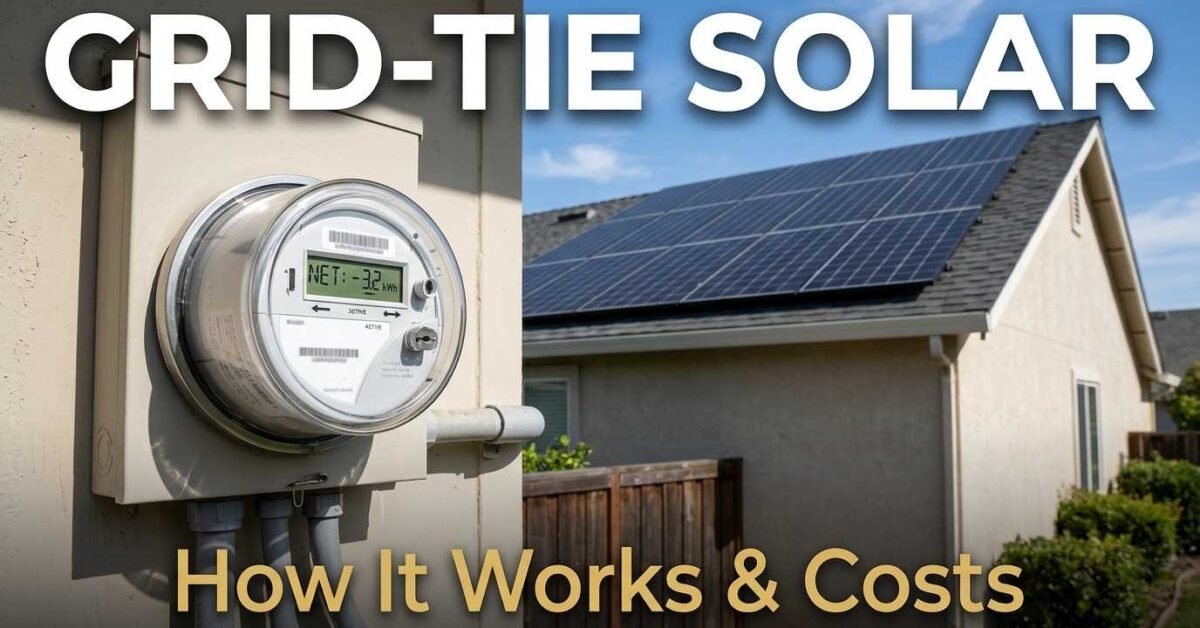
A grid-tie solar system connects your solar panels directly to the utility grid through a grid-tie inverter. There is no battery — excess solar production is exported to the grid, and you draw from the grid when solar is not enough (nighttime, cloudy days). Your electricity meter tracks the net difference, and you pay only for what you consume beyond what you produce. This is the simplest, cheapest, and most common type of residential solar installation in 2026.
How Grid-Tie Solar Works
Solar panels produce DC electricity. A grid-tie inverter converts that DC to AC at the same voltage and frequency as the utility grid (120/240V at 60 Hz in the US, 230V at 50 Hz in most other countries). The inverter synchronizes its output with the grid and feeds the solar power into your home’s electrical panel. Your appliances use the solar power first; any excess flows backward through the meter to the grid. When you need more power than the panels produce, the grid fills the gap seamlessly. You do not notice any difference — the lights do not flicker, the fridge does not pause. The transition between solar and grid power is instantaneous and automatic.
Net Metering: How You Get Paid
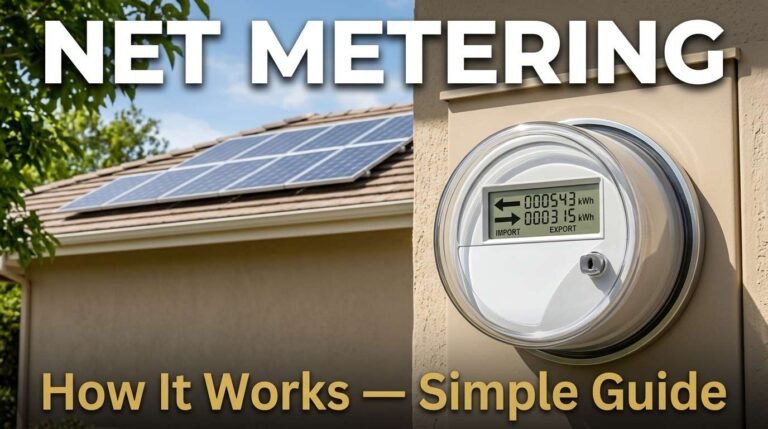
Net metering is the billing arrangement that makes grid-tie solar financially viable. Under full (1:1) net metering, every kWh you export to the grid earns a credit equal to the retail rate you would have paid to consume it. If you export 20 kWh during the day and consume 15 kWh at night, you pay for zero kWh net — you actually carry a 5 kWh credit to the next billing cycle. Over a full year, a properly sized grid-tie system with strong net metering can reduce your electricity bill to zero or near-zero.
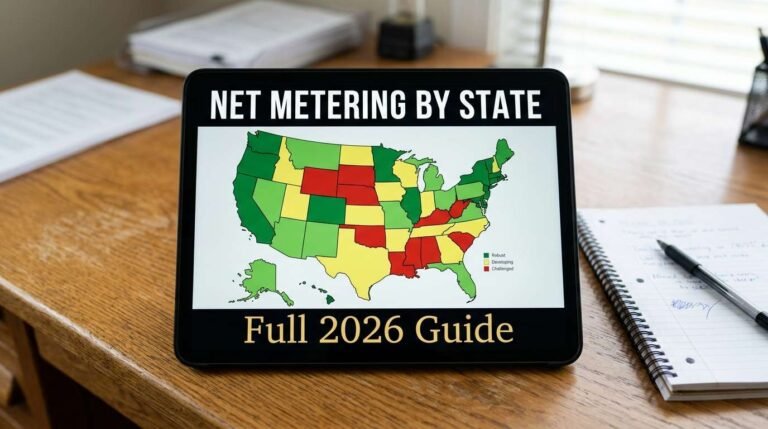
Not all net metering is equal. Some utilities pay wholesale rates (3 to 5 cents per kWh) for exports instead of retail (12 to 30 cents), dramatically reducing the value of excess production. California’s NEM 3.0 policy, implemented in 2023, significantly reduced export credits, making batteries more financially attractive in that state. Check your utility’s net metering policy before designing your system — it determines whether a pure grid-tie system or a grid-tie-plus-battery system makes more financial sense. Our Solar Savings Calculator models both scenarios.
Grid-Tie vs Off-Grid vs Hybrid
| Feature | Grid-Tie | Off-Grid | Hybrid |
|---|---|---|---|
| Battery required? | No | Yes | Yes |
| Works during outage? | No | Yes | Yes |
| Cost (8 kW system) | $14,000 – $18,000 | $25,000 – $40,000 | $21,000 – $28,000 |
| Payback period | 5 – 8 years | 8 – 15 years | 7 – 12 years |
| Best for | Reliable grid, strong net metering | No grid access | Frequent outages, weak net metering |
Grid-tie is the cheapest option because batteries account for 30 to 50 percent of a system’s cost. Without batteries, the system is simpler to install, has fewer components to maintain, and has no battery degradation or replacement cost. The tradeoff: when the grid goes down, your solar system shuts off too — even if the sun is shining — because the grid-tie inverter must disconnect to prevent feeding power into lines that utility workers may be repairing.
Can a Grid-Tie Inverter Be Used Off-Grid?
No. A grid-tie inverter requires the grid’s voltage and frequency signal to synchronize with. Without the grid, it has no reference signal and will not turn on. This is not a limitation you can work around with settings or firmware — it is a fundamental design difference. If you want both grid connection and backup power during outages, you need a hybrid inverter (which includes battery management and can operate in both grid-connected and off-grid modes). Our inverter vs charge controller guide explains the differences between all inverter types.
Grid-Tie Solar Costs
A grid-tie system without battery storage costs 2.00 to 3.25 dollars per watt installed in the US in 2026. For an 8 kW system: 16,000 to 26,000 dollars gross, reduced to 11,200 to 18,200 dollars after the 30 percent federal ITC. This is 30 to 50 percent cheaper than an equivalent hybrid or off-grid system because there is no battery, no charge controller (the grid-tie inverter handles MPPT internally), and simpler wiring. Use our Installation Cost Calculator to estimate your specific cost.
When to Add a Battery to Grid-Tie
Adding a battery to a grid-tie system (converting it to a hybrid) makes sense in three situations. First, if your utility reduces net metering credits below retail rate — a battery lets you store excess production and use it yourself instead of exporting at a loss. Second, if you experience frequent power outages — the battery provides backup power that pure grid-tie cannot. Third, if your utility charges time-of-use rates with expensive evening peaks — a battery stores cheap daytime solar and uses it during expensive peak hours. Our battery vs no-battery comparison breaks down the full cost analysis.