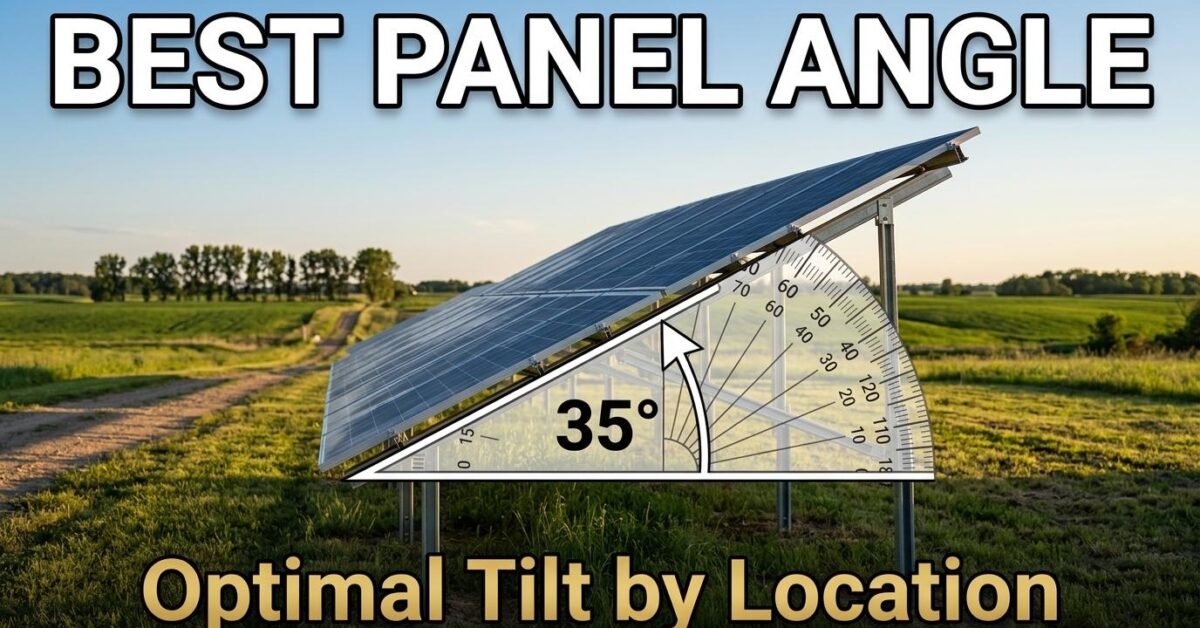
The best angle for solar panels equals your latitude. If you live at 35 degrees north, tilt your panels to 35 degrees from horizontal. This single rule captures 95 percent of what you need to know about solar panel tilt. The remaining 5 percent involves seasonal adjustments, azimuth direction, and whether your roof pitch is close enough to matter. Our Solar Panel Angle Calculator computes the exact angle for your location with monthly adjustments.
Why Latitude Equals Optimal Tilt
Solar panels produce maximum energy when sunlight hits them at a 90-degree angle (perpendicular). The sun’s position in the sky depends on your latitude — at the equator (0 degrees latitude), the sun is nearly overhead and panels should be nearly flat. At 45 degrees latitude, the sun is lower in the sky and panels must tilt to face it directly. The math works out so that the optimal tilt angle for maximum annual energy equals the latitude, plus or minus a few degrees depending on local weather patterns.
Optimal Solar Panel Angle by Location
| Location | Latitude | Optimal Fixed Tilt | Summer Tilt | Winter Tilt |
|---|---|---|---|---|
| Miami, FL | 25.8° | 26° | 11° | 41° |
| Houston, TX | 30.3° | 30° | 15° | 45° |
| Phoenix, AZ | 33.4° | 33° | 18° | 48° |
| Los Angeles, CA | 34.1° | 34° | 19° | 49° |
| New York, NY | 40.7° | 41° | 26° | 56° |
| Chicago, IL | 41.9° | 42° | 27° | 57° |
| Seattle, WA | 47.6° | 48° | 33° | 60° |
| London, UK | 51.5° | 52° | 37° | 60° |
| Islamabad, PK | 33.6° | 34° | 19° | 49° |
| Sydney, AU | 33.9° | 34° | 19° | 49° |
The “Summer Tilt” is latitude minus 15 degrees (panels face more upward toward the high summer sun). The “Winter Tilt” is latitude plus 15 degrees (panels face more toward the horizon to catch the low winter sun). If you adjust your panels twice a year — once in spring and once in fall — you capture approximately 5 to 8 percent more energy than a fixed mount. Our Solar Panel Angle Calculator shows the exact monthly angles for any latitude.
Does Solar Panel Angle Really Matter?
Yes, but less than most people think. A panel tilted to the optimal angle produces approximately 15 to 35 percent more energy per year than a completely flat (0 degree) panel at the same location. However, a panel that is within 10 degrees of optimal — say, 25 degrees on a roof when the optimal is 35 degrees — loses only about 2 to 5 percent of annual production. Most residential roofs in the US have a pitch between 20 and 35 degrees, which is close enough to optimal for most latitudes that the tilt “error” costs less than 5 percent of annual output.
The practical takeaway: if your roof pitch is within 15 degrees of your latitude, mount the panels flush to the roof and accept the small loss. The cost and complexity of adjustable tilt racking rarely justifies the 3 to 5 percent gain on a residential rooftop. Where tilt optimization does matter: ground-mount systems (where adjustable tilt is easy and cheap), RV and portable systems (where every watt counts), and high-latitude locations (above 50 degrees) where the difference between flat and optimal can exceed 30 percent.
Panel Direction (Azimuth): Which Way Should Panels Face?
In the Northern Hemisphere, panels should face due south (180 degrees azimuth). In the Southern Hemisphere, due north (0 degrees). An east-facing or west-facing panel produces roughly 80 to 85 percent of what a south-facing panel produces at the same tilt — a meaningful loss but not a dealbreaker if south-facing roof space is not available. East-facing panels produce more in the morning, west-facing in the afternoon. Some homeowners deliberately split panels east and west to spread production across more hours of the day, which better matches home consumption patterns than a south-facing array that peaks at noon when nobody is home.
Seasonal Adjustment: Is It Worth It?
Adjusting panel tilt twice a year (steeper in winter, flatter in summer) captures 5 to 8 percent more annual energy than a fixed mount. Adjusting four times (each season) captures 7 to 10 percent more. Monthly adjustment captures the theoretical maximum — about 10 to 12 percent more — but the labor of climbing onto a roof 12 times a year makes it impractical for most installations.
For a ground-mount system with accessible tilt adjustment, seasonal changes are worth the 5 minutes per adjustment. For a rooftop system, the gain rarely justifies the effort and risk of roof access. Single-axis trackers that automatically follow the sun capture 15 to 25 percent more energy than a fixed mount but cost significantly more and add mechanical complexity.
Calculate Your Optimal Angle
Our Solar Panel Angle Calculator computes the optimal tilt for any latitude worldwide, with monthly angles, seasonal adjustments, and an energy gain comparison versus a flat mount. Enter your latitude or select your city, and see the exact tilt that maximizes your annual production. Then use the Panel Output Calculator to estimate how much energy your panels produce at that angle, and the Solar Savings Calculator to see the financial impact.