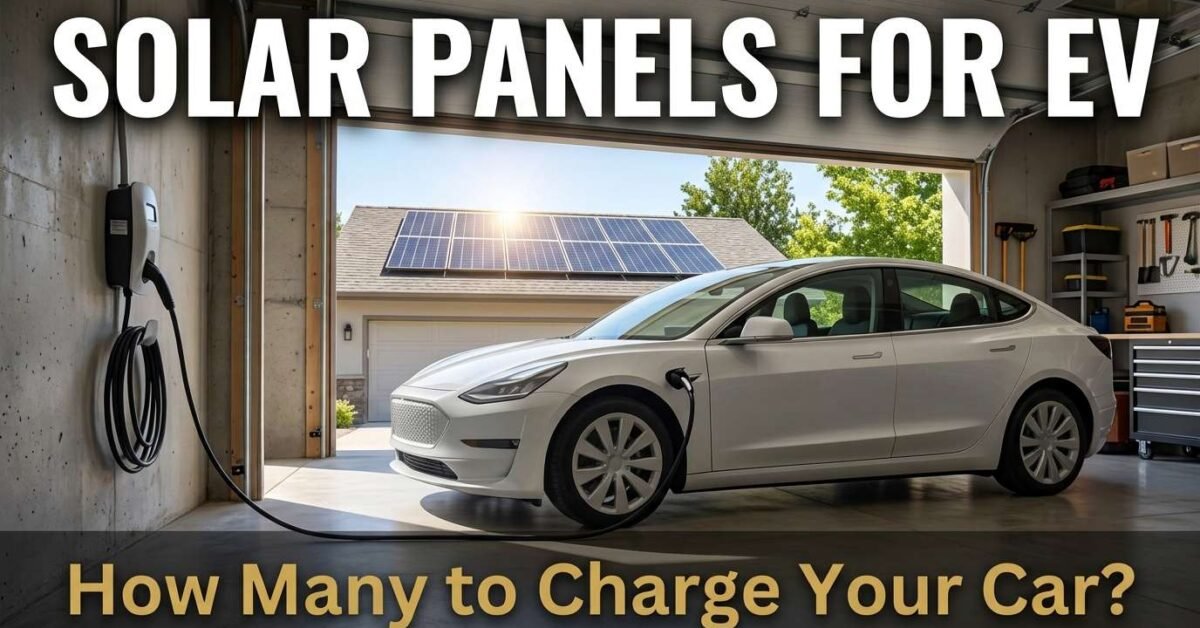
The average American drives 30 to 40 miles per day, which requires 8 to 13 kWh of electricity to recharge. At 5 peak sun hours, that needs 2 to 3.5 kW of solar panels — roughly 5 to 9 panels at 400W each. Our EV Charging Cost Calculator computes the exact panel count for your driving pattern and vehicle.
Solar Panels Needed by EV Model
| EV Model | Efficiency | 30 mi/day Needs | Panels (400W) |
|---|---|---|---|
| Tesla Model 3 LR | 3.2 mi/kWh | 9.4 kWh/day | 6 panels |
| Tesla Model Y LR | 3.1 mi/kWh | 9.7 kWh/day | 6 panels |
| Hyundai Ioniq 6 | 3.5 mi/kWh | 8.6 kWh/day | 6 panels |
| Chevy Equinox EV | 3.9 mi/kWh | 7.7 kWh/day | 5 panels |
| Rivian R1S | 2.7 mi/kWh | 11.1 kWh/day | 7 panels |
| Ford F-150 Lightning | 2.2 mi/kWh | 13.6 kWh/day | 9 panels |
Formula: Daily kWh = miles driven ÷ efficiency (mi/kWh). Panels needed = daily kWh ÷ (sun hours × 0.82 derating × panel watts ÷ 1,000). These panels are in addition to the panels powering your home — size the total system (home + EV) in our Solar System Calculator.
Level 1 vs Level 2 Charging with Solar
A Level 1 charger (standard 120V outlet) adds 3 to 5 miles of range per hour — enough for 30 miles overnight (8 hours). A Level 2 charger (240V, 32-48A circuit) adds 25 to 40 miles per hour — a full charge in 4 to 8 hours. For solar-powered EV charging, Level 2 is strongly preferred because it can charge the car during peak solar production hours (10 AM to 3 PM), maximizing the direct use of solar energy rather than drawing from the grid at night.
The Economics: Solar vs Grid vs Gas
At the US average electricity rate of $0.16/kWh, charging a Tesla Model 3 for 30 miles costs about $1.50. The same 30 miles in a 30 MPG gas car costs $3.50 in fuel at $3.50/gallon. With solar, the charging cost drops to near zero — the panels pay for themselves, and every mile driven on solar electricity is effectively free fuel. Over 10 years of average driving (12,000 miles/year), the fuel savings alone total $8,000 to $12,000 compared to gasoline. Calculate your exact savings in our EV Charging Cost Calculator.
Sizing the Complete Solar + EV System
When adding EV charging to an existing solar system, you need additional panels beyond what powers the home. A typical home uses 900 kWh/month. An EV adds 250 to 400 kWh/month. Combined, you need a system sized for 1,150 to 1,300 kWh/month — roughly 8 to 11 kW of solar. Size your complete system (home + EV) in our Solar System Calculator and see the total savings in the Savings Calculator.
When to Charge: Maximizing Solar Offset
If you are home during the day (work from home, retired), plug in your EV during peak solar hours (10 AM to 3 PM) to charge directly from solar panels without grid electricity. If you commute, a smart charger with a timer can delay charging to start when you arrive home in the afternoon — catching the last 2 to 3 hours of solar production. Many Level 2 chargers (ChargePoint Home Flex, Tesla Wall Connector) include scheduling features. Even partial solar offset during afternoon charging saves 30 to 50 percent compared to overnight grid charging.
Battery Storage for Overnight EV Charging
If you cannot charge during the day, a home battery stores daytime solar production for overnight EV charging. A 10 kWh battery stores enough for 30 to 35 miles of driving. A 20 kWh battery covers 60 to 70 miles — more than the average daily driving distance. The battery charges from solar during the day, then the EV charges from the battery at night. This makes your EV charging 100 percent solar-powered even if you are never home during daylight. Size the complete system — panels, home battery, and EV charging — in our Solar System Calculator.
Impact on Your Electric Bill
Adding an EV to a home without solar increases your electricity bill by $40 to $80 per month (at average US rates). Adding solar panels to offset EV charging eliminates this increase — and if the solar system is sized for both the home and the EV, it can reduce your combined electricity and fuel bill to near zero. The total savings versus a gas car typically reach $1,500 to $2,500 per year when combining solar electricity savings with eliminated gasoline costs. Calculate your exact scenario in our EV Charging Cost Calculator.