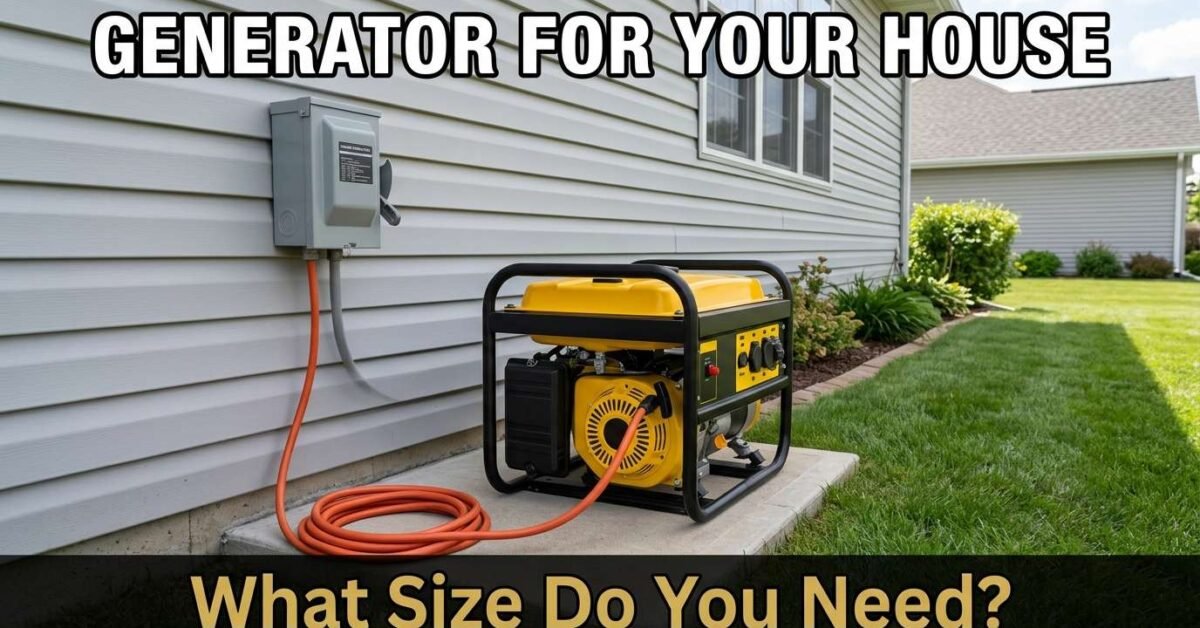
The generator size you need depends on what you want to power. An essentials-only backup (fridge, lights, router, phone charging) needs a 3 to 5 kW generator. A comfort backup adding fans, TV, and a laptop needs 5 to 7.5 kW. A full-house backup including air conditioning and a water pump needs 10 to 20 kW. Our Generator Sizing Calculator computes the exact size from your appliance list.
Generator Sizing by Scenario
| Scenario | Running Watts | Surge Watts | Generator Size |
|---|---|---|---|
| Essentials (fridge + lights + router + phones) | 225W | 825W | 3 kW |
| Comfort (+ fans + TV + laptop) | 445W | 1,045W | 3.5 kW |
| Standard (+ microwave + coffee maker) | 2,345W | 2,945W | 5 kW |
| Large home (+ washing machine + dishwasher) | 4,345W | 6,845W | 8-10 kW |
| Whole house with central AC (3-ton) | 7,345W | 16,845W | 20 kW |
The Sizing Formula
Generator size (watts) = Total running watts + Largest single motor surge. The largest motor is usually the air conditioner or well pump. A 3-ton central AC draws 3,500W running but surges to 10,500W at startup. Every other appliance runs at its normal wattage while the AC starts, so the generator must handle: all running loads + the AC surge simultaneously. This is why a home with central AC jumps from a 10 kW to a 20 kW generator — the AC surge alone consumes 10,500W for 2 to 3 seconds.
Add a 25 percent safety margin to avoid running the generator at full capacity continuously. A generator running at 75 percent load lasts longer, runs cooler, and consumes less fuel per watt than one at 100 percent. Our Generator Sizing Calculator handles the surge math and safety margin automatically.
Portable vs Standby Generators
Portable generators (3 to 12 kW) cost 400 to 2,000 dollars, run on gasoline or propane, and require manual startup and connection during an outage. Standby generators (10 to 22 kW) cost 3,000 to 6,000 dollars installed, run on natural gas or propane, and start automatically within 10 seconds of detecting a power outage via an automatic transfer switch. For homes with medical equipment, sump pumps, or security systems, a standby generator with automatic transfer is the safer choice.
Generator vs Solar Battery Backup
A generator provides unlimited runtime as long as you have fuel, but it is noisy, produces emissions, and has ongoing fuel costs. A solar battery backup is silent, has zero fuel cost after installation, and produces no emissions — but runtime is limited by battery capacity and solar production. For most homeowners, the best solution is a hybrid approach: solar panels and battery for daily use and short outages, with a generator as backup for extended multi-day outages. Compare the 25-year costs of both options in our Solar vs Generator Calculator.
For detailed appliance wattage data to use in the calculator, see our Appliance Wattage Database with 140+ appliances.
Fuel Storage and Safety
Gasoline should be stored in approved containers (UL-listed fuel cans) away from the generator and any ignition sources. Fresh gasoline lasts 3 to 6 months; adding fuel stabilizer (like Sta-Bil) extends shelf life to 12 months. Diesel stores better naturally — up to 12 months without additives. Propane stores indefinitely in sealed tanks, making it the best fuel for generators that sit idle for months between outages. Never refuel a running or hot generator — shut it down, wait 5 minutes to cool, then refuel.
Generator Placement and Safety
Generators produce carbon monoxide (CO) — a colorless, odorless gas that kills. Never run a generator inside a garage, basement, crawl space, or enclosed area. Place it at least 20 feet from the house with the exhaust pointed away from windows and doors. Install battery-powered CO detectors on every floor of your home when using a generator. More people die from generator CO poisoning during outages than from the outages themselves — this is the single most important generator safety rule.
Transfer Switch Requirements
Never plug a generator directly into a wall outlet (“backfeeding”) — this sends power into the utility grid, potentially electrocuting line workers repairing the outage. Use a manual transfer switch ($200-500 installed) or an interlock kit ($100-200) to safely connect a portable generator to your home’s electrical panel. Standby generators include an automatic transfer switch that handles this safely and automatically. Our Generator Sizing Calculator sizes both the generator and the transfer switch for your load.
Fuel Storage and Safety
Gasoline should be stored in approved containers (UL-listed fuel cans) away from the generator and any ignition sources. Fresh gasoline lasts 3 to 6 months; adding fuel stabilizer (like Sta-Bil) extends shelf life to 12 months. Diesel stores better naturally — up to 12 months without additives. Propane stores indefinitely in sealed tanks, making it the best fuel for generators that sit idle for months between outages. Never refuel a running or hot generator — shut it down, wait 5 minutes to cool, then refuel.
Generator Placement and Safety
Generators produce carbon monoxide (CO) — a colorless, odorless gas that kills. Never run a generator inside a garage, basement, crawl space, or enclosed area. Place it at least 20 feet from the house with the exhaust pointed away from windows and doors. Install battery-powered CO detectors on every floor of your home when using a generator. More people die from generator CO poisoning during outages than from the outages themselves — this is the single most important generator safety rule.
Transfer Switch Requirements
Never plug a generator directly into a wall outlet (“backfeeding”) — this sends power into the utility grid, potentially electrocuting line workers repairing the outage. Use a manual transfer switch ($200-500 installed) or an interlock kit ($100-200) to safely connect a portable generator to your home’s electrical panel. Standby generators include an automatic transfer switch that handles this safely and automatically. Our Generator Sizing Calculator sizes both the generator and the transfer switch for your load.
Fuel Storage and Safety
Gasoline should be stored in approved containers (UL-listed fuel cans) away from the generator and any ignition sources. Fresh gasoline lasts 3 to 6 months; adding fuel stabilizer (like Sta-Bil) extends shelf life to 12 months. Diesel stores better naturally — up to 12 months without additives. Propane stores indefinitely in sealed tanks, making it the best fuel for generators that sit idle for months between outages. Never refuel a running or hot generator — shut it down, wait 5 minutes to cool, then refuel.
Generator Placement and Safety
Generators produce carbon monoxide (CO) — a colorless, odorless gas that kills. Never run a generator inside a garage, basement, crawl space, or enclosed area. Place it at least 20 feet from the house with the exhaust pointed away from windows and doors. Install battery-powered CO detectors on every floor of your home when using a generator. More people die from generator CO poisoning during outages than from the outages themselves — this is the single most important generator safety rule.
Transfer Switch Requirements
Never plug a generator directly into a wall outlet (“backfeeding”) — this sends power into the utility grid, potentially electrocuting line workers repairing the outage. Use a manual transfer switch ($200-500 installed) or an interlock kit ($100-200) to safely connect a portable generator to your home’s electrical panel. Standby generators include an automatic transfer switch that handles this safely and automatically. Our Generator Sizing Calculator sizes both the generator and the transfer switch for your load.
Generator Safety: Carbon Monoxide
Generators produce carbon monoxide (CO) — a colorless, odorless killer gas. Never run a generator indoors, in a garage, or in any enclosed space. Place it at least 20 feet from the house with exhaust pointed away from windows. Install battery-powered CO detectors on every floor. More people die from generator CO poisoning during outages than from the outages themselves.
Transfer Switch Requirements
Never backfeed a generator into a wall outlet — this electrocutes utility workers. Use a manual transfer switch ($200-500 installed) or interlock kit ($100-200) to safely connect to your home panel. Standby generators include automatic transfer switches. Our Generator Sizing Calculator sizes both the generator and transfer switch.
Fuel Storage Tips
Gasoline lasts 3-6 months (12 with stabilizer). Diesel lasts 12 months. Propane stores indefinitely. For emergency-only generators that sit idle between outages, propane is the best fuel choice — no degradation, no spill risk, and refillable tanks are available at most hardware stores.