For most US homeowners, solar panels are worth it in 2026. A typical 8 kW system costs $14,000 to $18,000 after the 30 percent federal tax credit, pays for itself in 5 to 8 years, and saves $40,000 to $80,000 over its 25-year lifespan. The math works in most states — but not all situations are equal. This guide shows you exactly when solar is worth it and when it is not.
When Solar IS Worth It
Your electricity bill is above $100/month. The higher your bill, the faster solar pays for itself. A $200/month bill produces a 4 to 6 year payback. A $100/month bill produces a 7 to 10 year payback. Below $75/month, the savings are real but the payback stretches beyond 10 years. Calculate your exact payback in our Solar Savings Calculator.
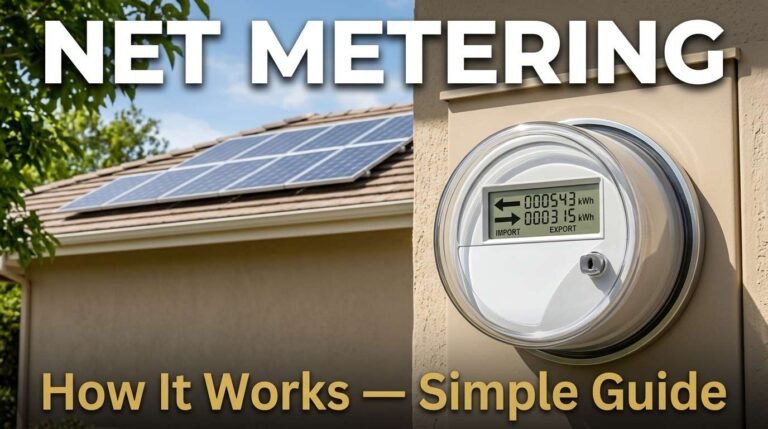
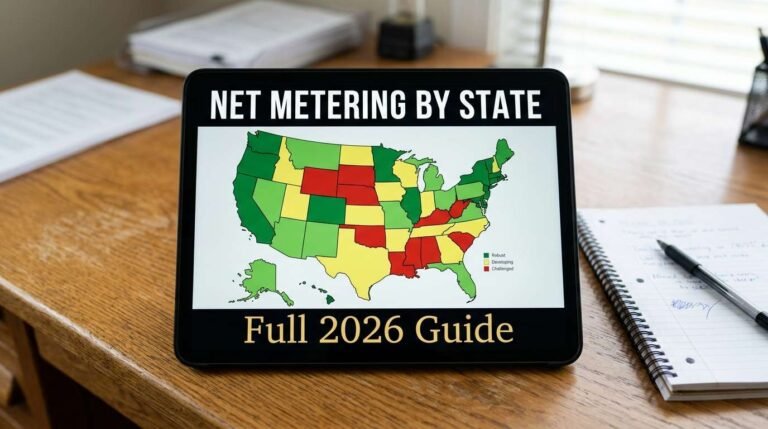
Your state has good net metering. States with full 1:1 net metering (where you get full retail credit for exported solar) produce the best returns. States that have reduced net metering credits (like California’s NEM 3.0) still work but the math favors adding a battery to store excess production rather than exporting it.
You plan to stay in the home 7+ years. Solar panels increase home value by roughly 4 percent according to multiple studies, but the full financial benefit comes from years of avoided electricity bills. If you sell the home before the payback period, you recoup most of the investment through the increased sale price — but the buyer gets the remaining 15 to 20 years of savings, not you.
When Solar Might NOT Be Worth It
Your roof needs replacement soon. Installing solar on a roof that needs replacement in 3 to 5 years means you will pay to remove the panels, replace the roof, and reinstall the panels — adding $3,000 to $5,000 in costs. Replace the roof first, then install solar. A new roof lasts 25 to 30 years, matching the solar panel lifespan perfectly.
Heavy shading on the roof. Trees, neighboring buildings, or other obstructions that shade more than 30 percent of the roof significantly reduce solar production. Partial shading does not just block the shaded panels — it can reduce output from the entire string. Microinverters mitigate this to some extent, but heavy shading reduces the ROI below the threshold for many homeowners.
The Numbers
Use our Installation Cost Calculator to see your total cost after incentives, then run it through the Savings Calculator to see the 25-year return. For most homeowners, the ROI is 200 to 400 percent over the system lifetime — meaning you get back 2 to 4 dollars for every dollar invested.
State and Local Incentives
Beyond the federal 30% ITC, many states offer additional rebates, tax credits, and incentives that reduce solar costs further. New York offers up to $5,000 in state tax credits. Massachusetts offers SMART program payments based on production. Some utilities offer rebates of $500 to $2,500 for solar installation. Check the Database of State Incentives for Renewables and Efficiency (DSIRE) for your state’s specific programs. Our Installation Cost Calculator lets you enter state and local incentives to see your true net cost after all credits and rebates are applied.
Getting Multiple Quotes
Always get at least 3 quotes from different installers. Solar installation prices vary by 20 to 40 percent between companies for the same system — the variation is almost entirely in soft costs (sales commission, overhead, profit margin), not equipment. Compare quotes on a cost-per-watt basis (total price divided by system size in watts) with matching equipment specifications. A lower cost-per-watt quote using the same panels and inverter is simply a better deal. Our guide on solar installation costs in 2026 shows average prices by state so you can identify fair pricing.
State and Local Incentives
Beyond the federal ITC, many states offer additional rebates and tax credits. New York offers up to $5,000 in state credits. Massachusetts has SMART program payments. Some utilities offer $500-2,500 rebates. Check DSIRE (dsireusa.org) for your state. Our Installation Cost Calculator applies all incentives automatically.
Getting Multiple Quotes
Always get 3+ installer quotes. Prices vary 20-40% between companies for the same system. Compare on cost-per-watt (total price ÷ system watts) with matching equipment specs. Our installation cost guide shows fair pricing by state.