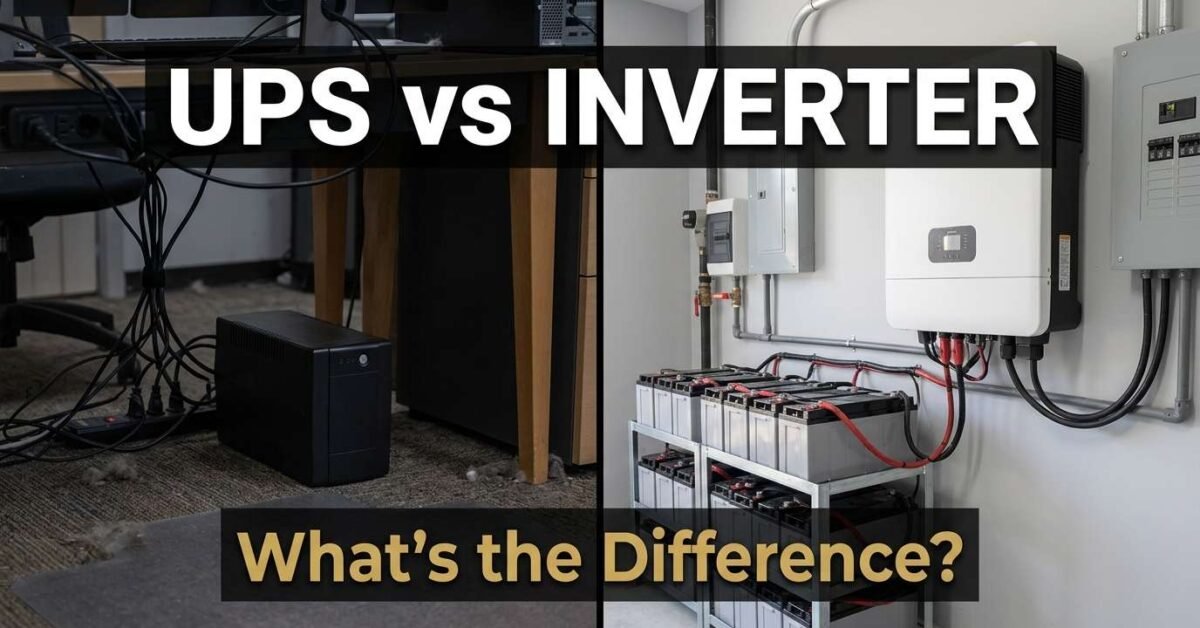
A UPS (uninterruptible power supply) and an inverter both convert battery power to AC electricity, but they serve fundamentally different purposes. A UPS provides instant, seamless backup for seconds to minutes — protecting computers and electronics from data loss during brief power cuts. An inverter provides hours of backup from large external batteries — powering appliances during extended outages. Understanding the difference saves you from buying the wrong device.
UPS vs Inverter: Side-by-Side
| Feature | UPS | Inverter + Battery |
|---|---|---|
| Primary purpose | Data protection, safe shutdown | Extended backup power |
| Switchover time | 0-5 ms (instant) | 10-50 ms (may flicker) |
| Runtime | 5-30 minutes | 2-24+ hours |
| Battery | Small internal (7-9Ah) | Large external (100-400Ah) |
| Typical load | Computers, networking | Fridge, fans, lights, TV |
| Voltage regulation | Built-in AVR | Basic or none |
| Cost | $50-500 | $200-2,000 (+ batteries) |
| Charging | Auto, 4-8 hours | Solar or grid, 2-6 hours |
When to Use a UPS
Use a UPS for devices that cannot tolerate even a momentary power interruption: desktop computers (data corruption, file system damage), network-attached storage (RAID rebuild risk), security DVR/NVR systems (recording gaps), modems and routers (network disruption), and medical devices like CPAP machines. The UPS’s instant switchover — as fast as zero milliseconds on online/double-conversion models — means the connected device never knows the power went out. Size your UPS in our UPS Sizing Calculator.
When to Use an Inverter
Use an inverter (with solar panels or grid-charged batteries) for appliances that need hours of backup: refrigerators, ceiling fans, LED lights, TV, and phone charging during extended outages. These devices can tolerate the 10 to 50 millisecond switchover delay of a standard inverter — the fridge compressor simply re-starts, and LED lights may flicker imperceptibly. An inverter paired with a 200Ah LiFePO4 battery provides 10 to 20 hours of backup for essentials — versus 10 to 30 minutes from a UPS. Size your inverter and battery in our Battery Backup Calculator.
Can You Use Both Together?
Yes — and many well-designed backup systems do. Connect your computer and networking equipment to a UPS for instant protection. Connect the UPS (along with lights, fridge, and fans) to a solar inverter with battery backup for extended runtime. When the grid fails, the inverter starts powering the house from the battery, and the UPS ensures zero-gap protection for the computer during the inverter’s switchover. This layered approach gives you both instant data protection and hours of whole-house backup. Compare both options and size the complete system in our Solar System Calculator.
Switchover Time: Why It Matters
When grid power fails, there is a gap between the moment power is lost and when the backup source takes over. A UPS has a switchover time of 0 to 5 milliseconds — so fast that computers, monitors, and networking equipment continue operating without any interruption. You do not even notice the switch. A standard inverter has a switchover time of 10 to 50 milliseconds. Most appliances (fridge, fans, lights) tolerate this gap — they simply restart. But a desktop computer may crash, losing unsaved work and potentially corrupting the file system. This is why a UPS exists: for devices where even a 20-millisecond gap causes damage or data loss.
Cost Comparison Over 5 Years
A 1,000 VA UPS costs $100 to $200 upfront plus one battery replacement at $40 to $80 = total 5-year cost of $140 to $280. It provides 10 to 20 minutes of backup for a desktop computer. An inverter with a 100Ah LiFePO4 battery costs $500 to $800 upfront with no battery replacement for 10+ years. It provides 6 to 10 hours of backup for the same computer. For pure computer protection (safe shutdown), the UPS is cheaper. For extended backup during frequent outages, the inverter delivers far more runtime per dollar over its lifetime.
Hybrid Approach: The Best of Both
The optimal setup for a home office in an area with frequent outages: connect the computer and networking equipment to a UPS (instant protection), and connect the UPS to an inverter with battery backup (extended runtime). The UPS provides seamless switchover; the inverter provides hours of power. During a grid outage, the inverter starts within 20 to 50 milliseconds, but the UPS bridges that gap with zero interruption to the computer. Total cost: $250 to $500 for UPS + inverter combo. Total protection: instant data safety plus 6 to 10 hours of runtime. Size the inverter and battery in our Battery Backup Calculator.