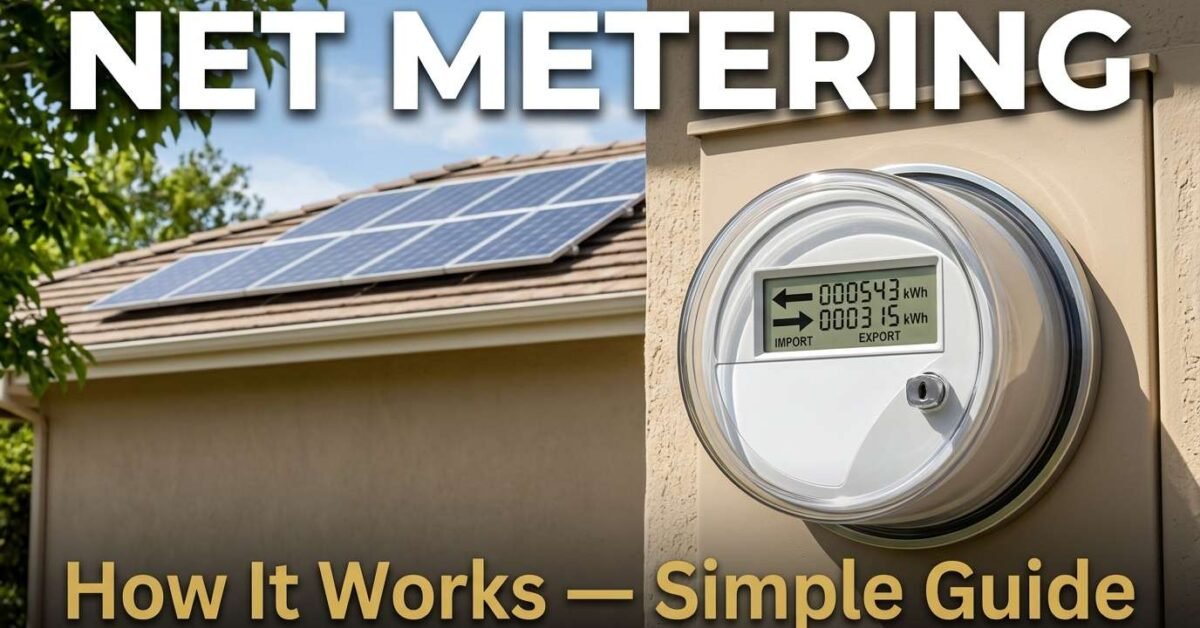
Net metering is a billing arrangement where your utility credits you for excess solar electricity you export to the grid. When your solar panels produce more power than your home uses, the excess flows to the grid and your electric meter effectively runs backward. At the end of the billing cycle, you pay only for the net difference between what you consumed and what you produced. Our Net Metering Calculator shows exactly how much net metering saves you.
How Net Metering Works: Step by Step
Daytime (solar producing): Your panels generate electricity. Your home uses what it needs. Any excess automatically flows to the grid. Your meter tracks the export — each kWh exported earns a credit on your account.
Nighttime (no solar): Your home draws electricity from the grid as normal. Each kWh consumed debits your account. The meter tracks your consumption.
End of billing cycle: Your utility calculates the net: total consumption minus total export credits. If you consumed 900 kWh and exported 400 kWh, you pay for 500 kWh net. If you exported more than you consumed, the excess credits typically roll over to the next month (rules vary by utility).
Types of Net Metering
| Type | Export Credit Rate | Best For |
|---|---|---|
| Full retail (1:1) | Same as what you pay | Maximum savings — the grid is your free battery |
| Reduced export | 50-80% of retail | Still good — consider adding a battery |
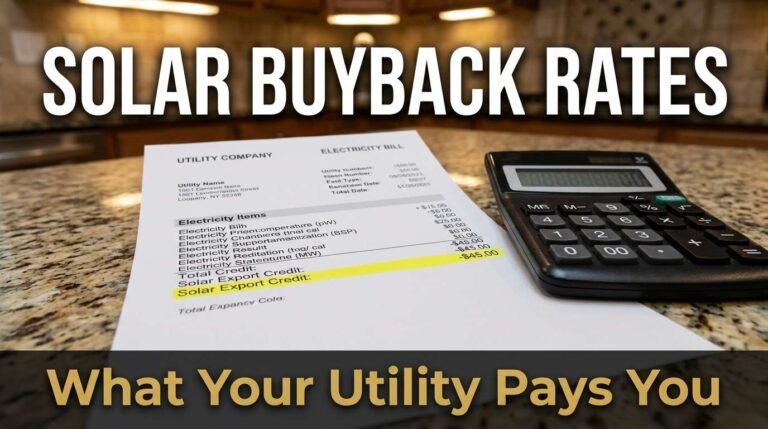
| Wholesale / avoided cost | $0.03-0.05/kWh | Battery is almost essential to capture value |
| No net metering | $0 — exports are free to utility | Battery is required — export is wasted |
Net Metering by State
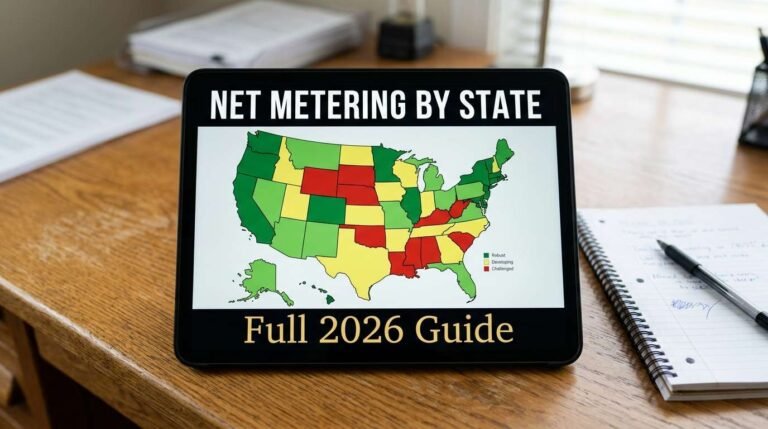
As of 2026, 38 US states plus DC have mandatory net metering policies. The most favorable states offer full retail (1:1) credit: New York, New Jersey, Maryland, Colorado, and most of the Northeast. California transitioned to NEM 3.0 in 2023, significantly reducing export credits to roughly $0.05 to $0.08/kWh — making batteries financially attractive there. Some states like Idaho, South Dakota, and Tennessee have no statewide net metering requirement. Check your state and utility at the DSIRE database (dsireusa.org).
Net Metering vs Feed-In Tariff
Net metering credits you for exports at or near the retail electricity rate. A feed-in tariff (FIT) pays you a fixed rate per kWh exported — sometimes higher than retail (to incentivize solar adoption), sometimes lower. FITs are common in Europe, Australia, and parts of Asia. In the US, net metering is the dominant model. The practical difference: under net metering, you benefit most by maximizing self-consumption (using solar during the day); under a high FIT, you benefit by maximizing exports. Our Net Metering Calculator models both scenarios.
Does Net Metering Make Solar Worth It?
Full retail net metering is the single biggest factor in solar payback. With 1:1 net metering, a properly sized system can reduce your electricity bill to zero. Without net metering, you only save on electricity consumed during daylight hours — typically 30 to 50 percent of your total production. The remainder either goes to waste or must be stored in a battery. See the exact financial impact for your situation in our Solar Savings Calculator and Net Metering Calculator.
Common Net Metering Misconceptions
“My meter literally runs backward.” Older analog meters with spinning disks did physically run backward when exporting. Modern smart meters track import and export separately on two digital registers. The billing effect is the same — you get credited for exports — but the meter does not visually spin backward.
“I can zero out my bill completely.” In most states, even with perfect 1:1 net metering, you still pay a monthly connection fee ($10 to $20) regardless of net consumption. Some utilities also have demand charges based on your peak usage, which solar does not eliminate. A true $0 bill is rare — but $10 to $20 per month versus $150 to $300 is still a massive reduction.
“Excess credits roll over forever.” Most utilities roll over monthly credits within a 12-month cycle, then pay out the remaining balance at a reduced rate (often wholesale or avoided cost) at the annual true-up. This means oversizing your system significantly beyond annual consumption wastes money on excess exports that are paid out at low rates. Size your system to match your annual consumption — not to maximize production.
How Net Metering Affects System Sizing
With full retail net metering, size your system to produce 100 to 110 percent of your annual electricity consumption. The 10 percent buffer accounts for panel degradation and weather variability. Without net metering (or with heavily reduced export rates), size to match only your daytime consumption — typically 40 to 60 percent of total — and add a battery for the rest. Our Solar System Calculator sizes the system based on your total consumption, and our Net Metering Calculator shows how different export rates affect the optimal system size.