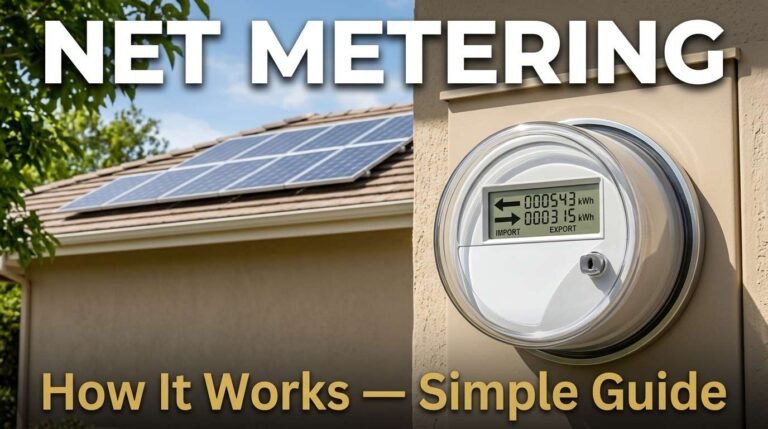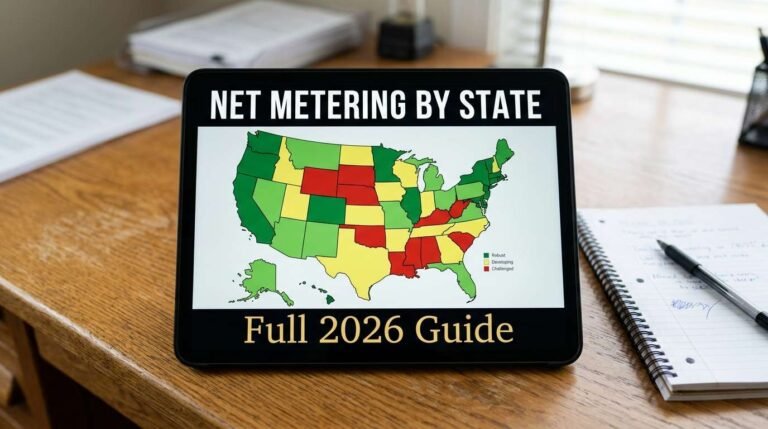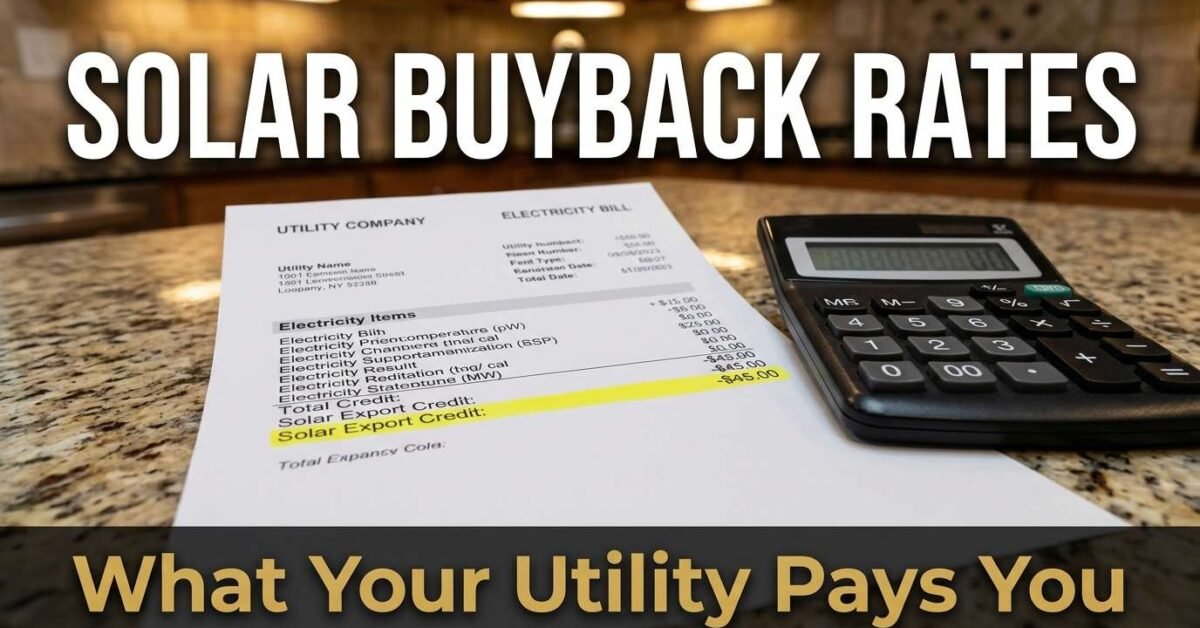
Solar buyback rates — what your utility pays you for electricity you export to the grid — range from $0.03 per kWh (wholesale/avoided cost) to full retail ($0.15 to $0.35/kWh) depending on your utility’s net metering policy. The rate you receive is the single biggest factor in determining whether a battery makes financial sense alongside your solar panels. Our Net Metering Calculator models the impact of any buyback rate on your savings.
Solar Buyback Rates by Major Utility
| Utility | State | Buyback Rate | Type |
|---|---|---|---|
| Con Edison | NY | Full retail ($0.20-0.35/kWh) | 1:1 Net metering |
| PSE&G | NJ | Full retail ($0.16-0.22/kWh) | 1:1 Net metering |
| Duke Energy | NC/SC | Full retail ($0.12-0.14/kWh) | 1:1 Net metering |
| Xcel Energy | CO/MN | Full retail ($0.13-0.15/kWh) | 1:1 Net metering |
| PG&E | CA | $0.05-0.08/kWh (time-varying) | NEM 3.0 |
| SCE | CA | $0.05-0.08/kWh (time-varying) | NEM 3.0 |
| APS | AZ | $0.09-0.11/kWh | Reduced NM |
| NV Energy | NV | 75% of retail ($0.08-0.10) | Reduced NM |
| Florida Power & Light | FL | Full retail ($0.13-0.15/kWh) | 1:1 Net metering |
| CPS Energy | TX | $0.097/kWh (flat) | Buyback program |
Rates change annually. Contact your utility or check their solar/net metering page for current rates before finalizing your system design.
How Buyback Rate Affects Your Solar ROI
At full retail ($0.16/kWh), every kWh you export has the same value as a kWh you consume yourself — making batteries unnecessary from a pure financial perspective. At reduced rates ($0.05 to $0.08/kWh), exported kWh are worth 50 to 70 percent less than consumed kWh — creating a strong financial incentive to add battery storage that captures exports for self-use later. At wholesale ($0.03 to $0.04/kWh), exports are nearly worthless — a battery is almost essential for reasonable solar ROI.
Should You Add a Battery Based on Your Buyback Rate?
The breakeven threshold: if your buyback rate is less than 60 percent of your retail electricity rate, a battery typically pays for itself within 7 to 10 years by shifting exports to self-consumption. If your buyback rate is above 75 percent of retail, the battery’s value comes primarily from backup power during outages, not from financial savings. Run both scenarios — with and without battery — in our Net Metering Calculator to see the exact dollar difference for your utility’s rate. Then compare the total system cost with our Installation Cost Calculator.
Time-of-Use Export Rates
Some utilities (particularly in California under NEM 3.0) pay time-varying export rates. Solar exports during off-peak hours (midday, when solar production is highest) receive the lowest rate ($0.03 to $0.05/kWh). Exports during peak hours (4 PM to 9 PM, when solar production is declining) receive higher rates ($0.15 to $0.35/kWh). This creates a strong incentive to add a battery: store midday excess (low export value) and either self-consume or export during peak hours (high value). The arbitrage between off-peak and peak rates can make a battery pay for itself in 5 to 7 years in TOU markets. Our Net Metering Calculator models the impact of different export rates on your savings.
How to Maximize Value at Any Buyback Rate
Regardless of your buyback rate, three strategies maximize solar value. First, shift heavy loads (dishwasher, laundry, EV charging) to peak solar production hours (10 AM to 3 PM) to maximize self-consumption. Every kWh consumed directly is worth the full retail rate — even if exports are worth only $0.04/kWh. Second, install a smart thermostat that pre-cools or pre-heats your home during solar hours, storing thermal energy in the building mass. Third, if your buyback rate is below 60 percent of retail, run the numbers on a battery — our battery vs no-battery comparison breaks down the full cost analysis.
Negotiating Better Rates
In deregulated electricity markets (Texas, parts of the Northeast), you can choose your retail electricity provider. Some providers offer better solar buyback rates than others as a competitive differentiator. Compare buyback rates alongside retail rates when choosing a provider — a provider offering $0.10/kWh retail with $0.10/kWh buyback (1:1) is better for solar than one offering $0.08/kWh retail with $0.04/kWh buyback (1:2). In regulated markets, the buyback rate is set by the public utility commission and is not negotiable — but you can advocate for better rates through public comment periods and state legislation.
Model any combination of retail and export rates in our Net Metering Calculator and see the complete 25-year picture in our Solar Savings Calculator.
What Happens to Excess Credits at Year-End?
Most utilities with net metering operate on a 12-month billing cycle. Credits earned in sunny months (April through September) roll forward and offset bills during low-production months (November through February). At the end of the 12-month cycle (the “true-up” date), any remaining excess credits are paid out — but usually at a reduced rate (wholesale or avoided cost), not at the retail rate you earned them at. This means significant overproduction is penalized at true-up. Size your system to produce 100 to 105 percent of your annual consumption — not 130 percent, where 25 percent of your excess gets paid out at $0.04/kWh instead of offsetting bills at $0.16/kWh. Our Solar System Calculator helps size the system to match your annual consumption precisely.