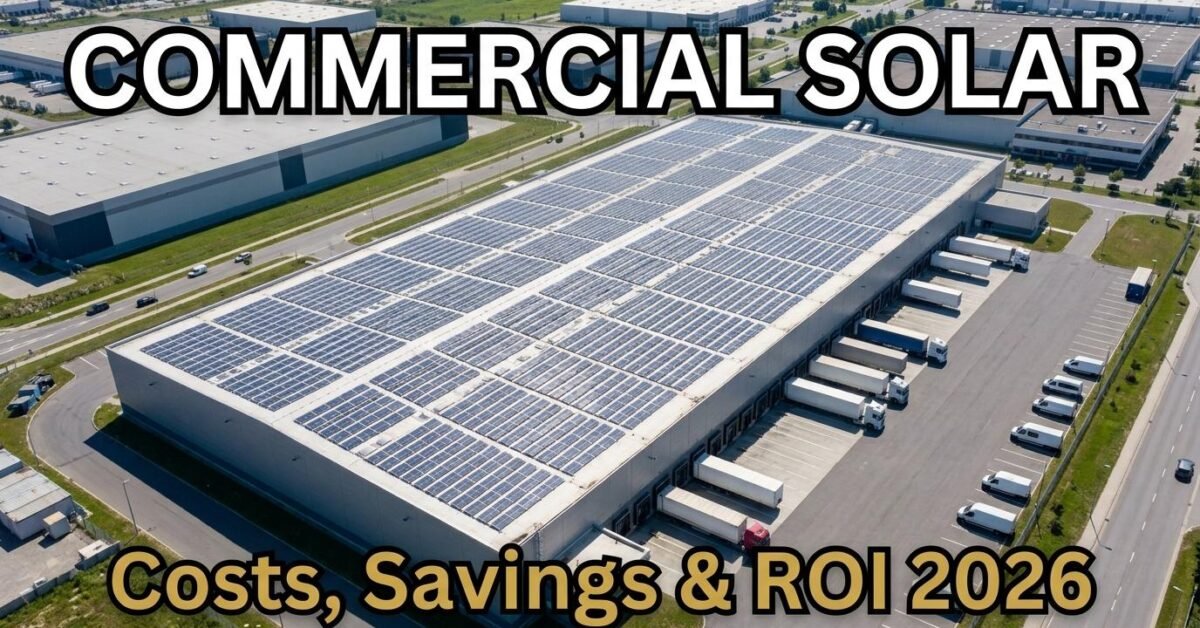
Commercial solar installations follow the same physics as residential systems but operate at a completely different scale of economics. A 50 kW rooftop system on a warehouse saves more per watt installed than a 8 kW residential system, qualifies for accelerated depreciation that residential buyers cannot access, and produces returns that make the CFO’s spreadsheet look better than nearly any other capital expenditure. This guide covers the numbers that matter for businesses considering solar in 2026.
Commercial Solar Costs in 2026
The installed cost per watt for commercial solar in the US ranges from 1.50 to 2.50 dollars depending on system size, roof type, and region. This is significantly lower than residential costs of 2.50 to 3.50 dollars per watt because commercial installations benefit from economies of scale — larger equipment orders, fewer mounting points per kilowatt, and more efficient crew deployment. A 50 kW commercial rooftop system costs roughly 75,000 to 125,000 dollars before incentives. A 200 kW system costs 300,000 to 450,000 dollars. A 500 kW ground-mount installation costs 650,000 to 1,000,000 dollars.
Use our Solar Installation Cost Calculator to estimate your system cost at your specific size and cost-per-watt — it handles the incentive math automatically.
Commercial Solar Incentives
Commercial solar projects in the US qualify for three powerful incentives that stack together. The federal Investment Tax Credit covers 30 percent of the total installed cost as a direct tax credit — not a deduction, a credit, dollar-for-dollar against your tax liability. The Modified Accelerated Cost Recovery System (MACRS) allows you to depreciate the full system cost over five years, creating substantial tax deductions in years one through five. And many states offer additional incentives: property tax exemptions for the added value of the solar system, sales tax exemptions on equipment, and performance-based incentives (payments per kWh produced).
The combined effect of the ITC plus MACRS is dramatic. On a 100,000 dollar system, the 30 percent ITC returns 30,000 dollars. MACRS depreciation on the remaining 70,000 dollars (the ITC reduces the depreciable basis by half the credit) creates approximately 20,000 to 25,000 dollars in tax savings over five years, depending on your marginal tax rate. The effective net cost after all federal incentives is roughly 45,000 to 50,000 dollars — less than half the sticker price.
Sizing a Commercial System
Commercial systems are sized to offset 70 to 100 percent of the facility’s electricity consumption, depending on roof space, utility rate structure, and net metering policy. The sizing process starts with 12 months of utility bills to establish the consumption baseline, then calculates the array size needed to match that consumption at the site’s solar resource level (peak sun hours).
A facility consuming 8,000 kWh per month in a 5-sun-hour region needs roughly a 60 kW system. At 10,000 kWh per month, about 75 kW. At 20,000 kWh per month, about 150 kW. Our Solar System Calculator handles this sizing for systems of any scale — enter your total load and it outputs the panel count, inverter rating, and controller specifications.
Commercial Solar ROI
The payback period for commercial solar in the US is typically three to six years after incentives — shorter than residential because of the lower cost per watt and the MACRS depreciation benefit. After payback, the system generates free electricity for another 19 to 22 years of its warranted life. The internal rate of return typically ranges from 15 to 30 percent, which significantly outperforms most alternative uses of the capital.
A practical example: a warehouse with a 15,000 dollar monthly electricity bill installs a 200 kW system for 400,000 dollars gross. After the 30 percent ITC (120,000 dollar credit) and MACRS depreciation (approximately 56,000 dollars in tax savings over five years), the effective net cost is roughly 224,000 dollars. Annual electricity savings of 60,000 to 70,000 dollars produce a payback period of approximately 3.5 years. Over 25 years, the system generates roughly 1,500,000 dollars in cumulative savings against a 224,000 dollar investment. Run similar scenarios for your facility in the Solar Savings Calculator.
Roof Considerations for Commercial Buildings
Commercial roofs are typically flat or low-slope, which simplifies panel mounting — ballasted racking systems sit on the roof membrane without penetrating it, eliminating leak risk. Metal standing-seam roofs allow clamp-on mounting with zero penetrations. Roof age and structural capacity are the two critical assessments: the roof should have at least 15 years of remaining life (replacing a roof under panels is expensive), and the structure must support the additional dead load of panels and racking (typically 3 to 5 pounds per square foot). A structural engineer’s assessment is standard practice for commercial projects.
Choosing a Commercial Installer
Commercial solar installation is a specialized trade. Verify that any installer you evaluate has completed at least 10 commercial projects of similar size, carries proper commercial insurance and bonding, and will handle permitting, utility interconnection, and incentive paperwork. Request three references from completed commercial projects and call them. Compare quotes on a cost-per-watt basis using the same equipment specifications — our Solar Installation Cost Calculator gives you a baseline expectation before the first quote arrives, so you can immediately identify outliers.
The lowest-cost quote is not always the best value. Equipment quality (panel efficiency and warranty length), inverter technology (string vs microinverter vs power optimizer), workmanship warranty duration, and the installer’s financial stability all affect the 25-year return. A quote that is 10 percent higher but includes a 25-year workmanship warranty and tier-one panels may deliver better lifetime ROI than the cheapest bid with minimal warranty coverage.
Estimate your commercial solar installation cost →
☀️ Get Free Solar Quotes
Tell us about your home — get matched with qualified solar installers in your area. Free, no obligation.
By submitting you consent to being contacted by solar professionals regarding your inquiry. See our privacy policy.
⚡ Free Solar Sizing Cheat Sheet
Get our one-page guide to sizing panels, batteries and inverters — plus weekly solar tips. No spam, unsubscribe anytime.
By subscribing you agree to our privacy policy. We'll email your guide and occasional solar tips — never spam.