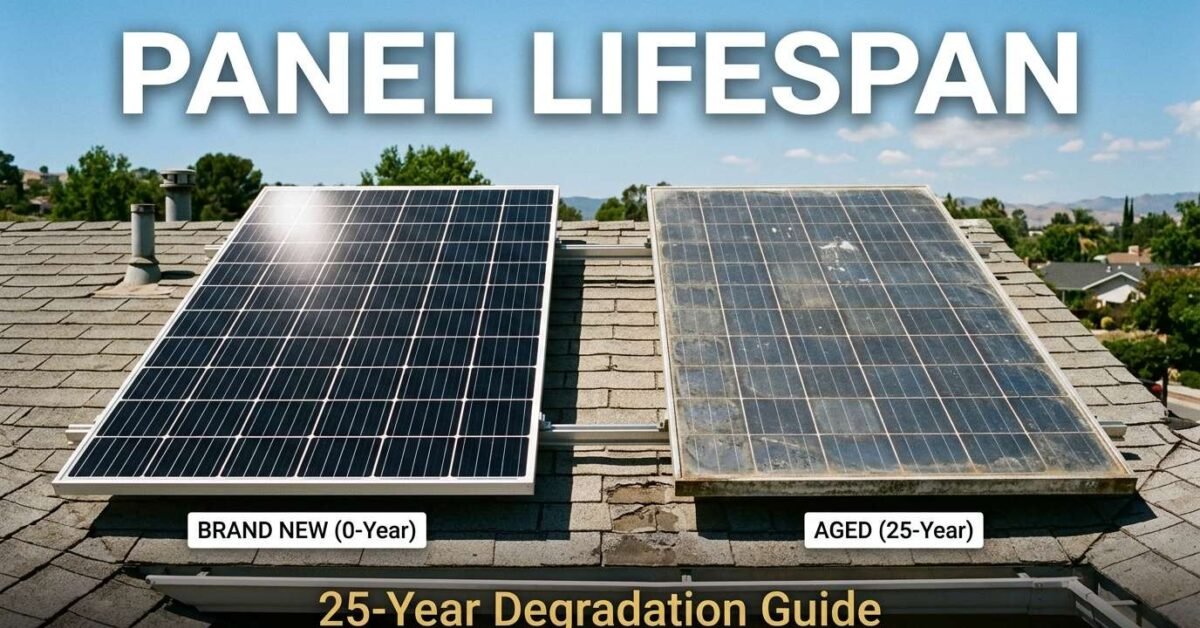
Solar panels last 25 to 30 years and continue producing electricity beyond that — they do not suddenly stop working at year 25. They degrade gradually at 0.3 to 0.5 percent per year, meaning a panel rated at 400W produces approximately 350 to 370W after 25 years. Most manufacturers guarantee at least 80 to 87 percent of original output at year 25 through their performance warranty. Our Solar Panel Degradation Calculator models the output decline over any timeframe.
Solar Panel Degradation Rates
| Panel Type | Annual Degradation | Output at Year 25 | Output at Year 30 |
|---|---|---|---|
| Premium monocrystalline (2024+) | 0.25-0.35% | 91-94% | 89-92% |
| Standard monocrystalline | 0.35-0.50% | 87-91% | 84-89% |
| Polycrystalline | 0.40-0.60% | 85-90% | 82-87% |
| Thin-film | 0.50-0.80% | 80-87% | 76-83% |
What Actually Fails Before the Panels
The panels themselves almost never fail within 25 years. What does fail: the inverter typically lasts 10 to 15 years and needs replacement once during the panel lifetime ($1,000 to $2,500). Wiring connections can corrode or loosen over time, especially in coastal or high-humidity environments. Racking hardware bolts and clamps may need tightening every 5 to 10 years. The total maintenance cost over 25 years is typically $2,000 to $4,000 — far less than the $50,000+ in electricity savings the system produces.
Model your system’s output decline and lifetime savings in our Degradation Calculator and Savings Calculator.
Real-World vs Laboratory Performance
Solar panel specifications are measured under Standard Test Conditions (STC): 25 degrees Celsius cell temperature, 1,000 W/m2 irradiance, and AM 1.5 spectrum. In real-world conditions, panels rarely achieve STC performance because cell temperature exceeds 25 degrees (every degree above STC reduces output by 0.3 to 0.4 percent), irradiance varies throughout the day, and atmospheric conditions differ from the laboratory standard. Expect real-world output to be 80 to 85 percent of the STC rating — this is already factored into our calculators through the system derating factor.
Maintenance and Cleaning
Solar panels require minimal maintenance. Rain cleans most dust and debris naturally. In dry, dusty regions, washing panels with water once or twice a year recovers 2 to 5 percent of lost output. Do not use pressure washers, abrasive cleaners, or soap — these can damage the anti-reflective coating. A garden hose from the ground is sufficient for most installations. Annual visual inspection of the racking, wiring, and connections catches loose bolts and corroded terminals before they become problems.
Model your system’s performance over time in our Panel Degradation Calculator and calculate the financial impact of panel choices in the Solar Savings Calculator.
Real-World vs Laboratory Performance
Panel specs are measured at 25°C and 1,000 W/m² irradiance (STC). Real-world output is 80-85% of STC due to heat, dust, and varying sun angles. Every degree above 25°C reduces output by 0.3-0.4%. This derating is already factored into our calculators. Expect a 400W panel to produce 320-340W peak in practice.
Maintenance and Cleaning
Solar panels need minimal maintenance. Rain cleans most dust naturally. In dry regions, wash with water 1-2 times per year to recover 2-5% of lost output. Never use pressure washers or abrasive cleaners. Annual visual inspection of racking and wiring catches loose connections before they become problems. Model your system over time in our Degradation Calculator.
Energy Cost Impact
Monthly cost formula: (Watts × hours per day × 30) ÷ 1,000 × electricity rate. At the US average of $0.16/kWh, a 1,500W appliance running 2 hours daily costs $14.40/month. A 100W device running 8 hours costs $3.84/month. Even small wattage reductions compound over a year — saving 50W over 8 daily hours saves $23 annually. Calculate all your appliances combined in our Electricity Bill Calculator.
Measuring Your Actual Consumption
Published wattage ranges are approximations. Your specific model may draw more or less depending on age, settings, and condition. For exact numbers, use a plug-in watt meter (Kill A Watt P4400 or Poniie PN2000, both under $25) between the appliance and the wall for 24 hours. The meter captures running watts, peak surge, and total kWh consumed — the precise values for sizing solar panels, batteries, or generators. Look up typical values first in our Appliance Wattage Database with 140+ devices.
Sizing Solar Panels and Battery Backup
Use the average wattage for energy calculations (how many panels you need) and the startup surge for inverter and generator sizing (how big the inverter must be to handle the peak). Our Solar System Calculator handles both — enter all your appliances and get the complete system specification. For battery backup runtime, use our Battery Backup Calculator. For generator sizing, use our Generator Sizing Calculator which accounts for motor startup surge automatically.
Reducing Energy Consumption
The cheapest watt is the one you never use. Before sizing a solar system or generator, consider whether you can reduce consumption first. Upgrading to Energy Star rated appliances typically reduces consumption by 20 to 50 percent. Using timers and smart plugs eliminates standby power draw (which accounts for 5 to 10 percent of total home electricity use). Switching from incandescent or halogen to LED lighting reduces lighting consumption by 75 percent. Every watt you eliminate from your load reduces the solar panel count, battery size, and inverter capacity — saving thousands of dollars on the system.