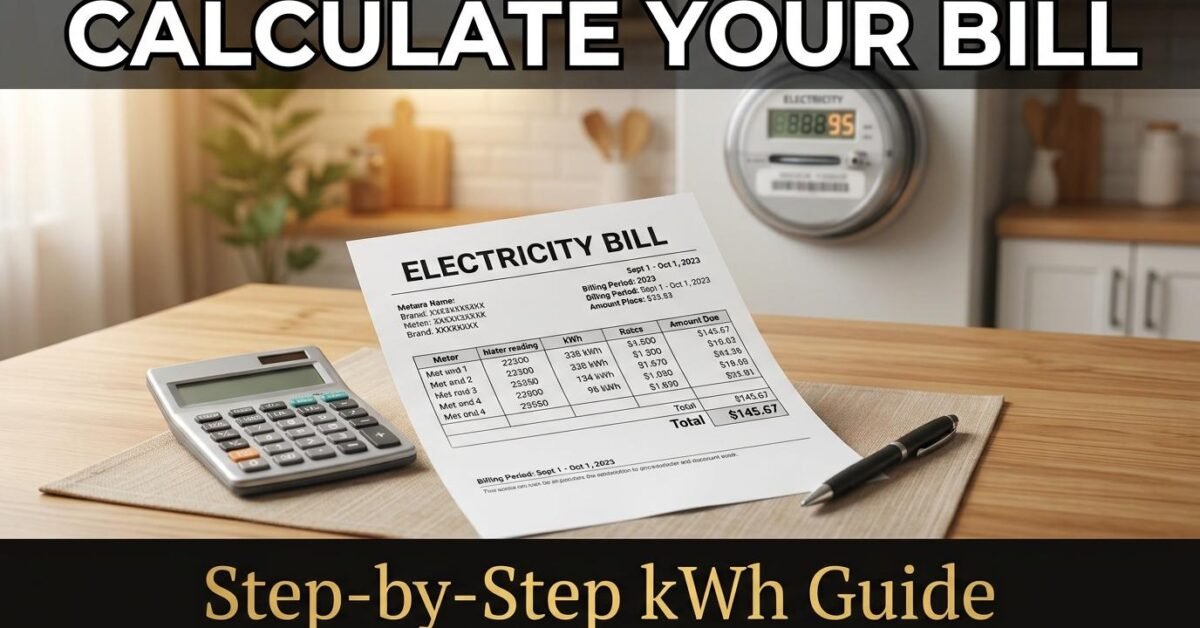
Your electricity bill looks complicated, but underneath the fees and line items sits one simple formula: energy used (kWh) multiplied by your rate, plus fixed charges, plus tax. Once you can run that calculation yourself, you can verify your utility’s math, predict next month’s bill before it arrives, and see exactly which appliances are costing you the most. This guide walks through the full calculation with worked examples — and our free Electricity Bill Calculator automates every step.
Step 1: Understand the kWh
Electricity is billed in kilowatt-hours. One kWh is 1,000 watts running for one hour. A 100-watt device running for 10 hours uses 1 kWh. A 2,000-watt water heater running for 30 minutes also uses 1 kWh. Every appliance in your home contributes: watts times hours of use, divided by 1,000, equals its kWh consumption. Find any appliance’s wattage on its nameplate label or in our Appliance Wattage Database, which lists 140 appliances with typical watts and daily hours.
Step 2: Calculate Each Appliance’s Monthly Usage
The formula per appliance is: watts × hours per day × 30.4 days ÷ 1,000 = kWh per month. Worked examples: a 150 W refrigerator running 24 hours (it cycles, but for billing estimates the always-on figure works) uses 150 × 24 × 30.4 ÷ 1,000 = 109 kWh per month. A 1,200 W air conditioner running 6 hours daily uses 1,200 × 6 × 30.4 ÷ 1,000 = 219 kWh per month. Four 10 W LED bulbs at 6 hours each use 10 × 6 × 4 × 30.4 ÷ 1,000 = 7.3 kWh per month. Notice the pattern: cooling and heating dominate, lighting barely registers. Add every appliance’s number and you have your monthly consumption.
Step 3: Find Your Rate
Your rate per kWh is printed on your bill, usually labeled “energy charge” or “supply rate.” The US average is around $0.16 per kWh, but it ranges from under $0.11 in Louisiana to over $0.30 in California and $0.40+ in Hawaii. If your bill only shows a total, divide the energy charge portion by the kWh consumed that month — that back-calculates your effective rate, which is often more accurate than the advertised rate because it captures riders and adjustments.
Step 4: Apply the Bill Formula
Monthly bill = (kWh × rate) + fixed charges + tax. Continuing the example: suppose your appliances total 550 kWh, your rate is $0.16, your utility charges a $12 monthly connection fee, and your state applies 6 percent tax. Energy charge: 550 × 0.16 = $88.00. Add fixed charges: $88 + $12 = $100. Apply tax: $100 × 1.06 = $106.00. That is your bill. Run your own numbers in the Electricity Bill Calculator — it builds the appliance list for you with preset buttons, shows each appliance’s monthly kWh, and produces this exact breakdown automatically.
What About Tiered (Slab) Rates?
Many utilities do not charge a flat rate — they use tiers, also called slabs. A typical structure: the first 300 kWh at $0.13, the next 300 kWh at $0.17, everything above 600 kWh at $0.22. To calculate a 750 kWh bill on that tariff: 300 × 0.13 = $39, plus 300 × 0.17 = $51, plus 150 × 0.22 = $33, for a $123 energy charge before fixed fees and tax. Tiered pricing is why cutting the last 100 kWh of a heavy bill saves more money than cutting the first 100 — the top slab is always the most expensive. South Asian utilities (Pakistan, India) use aggressive slab structures where crossing a threshold can re-price your entire consumption, making load reduction even more valuable.
Time-of-Use Rates
The other common structure is time-of-use (TOU): electricity costs more during peak hours (typically 4 PM to 9 PM) and less overnight. If your utility uses TOU, the calculation splits your kWh by time window: peak kWh × peak rate + off-peak kWh × off-peak rate. The practical strategy is shifting flexible loads — laundry, dishwasher, EV charging, water heating — into off-peak windows. A household that moves 150 kWh per month from a $0.30 peak rate to a $0.12 off-peak rate saves $27 per month without reducing consumption at all.
Reading Your Meter
To verify your bill against reality, read your meter at the start and end of a billing period. Digital meters show a cumulative kWh figure — subtract the earlier reading from the later one and that is your consumption. If the bill’s kWh does not match your readings within a few percent, contact your utility; estimated readings (marked “E” on many bills) are a common source of overbilling that gets corrected when an actual reading occurs.
Where the Money Actually Goes
Run the per-appliance formula across a typical home and the hierarchy is consistent: air conditioning and heating take 40 to 50 percent of the bill, water heating 10 to 15 percent, the refrigerator 8 to 10 percent, laundry and cooking 8 to 12 percent, and lighting plus electronics the remainder. This hierarchy tells you where reduction effort pays: one degree of thermostat adjustment or a soft-starter-equipped efficient AC saves more than replacing every bulb in the house. Our guides to air conditioner wattage and refrigerator wattage break down the biggest consumers in detail.
The Solar Angle
Here is the reason this calculation matters beyond curiosity: the energy-charge portion of your bill — usually 80 to 90 percent of the total — is exactly what a correctly sized solar system eliminates. Once you know your monthly kWh, our Solar System Calculator converts it into the panels, battery and inverter required, and the Solar Savings Calculator shows your payback period and 25-year savings at your actual rate. Calculate the bill first, then calculate its replacement.