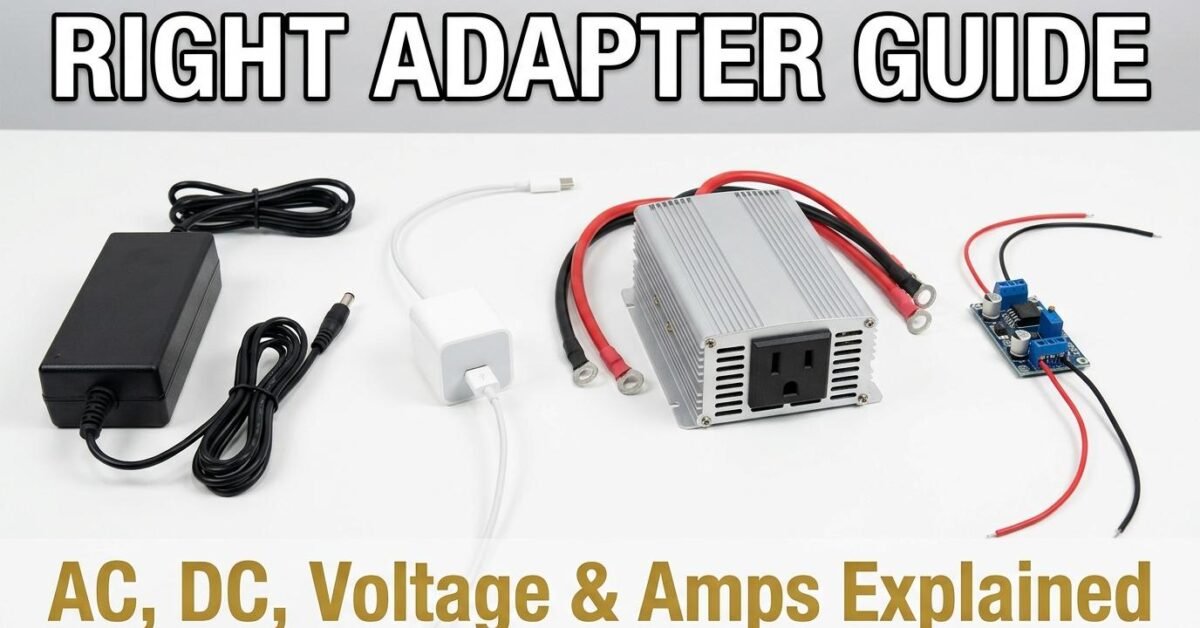
Every year thousands of devices are destroyed by the wrong adapter. The replacement cost is not the adapter — it is the device. A 15V adapter on a 12V cooler burns the motor. A 5A adapter on an 8A device overheats and fails. A modified sine wave inverter on a CPAP machine voids the warranty. All of these are preventable with one principle: match the voltage exactly, meet or exceed the current, and choose the right conversion type. This guide covers every scenario with the formula and our free AC/DC Adapter Calculator does the math automatically.
The Three Rules of Adapter Sizing
Rule 1: Voltage must match exactly. If your device says 12V, the adapter must output 12V. Not 13V, not 9V, not “close enough.” Higher voltage pushes more current than the device’s circuits can handle, causing overheating, component failure, or fire. Lower voltage means the device either will not start or runs weakly with excess current draw that overheats the adapter. The only acceptable tolerance is plus or minus 5 percent — a 12V device on a 12.5V adapter is fine; on a 15V adapter it is not.
Rule 2: Current (amps) must meet or exceed. This is the rule most people misunderstand. If your device draws 8 amps, the adapter must be rated for at least 8 amps — but a 10A, 15A, or 30A adapter is perfectly safe. The device only pulls what it needs. A higher-amp adapter simply has capacity to spare. Think of it like a water pipe: a bigger pipe does not force more water through — it just has room for more if needed. What kills devices is insufficient amps: a 5A adapter on an 8A device runs at 160 percent of its capacity, overheats, and either melts or shuts down.
Rule 3: Choose the correct conversion type. There are four possible conversions, and each requires a different device:
| Your Device | Your Power Source | What You Need |
|---|---|---|
| DC (e.g. 12V cooler) | AC mains (wall outlet) | AC-to-DC power supply |
| AC (e.g. fridge, TV) | DC battery | DC-to-AC inverter |
| DC (e.g. 12V fan) | Different DC voltage (24V battery) | DC-to-DC converter |
| AC (e.g. 120V device) | Different AC voltage (230V mains) | Step-up/down transformer |
Scenario 1: DC Device on AC Power
This is the most common adapter scenario — a 12V DC cooler, fan, LED strip, or CCTV camera that you want to run from a wall outlet. You need an AC-to-DC power supply (also called an adapter, transformer, or rectifier, though technically these are different things). The formula: read the device label for voltage and amps, add 25 percent to the amps for safety margin, and search for that exact voltage and the higher amp rating. A device rated at 12V 8A needs a 12V 10A adapter (96W device, 120W adapter). Our AC/DC Adapter Calculator computes this instantly and tells you exactly what to search for.
Common DC devices and the adapters they need: a 12V DC ceiling fan at 3A needs a 12V 5A adapter. A 12V DC room cooler at 8A needs a 12V 10A supply. A 5V USB device at 2A needs a 5V 3A charger (which is what a standard phone charger is). A 24V DC water pump at 4A needs a 24V 5A power supply. A 12V LED strip at 2A needs a 12V 3A adapter. In every case: match voltage, exceed amps.
Scenario 2: AC Device on DC Battery
Running household appliances from a battery requires an inverter — a device that converts DC to AC. The inverter’s input voltage must match the battery (12V, 24V, or 48V), and its output power must exceed the device’s consumption with margin. A 500W load needs at least a 625W (500 x 1.25) inverter. If the load has a motor (fridge, pump, AC unit), the inverter must also handle the startup surge — typically 3 times the running watts for 1 to 3 seconds. A 150W refrigerator with a 450W surge needs an inverter rated for at least 500W continuous and 1,000W surge.
Always use a pure sine wave inverter for permanent installations. Modified sine wave inverters produce a square-ish waveform that causes buzzing, overheating, and premature failure in motors, electronics, and medical devices. The cost difference has shrunk to about 15 to 25 percent — pure sine is always the correct choice. Our Battery Charge and Discharge Calculator sizes the inverter automatically based on your load and largest motor.
Scenario 3: DC Device on Different DC Voltage
A 12V device on a 24V battery needs a DC-to-DC converter (step-down or “buck” converter). A 24V device on a 12V battery needs a step-up (“boost”) converter. These are small, efficient electronic modules that change the voltage while adjusting the current proportionally. A 12V 8A device on a 24V battery needs a 24V-to-12V converter rated for at least 10A output (96W). The source side draws 12V x 8A / 24V = 4A plus conversion losses — roughly 4.5A from the 24V battery.
DC-to-DC converters are commonly used in vehicles (converting 24V truck systems to 12V for accessories), in solar systems (matching panel voltage to battery voltage — which is what an MPPT charge controller essentially is), and in electronics projects.
The Efficiency Question: DC Direct vs AC Conversion
Every conversion wastes some energy as heat. An inverter is typically 90 to 95 percent efficient — meaning 5 to 10 percent of your battery energy is lost in the conversion. If you are running a DC device through an inverter and then an AC-to-DC adapter (battery DC to AC to DC again), you lose energy twice: roughly 10 to 15 percent total. The smarter approach for off-grid and solar systems is to use native DC devices wherever possible — 12V DC fans, 12V DC LED lights, 12V DC refrigerators — and connect them directly to the battery, skipping the inverter entirely.
This is why off-grid RVs and cabins often run a dual system: DC loads (lights, fans, phone charging, water pump) connected directly to the battery bank through a DC distribution panel, and AC loads (occasional power tools, microwave, blender) through an inverter that is only switched on when needed. The DC-direct loads run at nearly 100 percent efficiency, and the inverter’s standby consumption (5 to 25W depending on size) is eliminated when not in use.
Calculate Your Adapter Now
Our AC/DC Adapter Calculator handles all four scenarios. Select your device type (DC or AC), enter voltage and amps from the label, select your power source, and it tells you the exact adapter, power supply, inverter, or converter specifications plus what to search for when buying. Look up your device’s wattage in our Appliance Wattage Database if you do not have the label handy.