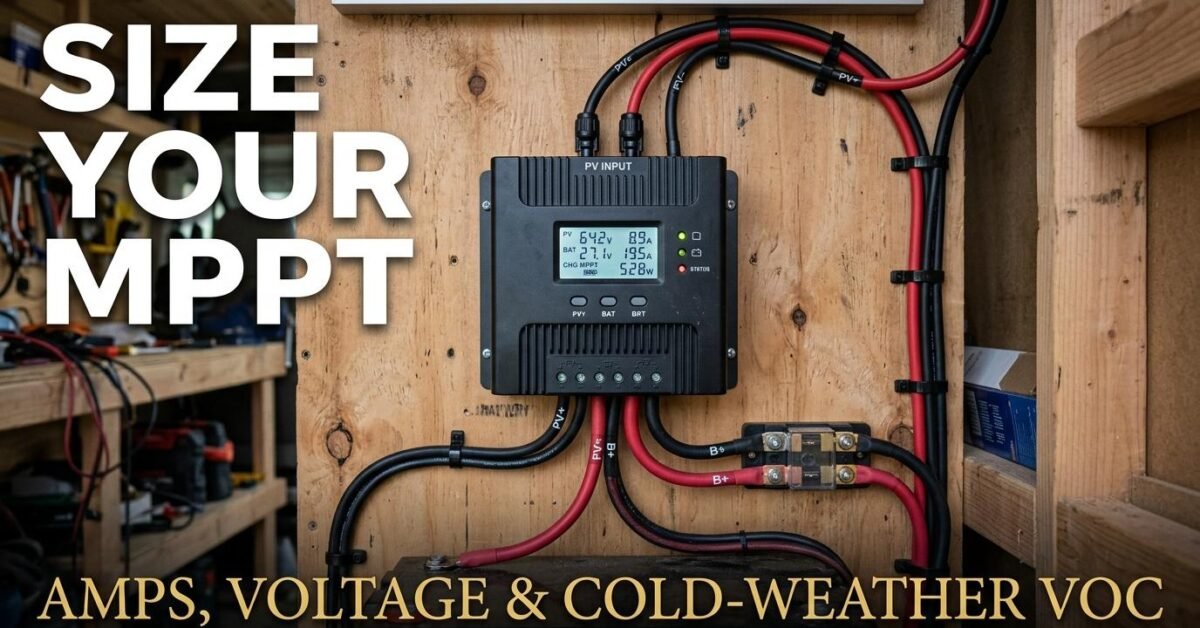
An undersized MPPT charge controller wastes solar energy by capping what reaches your batteries. An oversized one wastes money. And one with insufficient voltage headroom dies the first cold morning. Sizing an MPPT controller correctly requires matching three specifications simultaneously: output current to the battery, maximum PV input voltage from the panel string, and maximum PV input power. This guide covers all three with the real formulas and the cold-weather voltage correction that most online guides omit.
Specification 1: Output Current (Amps)
The controller’s amp rating determines how much current it can push into the battery bank. The formula is simple: Controller amps = Array watts ÷ Battery bank voltage × 1.25 safety factor. A 600W solar array charging a 12V bank needs 600 ÷ 12 × 1.25 = 62.5A — a 60A controller runs at its limit, an 80A controller gives comfortable headroom. The same 600W array on a 24V bank needs only 31.3A — a 40A controller works fine. This is one of the practical reasons higher-voltage battery banks are preferred for larger systems.
Specification 2: Maximum PV Input Voltage
This is where controllers die in the field. Every solar panel has an open-circuit voltage (Voc) — the voltage it produces when nothing is drawing current (disconnected from load, full sun). When panels are wired in series, their Voc values add up. Two panels with 41V Voc each produce 82V in series. The controller’s PV input limit must exceed this combined Voc.
The critical detail: Voc increases in cold weather. A panel rated at 41V Voc at 25°C (the standard test condition) produces approximately 45V at -10°C. Two in series: 90V. If your controller has a 100V input limit, you have only 10V of headroom — and a colder morning or a different panel batch with slightly higher Voc can exceed 100V and destroy the controller’s input stage.
The cold-weather Voc formula: Adjusted Voc = Rated Voc × (1 + (T_cold – 25) × Temperature coefficient). Most panels have a Voc temperature coefficient of about -0.30 percent per degree Celsius (it is negative because voltage goes UP as temperature goes DOWN — counterintuitive but physically correct). At -10°C: Voc = 41 × (1 + (-10 – 25) × -0.003) = 41 × 1.105 = 45.3V. Two in series: 90.6V. Our Battery Charge & Discharge Calculator helps you verify that your controller handles your panel string.
Specification 3: Maximum PV Input Power
Many controllers have a maximum input power that is lower than their voltage × current rating would suggest. A controller rated at 60A and 150V is not necessarily rated for 60 × 150 = 9,000 watts. On a 12V bank, a 60A controller typically handles 800 to 900W of PV; on 24V, 1,600 to 1,800W; on 48V, 3,200 to 3,600W. Always check the datasheet’s maximum PV wattage at your specific bank voltage, not the headline specs.
Sizing Examples
Small RV system: 2× 200W panels (400W array) on a 12V bank. Controller amps: 400 ÷ 12 × 1.25 = 42A → 50A controller. Panel Voc: 2 × 24.5V = 49V (cold weather: ~54V) → 100V controller is fine. Recommendation: Victron SmartSolar 100/50 or Renogy Rover 40A (slightly tight but workable).
Medium off-grid cabin: 6× 400W panels (2,400W array) on a 48V bank. Controller amps: 2,400 ÷ 48 × 1.25 = 62.5A → 80A controller. Panels wired as 2 strings of 3 in series: Voc per string = 3 × 37V = 111V (cold: ~122V) → 150V controller required. Recommendation: Victron SmartSolar 150/85 or split into two 150/45 controllers with 3 panels each.
Large residential: 14× 585W panels (8,190W array) on a 48V bank. Controller amps: 8,190 ÷ 48 × 1.25 = 213A → not achievable with one controller. Solution: multiple controllers. Three Victron 250/85 controllers, each handling 4-5 panels in a series string. This is how real large systems are built — multiple parallel controllers, each managing its own panel string.
Common Sizing Mistakes
Using Vmp instead of Voc: Some guides calculate string voltage using the maximum power voltage (Vmp ≈ 34V on a 41V Voc panel). This is wrong and dangerous — when the battery is full or the load drops, the panels swing to open circuit and hit Voc. The controller must survive Voc, not Vmp.
Ignoring cold weather: Controllers destroyed by overvoltage are almost always installed in temperate or cold climates where winter Voc exceeds the summer calculation by 10 to 15 percent. Calculate for the coldest expected morning, not the day you install.
Undersizing amps to save money: A controller that clips at its maximum current does not damage itself — it simply wastes the excess solar production. But if your 40A controller clips 15 percent of your midday production every sunny day, you lose that energy permanently. The cost of the next size up is repaid within months in recovered production.
Our Battery Charge & Discharge Calculator sizes the controller for any battery and array combination, and our MPPT controller comparison reviews the best units at each amperage tier.