How long will my battery actually last? It is the single most common question from anyone buying a UPS, solar battery, or backup power system. The simple answer — divide amp-hours by load amps — is dangerously wrong because it ignores the two factors that cut real runtime in half: depth of discharge and system efficiency. Our free Battery Backup Calculator gives you the honest answer in seconds.
Why Simple “Ah ÷ Amps” Math Overstates Runtime
A 200 Ah battery at 12 volts stores 2,400 watt-hours on paper. Divide that by a 500-watt load and you get 4.8 hours. That number is what most quick-answer websites give you, and it is roughly 40 to 50 percent too high for lead-acid and 15 to 20 percent too high for lithium. The reason is two losses that simple division ignores.
First, depth of discharge. A lead-acid battery should not be drained below 50 percent of its rated capacity — do it regularly and a battery rated for 4 years will fail in 18 months. So only half of that 2,400 Wh is actually usable. LiFePO4 batteries can safely use 90 percent, which is much better but still not 100. Second, inverter and cable losses consume about 10 to 15 percent of the energy flowing from battery to load. Combined, these factors reduce the lead-acid runtime from the theoretical 4.8 hours to about 2.0 hours — less than half the naive estimate.
Our Battery Backup Calculator applies both factors automatically. Enter your battery specs, select your chemistry, and it shows rated capacity, usable capacity, and honest backup time side by side.
How to Use the Battery Backup Calculator
The calculator takes five inputs. Battery voltage — typically 6V, 12V, 24V, or 48V depending on your system. Battery capacity in amp-hours, with presets from 7 Ah UPS batteries up to 314 Ah LiFePO4 cells, plus a custom field for any size. Number of batteries — for banks with multiple units in parallel, this scales the total capacity proportionally. Chemistry — choose Lead-Acid, AGM, Lithium-Ion, or LiFePO4, and the calculator applies the correct depth of discharge automatically. Or set a custom DoD for unusual configurations. Finally, your total load in watts.
The results update instantly as you change any input. You see rated capacity in kWh, usable capacity after DoD and efficiency losses, backup time in hours and minutes, and total watt-hours delivered. A plain-language note below the results explains the math so you understand exactly where the numbers come from.
Common Battery Backup Scenarios
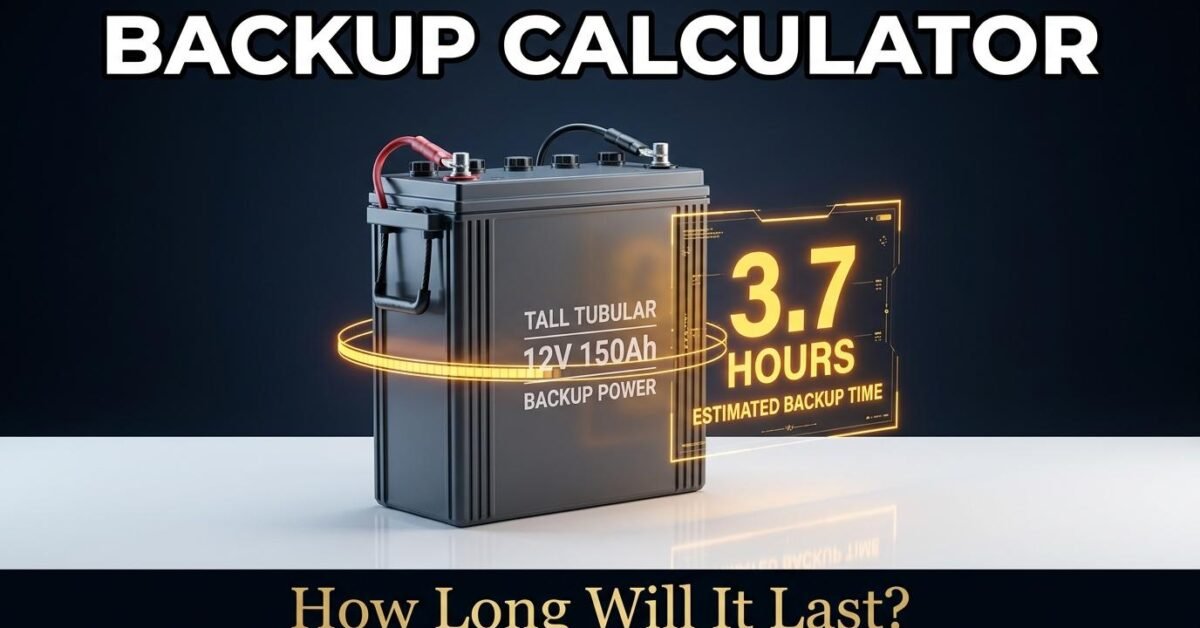
Here are real-world examples you can verify in the calculator. A single 12V 200Ah lead-acid battery running a 500W essential load (lights, fans, router) lasts about 2.0 hours. The same battery as LiFePO4 lasts about 3.7 hours — nearly double. Two LiFePO4 batteries in parallel at 400 Ah total extend that to 7.3 hours, enough for a full overnight backup of essentials.
A small 12V 7Ah UPS battery running a 60W modem and router lasts about 50 minutes on lead-acid — useful to know if your internet goes down during every power cut. A 12V 100Ah lithium battery running a 150W refrigerator lasts about 6.1 hours. These are the practical, DoD-adjusted numbers that matter when you are deciding whether your existing battery bank is enough or whether you need to add capacity.
Understanding the Results
The gap between rated and usable capacity is the most important number in the results. For lead-acid, usable capacity is roughly 42 percent of rated (50 percent DoD × 85 percent efficiency). For LiFePO4, it is about 76 percent (90 percent DoD × 85 percent efficiency). This means a 200 Ah lead-acid battery delivers about 1.02 kWh of real energy, while a 200 Ah LiFePO4 delivers about 1.84 kWh. For a deeper comparison of how chemistry affects your battery bank, see our lead-acid vs LiFePO4 guide.
The efficiency slider defaults to 85 percent, which accounts for typical inverter conversion losses plus cable resistance. If you are running DC loads directly without an inverter, you can increase this to 95 percent. If your inverter is older or the cables are long, drop it to 80 percent for a more conservative estimate.
From Backup Time to Battery Sizing
The calculator works both ways. If you know how long you need backup to last, you can adjust the number of batteries until the runtime meets your target. Need 8 hours of backup for a 500W essential load? Start with one 200 Ah LiFePO4 battery (3.7 hours), add a second (7.3 hours), add a third (11 hours) — two batteries falls just short, three gives comfortable headroom. That is exactly how professional battery bank sizing works, and our battery bank sizing guide explains the full process.
For complete system sizing — panels, batteries, inverter, charge controller, and cost — the Solar System Calculator walks you through everything in five steps, using the same DoD and efficiency math this calculator uses.
Quick-Load Buttons
Not sure what your load is? The calculator includes quick-load buttons for common scenarios: 100W for lights only, 250W for fans plus lighting, 500W for essentials (lights, fans, router, phone charging), 1,200W for essentials plus air conditioning, and 2,000W for heavy loads. Tap any button to load that value instantly, then fine-tune if your actual load is different.
Calculate Your Backup Time Now
Stop guessing and get the real number. Our Battery Backup Calculator handles any battery from a 7 Ah UPS to a 314 Ah lithium cell, any voltage, any chemistry, and any load — with depth of discharge and efficiency losses applied honestly. Enter your specs and know exactly how long your battery will last before you rely on it.
Open the Battery Backup Calculator →
⚡ Free Solar Sizing Cheat Sheet
Get our one-page guide to sizing panels, batteries and inverters — plus weekly solar tips. No spam, unsubscribe anytime.
By subscribing you agree to our privacy policy. We'll email your guide and occasional solar tips — never spam.