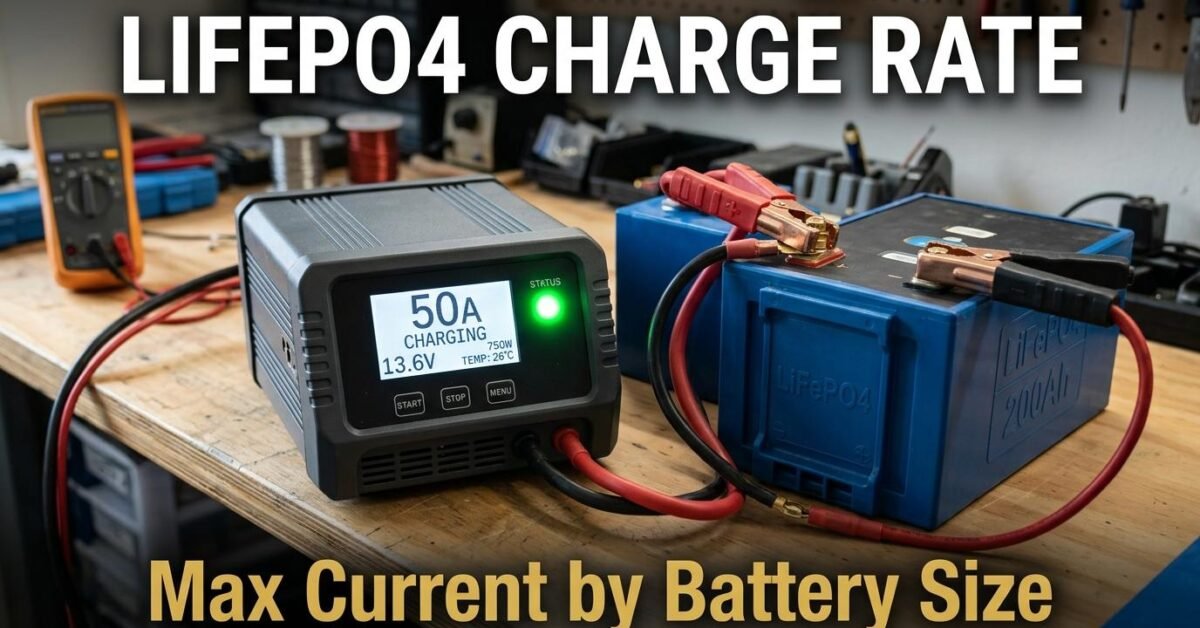
The standard charging current for a LiFePO4 battery is 0.5C — half the amp-hour capacity. A 100Ah battery charges at 50 amps standard. The maximum safe rate is 1C — 100 amps for a 100Ah battery. Exceeding 1C triggers the BMS (Battery Management System) to disconnect, protecting the cells from thermal damage. This guide covers the charging rates for every common LiFePO4 size and what happens when you push the limits.
Charge Rates by Battery Size
| Battery | Standard (0.5C) | Maximum (1C) | Charge Time (0.5C) |
|---|---|---|---|
| 50Ah | 25A | 50A | ~2 hours |
| 100Ah | 50A | 100A | ~2 hours |
| 150Ah | 75A | 150A | ~2 hours |
| 200Ah | 100A | 200A | ~2 hours |
| 300Ah | 150A | 300A | ~2 hours |
Notice the charge time is always approximately 2 hours at 0.5C regardless of battery size — that is the nature of the C-rate system. At 1C, charge time drops to approximately 1 hour. At 0.2C (a gentler rate that maximizes cycle life), charge time stretches to about 5 hours.
What C-Rate Means
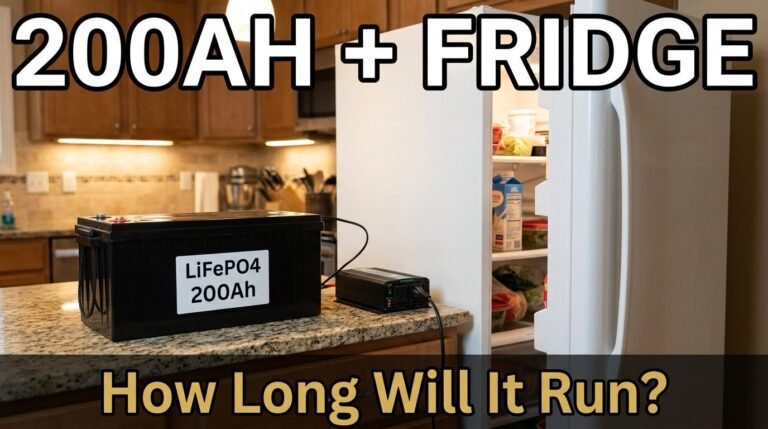
C-rate expresses current as a fraction of capacity. 1C on a 200Ah battery is 200 amps. 0.5C is 100 amps. 0.2C is 40 amps. The formula: Charge current (amps) = Battery Ah × C-rate. Charge power (watts) = Charge current × Charge voltage. For a 200Ah 12V LiFePO4 at 0.5C: 100A × 14.6V = 1,460 watts of charging power. This tells you the minimum size of your solar array or charger — it must supply at least 1,460W to charge at the standard rate. Our Battery Charge & Discharge Calculator computes the exact charge current, power, and time for any battery.
Why 0.5C Is the Sweet Spot
At 0.5C, LiFePO4 cells charge efficiently with minimal heat generation, achieving 98 percent charge efficiency — meaning 98 percent of the energy going in is actually stored. At 1C, efficiency drops slightly to 95 to 97 percent and the cells warm up noticeably. The heat itself is not dangerous at 1C, but sustained high-temperature charging accelerates calendar aging. For maximum battery lifespan (6,000+ cycles), charge at 0.5C or lower. For fastest charging when speed matters more than longevity, 1C is safe.
What Happens If You Exceed 1C
Every quality LiFePO4 battery has a BMS that monitors charge current. If the current exceeds the BMS limit (usually set at 1C to 1.5C depending on the manufacturer), the BMS disconnects the battery from the charger — a hard cutoff that stops all charging instantly. This is a safety feature, not a failure. The battery is undamaged, but your charger or solar controller sees a sudden open circuit, which can cause voltage spikes. The solution: size your charger and solar array to stay within the battery’s rated charge current. The BMS limit is listed in the battery’s datasheet — always check it before buying a charger.
Solar Panels and Charge Rate
Your solar array determines how fast you can charge from the sun. A 200Ah 12V LiFePO4 battery accepts 100A at 0.5C, which requires 100A × 14.6V = 1,460W of charging power. But solar panels do not produce their rated watts constantly — a 400W panel produces roughly 320W average during peak hours after derating. To charge at the full 0.5C rate from solar, you need approximately 1,460 ÷ 0.82 (system derating) = 1,780W of panels — roughly four 450W panels or nine 200W panels. Our Battery Charge & Discharge Calculator sizes the exact panel array for any battery and charge rate.
Temperature and Charging
LiFePO4 batteries should not be charged below 0 degrees Celsius. Most quality BMS units disable charging automatically at or near freezing to prevent lithium plating — a permanent and irreversible form of damage that reduces capacity. If your installation is in a cold climate, look for batteries with built-in heating (self-heating LiFePO4 models are widely available) or install the battery bank in an insulated, temperature-controlled enclosure. Discharge in cold temperatures is safe down to minus 20 degrees Celsius for most LiFePO4 batteries, with a 15 to 20 percent capacity reduction.
Comparison with Other Chemistries
| Chemistry | Standard Rate | Max Rate | Charge Efficiency |
|---|---|---|---|
| LiFePO4 | 0.5C | 1C | 98% |
| AGM | 0.2C | 0.3C | 85% |
| Flooded Lead-Acid | 0.1C | 0.2C | 85% |
| Gel | 0.1C | 0.2C | 88% |
LiFePO4 charges 2.5 to 5 times faster than lead-acid chemistries. This means a smaller solar array can fully charge a LiFePO4 battery in the same number of sun hours — or the same array charges it much faster, leaving more margin for cloudy days.
Charge Voltage Settings for LiFePO4
The charge voltage is equally important as the current. For a 12V LiFePO4 bank, the bulk/absorption voltage should be set to 14.4 to 14.6V. The float voltage (maintenance after full charge) should be 13.6V. Never exceed 15.0V — overvoltage can trigger the BMS disconnect or, in extreme cases, damage the cells. For 24V systems, double these values (28.8 to 29.2V bulk, 27.2V float). For 48V, multiply by four (57.6 to 58.4V bulk, 54.4V float). Always verify the battery manufacturer’s recommended charge profile — some brands use slightly different setpoints depending on their cell chemistry and BMS configuration.