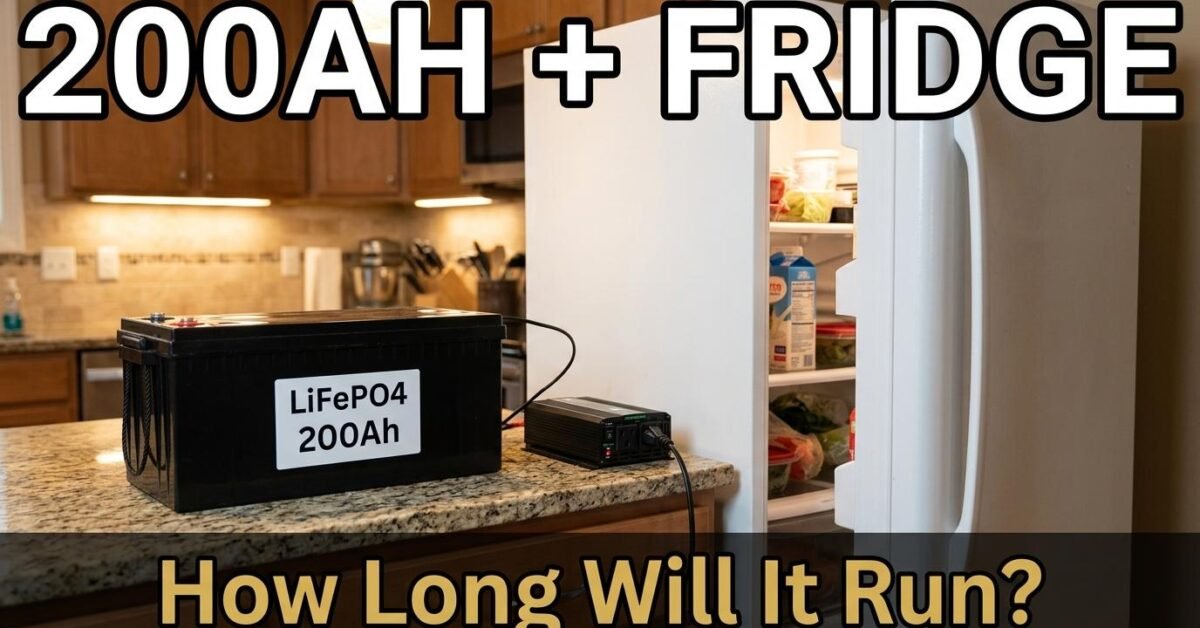
A 200Ah 12V LiFePO4 battery runs a standard household refrigerator for 10 to 14 hours. The range depends on the fridge’s actual power draw, which varies between 100 and 200 watts depending on size, age, ambient temperature, and how often the door is opened. This guide shows the exact calculation and what affects the real-world number.
The Runtime Calculation
Runtime = Usable battery energy divided by fridge power consumption. A 200Ah 12V LiFePO4 battery stores 2,400 Wh total. At 90 percent depth of discharge and 95 percent inverter efficiency, usable energy is 2,400 × 0.90 × 0.95 = 2,052 Wh. A fridge drawing 150W continuously runs for 2,052 ÷ 150 = 13.7 hours. Our Battery Backup Calculator runs this formula with your exact battery specs.
Runtime by Fridge Type
| Fridge Type | Avg Watts | 200Ah LiFePO4 | 200Ah Lead-Acid |
|---|---|---|---|
| Mini fridge (3-5 cu ft) | 60-80W | 25-34 hours | 14-19 hours |
| Standard fridge (18-22 cu ft) | 100-150W | 14-20 hours | 7-11 hours |
| Large fridge (25+ cu ft) | 150-200W | 10-14 hours | 6-7 hours |
| Chest freezer | 50-100W | 20-41 hours | 11-23 hours |
| RV 12V DC fridge | 40-60W | 34-51 hours | 19-29 hours |
The lead-acid column is roughly half the LiFePO4 runtime because lead-acid can only safely discharge to 50 percent versus 90 percent for LiFePO4.
Why Real Runtime Differs From the Label
A refrigerator does not draw a constant 150 watts. The compressor cycles on and off — running at 150 to 200 watts for 15 to 20 minutes, then shutting off for 20 to 30 minutes. The average consumption over an hour is typically 60 to 80 watts for a modern Energy Star fridge, which means the actual runtime is often 50 to 100 percent longer than the label wattage suggests. The startup surge when the compressor kicks in draws 3 to 5 times the running watts for 1 to 3 seconds, which does not affect runtime but does affect inverter sizing — you need an inverter that handles 450 to 750W surge even though the fridge runs at 150W.
The most accurate way to determine your fridge’s real consumption is to measure it with a watt meter (Kill A Watt or similar) for 24 hours. Look up your fridge’s estimated wattage in our Appliance Wattage Database as a starting point.
Running a Fridge Plus Other Essentials
During a power outage, you typically run more than just the fridge. A common essentials package: fridge (150W avg) + LED lights (40W) + Wi-Fi router (15W) + phone charging (15W) = 220W total. Runtime on a 200Ah LiFePO4: 2,052 ÷ 220 = 9.3 hours. Add a ceiling fan (75W) and it drops to 6.9 hours. Our Battery Backup Calculator handles multiple simultaneous loads.
How to Extend Fridge Runtime on Battery
There are four practical ways to extend battery runtime for a fridge. First, reduce door openings — each opening lets warm air in, forcing the compressor to run longer. During an outage, plan your fridge visits. Second, set the thermostat to the warmest safe setting (37 to 40°F / 3 to 4°C) rather than the coldest. Third, if you have a 12V DC fridge (common in RVs), connect it directly to the battery without an inverter — this eliminates the 5 percent inverter loss and extends runtime by about 30 minutes per 10 hours. Fourth, pair the battery with even a small solar panel — a single 200W panel during daytime replaces roughly 800 to 1,000 Wh, nearly doubling the effective runtime. Size your panel array with our Battery Charge & Discharge Calculator.
200Ah at 24V and 48V
The same 200Ah capacity at higher voltage stores proportionally more energy and runs a fridge proportionally longer. A 200Ah 24V LiFePO4 battery stores 4,800 Wh and delivers about 4,104 usable Wh — running a 150W fridge for approximately 27 hours. A 200Ah 48V battery stores 9,600 Wh with 8,208 usable Wh — over 54 hours of fridge runtime. When comparing batteries, always note the voltage: “200Ah” means very different things at 12V versus 48V.
Lead-Acid vs LiFePO4: The Fridge Runtime Gap
A 200Ah lead-acid battery (AGM or flooded) only delivers about half the runtime of LiFePO4 because its safe depth of discharge is 50 percent versus 90 percent. The same 150W fridge runs 13.7 hours on LiFePO4 but only 7.2 hours on lead-acid. When you factor in the 85 percent charge efficiency of lead-acid versus 98 percent for LiFePO4, the total energy cost over the battery’s lifetime is actually higher for the cheaper lead-acid option. This is why LiFePO4 has become the standard for home backup despite the higher purchase price.
Battery Sizing for Extended Fridge Backup
If you need the fridge to run for a full 24-hour outage, a single 200Ah 12V LiFePO4 is not enough at 150W continuous draw (only 13.7 hours). You need either two 200Ah batteries in parallel (27.4 hours of runtime) or one 200Ah paired with solar panels that recharge during daylight. A 200W panel producing 800 to 1,000 Wh during the day extends the effective fridge runtime by 5 to 7 hours. For multi-day outage preparedness, the combination of 200Ah LiFePO4 plus 400W of solar panels provides indefinite fridge operation as long as there is some sunlight — the panels fully recharge the overnight deficit each day with margin to spare.
For a detailed runtime table across all battery sizes, see our 100Ah battery runtime guide — the same formulas apply, just double the numbers for 200Ah.