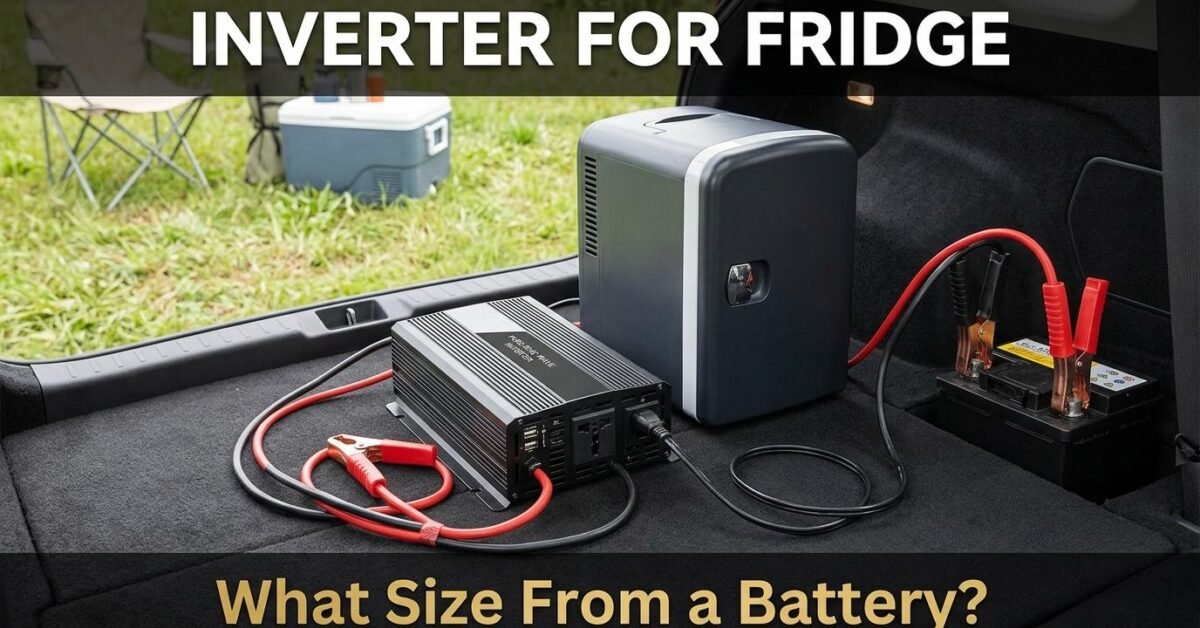
To run a standard household fridge from a car or deep-cycle 12V battery, you need a 500 to 800 watt pure sine wave inverter. The fridge itself draws only 100 to 200 watts while running, but the compressor startup surge hits 400 to 600 watts for 1 to 3 seconds. The inverter must handle both the running watts and the surge without tripping.
The Sizing Math
A standard 18 to 22 cubic foot refrigerator draws 100 to 150 watts when the compressor is running and zero watts when the compressor cycles off. The compressor starts every 20 to 40 minutes and draws 3 to 4 times its running watts for 1 to 3 seconds: 150W × 3 = 450W surge. The inverter must handle this surge plus any other loads running simultaneously. If lights (40W) and a router (15W) are also running: surge = 450 + 40 + 15 = 505W. A 600W or 800W inverter covers this with margin. Our Battery Charge & Discharge Calculator sizes the inverter automatically when you enter your load and largest motor.
Why a Car Battery Is a Bad Choice
A car battery (starting battery) is designed to deliver very high current for a few seconds to crank the engine, then immediately recharge from the alternator. It is not designed for deep discharge — draining it below 50 percent even once significantly shortens its lifespan. A standard car battery is roughly 50 to 70Ah, giving only 285 to 400 usable Wh with a safe 50 percent DoD. At 150W average fridge draw, that is only 1.9 to 2.7 hours of runtime — and you may damage the battery in the process.
A deep-cycle battery (marine, RV, or LiFePO4) is the correct choice for running a fridge. A 100Ah deep-cycle LiFePO4 battery provides 1,026 usable Wh — about 6.5 hours of fridge runtime without risking battery damage. See our 200Ah fridge runtime guide for detailed calculations by fridge type.
Modified Sine Wave vs Pure Sine Wave
Always use a pure sine wave inverter for a refrigerator. Modified sine wave inverters produce a choppy waveform that causes the compressor motor to run hotter, buzz audibly, and draw 10 to 20 percent more power than necessary. Some newer inverter-compressor fridges may refuse to start on modified sine wave entirely. The price difference between a 600W modified and a 600W pure sine wave inverter is typically 20 to 40 dollars — a negligible cost to protect a 500 to 2,000 dollar appliance.
How Long Will It Actually Run?
With a proper deep-cycle battery, here is the realistic fridge runtime by battery size, assuming average 80W consumption (compressor cycling on and off):
| Battery | Chemistry | Usable Wh | Fridge Runtime |
|---|---|---|---|
| 100Ah 12V | LiFePO4 | 1,026 Wh | ~12.8 hours |
| 100Ah 12V | AGM | 570 Wh | ~7.1 hours |
| 200Ah 12V | LiFePO4 | 2,052 Wh | ~25.6 hours |
| 50Ah car battery | Starting | 285 Wh | ~3.6 hours (damages battery) |
These numbers assume 80W average fridge draw (compressor cycling). Your fridge may draw more or less — measure with a watt meter for the most accurate prediction, or look it up in our Appliance Wattage Database.
12V DC Fridge: The Better Option
If you frequently run a fridge on battery (RV, boat, off-grid cabin, regular outage area), consider a 12V DC compressor fridge instead of running an AC fridge through an inverter. A DC fridge connects directly to the battery — no inverter needed — which eliminates the 5 percent inverter loss, removes the inverter’s standby consumption (5 to 25W even when the fridge compressor is off), and eliminates the surge concern entirely because DC compressors use variable-speed drives with soft startup. A quality 12V DC fridge (Dometic, Engel, or Alpicool) costs 300 to 800 dollars and pays for itself in extended battery runtime and eliminated inverter cost within 1 to 2 years of regular use.
Connecting the Inverter Safely
Connect the inverter to the battery with properly sized cables — at minimum 8 AWG for a 500W inverter and 6 AWG for an 800W inverter at 12V (use our Wire Gauge Calculator for exact sizing). Install a fuse or circuit breaker between the battery positive terminal and the inverter — a 60A fuse for a 500W inverter or an 80A fuse for 800W. Never connect an inverter to a battery without a fuse — a short circuit in the inverter will draw hundreds of amps from the battery, melting the cables instantly. Place the fuse as close to the battery terminal as possible, within 18 inches (45 centimeters) of the positive post.
Emergency Setup: Fridge on Battery During an Outage
If the power goes out and you need to keep the fridge running on a battery: connect a pure sine wave inverter (500W or larger) to a deep-cycle battery using properly sized cables (8 AWG minimum for a 500W inverter at 12V — see our Wire Gauge Calculator). Plug only the fridge into the inverter. Keep the fridge door closed as much as possible — a closed fridge maintains safe food temperature for 4 hours without power, and 24 hours if you minimize door openings while running on battery. If you have solar panels available, connect them through an MPPT charge controller to the battery to extend the runtime indefinitely during daylight hours. Size the complete system in our Solar System Calculator.