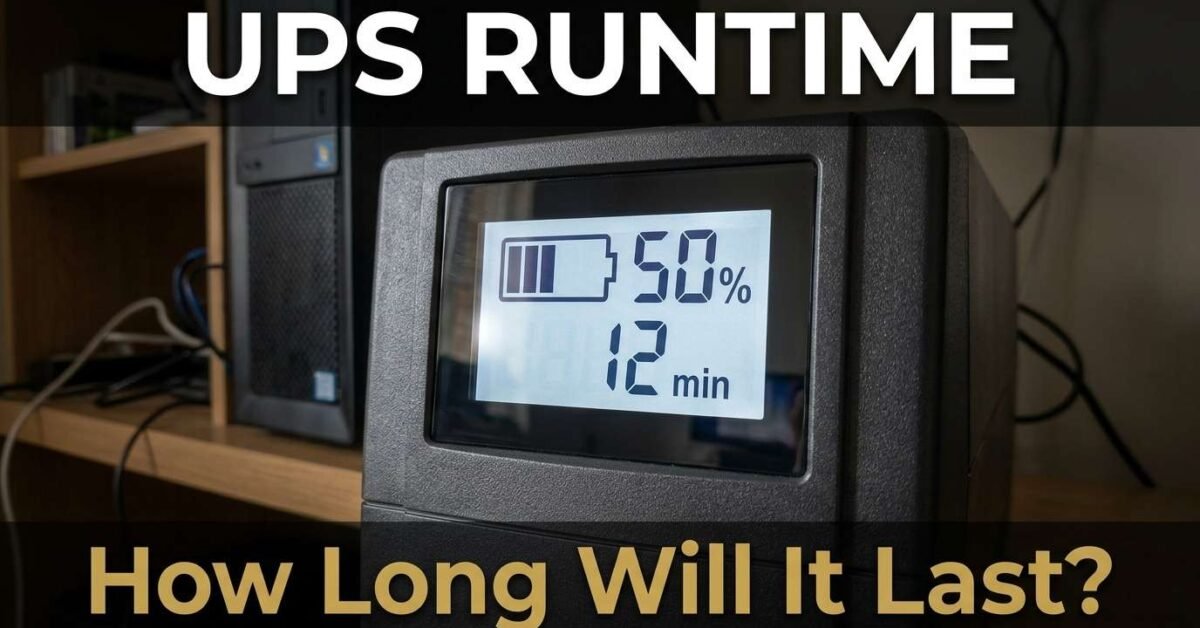
UPS runtime depends on three factors: the UPS battery capacity (measured in VA or Wh), the connected load in watts, and the battery’s age and condition. A typical 750 VA UPS with an internal 12V 9Ah battery provides 5 to 10 minutes of runtime at 300W load. A 1,500 VA UPS provides 10 to 20 minutes at the same load. Our UPS Sizing Calculator estimates runtime for any load and UPS size.
UPS Runtime by Size and Load
| UPS Size | 100W Load | 200W Load | 300W Load | 500W Load |
|---|---|---|---|---|
| 450 VA (54 Wh) | 25-30 min | 12-15 min | 7-9 min | 4-5 min |
| 750 VA (108 Wh) | 50-60 min | 25-30 min | 15-18 min | 8-10 min |
| 1,000 VA (144 Wh) | 70-80 min | 35-40 min | 20-25 min | 12-15 min |
| 1,500 VA (216 Wh) | 100+ min | 50-60 min | 30-35 min | 18-22 min |
| 2,200 VA (396 Wh) | 180+ min | 90-100 min | 55-65 min | 35-40 min |
| 3,000 VA (540 Wh) | 240+ min | 120+ min | 75-90 min | 45-55 min |
These values assume new batteries. After 2 to 3 years, lead-acid UPS batteries lose 20 to 30 percent of their original capacity. After 4 to 5 years, most UPS batteries need replacement — they may hold only 50 percent of their original runtime.
The Runtime Formula
Runtime (minutes) = Battery Wh ÷ Load watts × Efficiency × 60. Most UPS batteries are 12V 7Ah to 12V 9Ah (84 to 108 Wh). Larger units use 24V or 48V batteries or multiple batteries in series. Inverter efficiency is typically 85 to 90 percent. Example: 750 VA UPS with 12V 9Ah battery = 108 Wh. At 300W load: 108 ÷ 300 × 0.85 × 60 = 18.4 minutes.
How to Extend UPS Runtime
There are three approaches. First, reduce the connected load — unplug non-essential devices (monitors can power off while the PC saves and shuts down safely). Second, buy a UPS with extended battery ports — some models accept external battery packs that double or triple the runtime. Third, for runtime beyond 30 minutes, switch to an inverter with external batteries — a 100Ah LiFePO4 battery provides 6 to 10 hours of computer runtime versus 15 to 30 minutes from a UPS. Our Battery Backup Calculator sizes extended backup systems, and our Solar System Calculator adds solar charging for indefinite runtime.
Battery Age and Runtime Degradation
UPS batteries degrade with age and use. A new UPS battery provides 100 percent of its rated capacity. After 1 year: approximately 95 percent. After 2 years: 85 to 90 percent. After 3 years: 70 to 80 percent. After 4 years: 50 to 70 percent. After 5 years: most batteries should be replaced. Temperature accelerates degradation — every 10 degrees Celsius above 25 degrees reduces battery life by roughly 50 percent. A UPS in a hot server closet (35 degrees) may need battery replacement after 2 years instead of 4. Keep your UPS in a climate-controlled space for maximum battery life.
Self-Test and Runtime Monitoring
Most UPS models include a self-test function that periodically switches to battery and measures the runtime under current load. Check this result monthly — it tells you exactly how much backup time you have left. When self-test runtime drops below your safe shutdown time (typically 3 to 5 minutes for a desktop PC), replace the battery immediately. Many UPS models also include software (APC PowerChute, CyberPower PowerPanel) that monitors battery health, triggers automatic shutdown when runtime drops to a configured threshold, and sends email alerts when the battery needs replacement.
UPS vs Extended Battery vs Solar Battery
If you need more than 30 minutes of backup, three options exist. First, buy a UPS with an extended battery module — APC Smart-UPS and CyberPower PR series support external battery packs that double or triple runtime. Second, connect a solar inverter with a LiFePO4 battery bank to your critical circuits — this provides hours of backup instead of minutes, with solar recharging during the day. Third, combine both: a UPS for instant data protection, powered by a solar battery system for extended runtime. Our Solar System Calculator sizes the battery and panel array for any runtime requirement, and our UPS Sizing Calculator sizes the UPS for your immediate protection needs.
Choosing the Right UPS for Maximum Runtime
If runtime is your priority, look at the UPS’s watt-hour (Wh) rating rather than its VA rating. Two 1,500 VA UPS models can have very different runtimes because one has a 216 Wh battery while another has a 396 Wh battery. The Wh rating directly determines runtime — higher Wh means longer backup. APC and CyberPower publish runtime charts by load level for every model on their websites. Compare these charts at your expected load before purchasing. A UPS with 50 percent more Wh costs only 20 to 30 percent more but delivers 50 percent longer runtime — the best upgrade for the money.