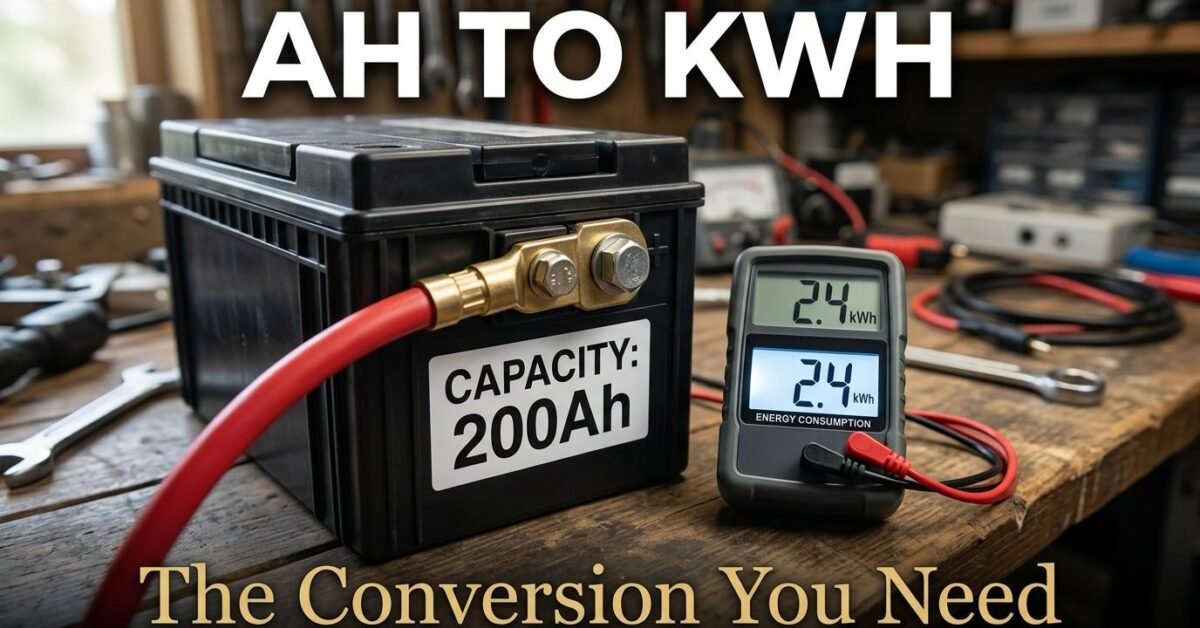
Every battery is rated in amp-hours (Ah) and every electricity bill is in kilowatt-hours (kWh). Converting between them is the most common calculation in solar and backup system design — and the most commonly done wrong, because most people forget to include depth of discharge and inverter losses, which change the real number by 30 to 50 percent.
The Complete Formula
Usable kWh = Ah × Voltage × DoD × Inverter efficiency ÷ 1,000. The raw conversion (Ah × V ÷ 1,000) gives you the theoretical maximum. The usable figure — what actually powers your loads — is always lower. For LiFePO4 with 90 percent DoD and 95 percent inverter efficiency: multiply the raw kWh by 0.855. For lead-acid with 50 percent DoD: multiply by 0.475. Our Battery Backup Calculator applies these factors automatically.
Quick Conversion Tables
12V batteries:
| Battery Ah | Raw kWh | Usable kWh (LiFePO4) | Usable kWh (Lead-Acid) |
|---|---|---|---|
| 50 Ah | 0.60 | 0.51 | 0.29 |
| 100 Ah | 1.20 | 1.03 | 0.57 |
| 150 Ah | 1.80 | 1.54 | 0.86 |
| 200 Ah | 2.40 | 2.05 | 1.14 |
| 300 Ah | 3.60 | 3.08 | 1.71 |
24V batteries (or two 12V in series):
| Battery Ah | Raw kWh | Usable kWh (LiFePO4) | Usable kWh (Lead-Acid) |
|---|---|---|---|
| 100 Ah | 2.40 | 2.05 | 1.14 |
| 200 Ah | 4.80 | 4.10 | 2.28 |
| 300 Ah | 7.20 | 6.16 | 3.42 |
48V batteries (or four 12V in series):
| Battery Ah | Raw kWh | Usable kWh (LiFePO4) | Usable kWh (Lead-Acid) |
|---|---|---|---|
| 100 Ah | 4.80 | 4.10 | 2.28 |
| 200 Ah | 9.60 | 8.21 | 4.56 |
Why DoD Changes Everything
A 100Ah lead-acid battery and a 100Ah LiFePO4 battery have the same label. But the lead-acid delivers 0.57 usable kWh while the LiFePO4 delivers 1.03 — nearly twice as much from the same rated capacity. This is entirely because of depth of discharge: draining a lead-acid past 50 percent destroys it within a few hundred cycles, while LiFePO4 handles 90 percent discharge for 4,000 or more cycles without meaningful degradation.
When comparing batteries, always compare usable kWh, not Ah. A 200Ah lead-acid bank (1.14 kWh usable) is outperformed by a single 100Ah LiFePO4 (1.03 kWh usable) at a fraction of the weight and footprint — and the LiFePO4 will still be working years after the lead-acid has been replaced twice.
Wh, kWh, and Ah: Clearing Up the Units
These three units describe the same thing — stored energy — from different angles. Amp-hours (Ah) tell you how much current a battery can deliver for how long: a 100Ah battery can deliver 1 amp for 100 hours, or 10 amps for 10 hours. But Ah alone does not tell you how much energy that represents because it ignores voltage. Watt-hours (Wh) fix this by multiplying Ah by voltage: 100Ah × 12V = 1,200 Wh. Kilowatt-hours (kWh) is simply Wh divided by 1,000: 1,200 Wh = 1.2 kWh. Since your electricity bill and your appliances speak in watts and kWh, converting your battery capacity to the same unit lets you directly answer the question that actually matters — how many hours will this battery run my load?
Common Mistakes in Ah-to-kWh Conversion
The most common error is ignoring depth of discharge entirely — calculating 100Ah × 12V = 1.2 kWh and treating that as the available energy. In reality, you get 1.03 kWh from LiFePO4 and only 0.57 kWh from lead-acid. Building a system around the raw number means the battery runs out 15 to 50 percent sooner than expected, which is when damage occurs (lead-acid below 50 percent DoD) or the inverter shuts down (low-voltage cutoff).
The second mistake is comparing batteries at different voltages by Ah alone. A 200Ah 12V battery (2.4 kWh raw) is not “bigger” than a 100Ah 24V battery (2.4 kWh raw) — they store identical energy. The 24V unit just does it at half the current, which means thinner cables, less heat, and lower losses. Always convert to kWh before comparing batteries, and always use the usable kWh (with DoD applied), not the raw number.
Real-World Examples
Example 1: You want 8 hours of backup for a refrigerator (150W) and lights (40W) — that is 190W × 8 hours = 1,520 Wh needed. On a 12V LiFePO4 system, you need 1,520 ÷ 12 ÷ 0.90 ÷ 0.95 = 148 Ah — two 100Ah batteries or one 200Ah battery.
Example 2: Your daily consumption is 10 kWh and you want one day of autonomy on a 48V LiFePO4 bank. You need 10,000 ÷ 48 ÷ 0.90 ÷ 0.95 = 243 Ah. A single 300Ah 48V battery covers it with headroom, or three 100Ah 48V batteries in parallel.
Example 3: You are comparing a 200Ah AGM lead-acid bank at 12V versus a 100Ah LiFePO4 at 24V. The AGM delivers 200 × 12 × 0.50 × 0.95 = 1,140 Wh usable. The LiFePO4 delivers 100 × 24 × 0.90 × 0.95 = 2,052 Wh usable. The LiFePO4 stores nearly twice the usable energy despite having half the Ah rating — because voltage and DoD both work in its favor.
Going the Other Way: kWh to Ah
If you know how much energy you need (from your electricity bill or from our Electricity Bill Calculator) and you want to know what battery capacity to buy: Ah = kWh needed × 1,000 ÷ Voltage ÷ DoD ÷ Inverter efficiency. For example, if you need 3 kWh of usable backup on a 12V LiFePO4 system: 3 × 1,000 ÷ 12 ÷ 0.90 ÷ 0.95 = 292 Ah — so three 100Ah batteries or two 150Ah batteries. Our Solar System Calculator does this calculation as part of the full system sizing.