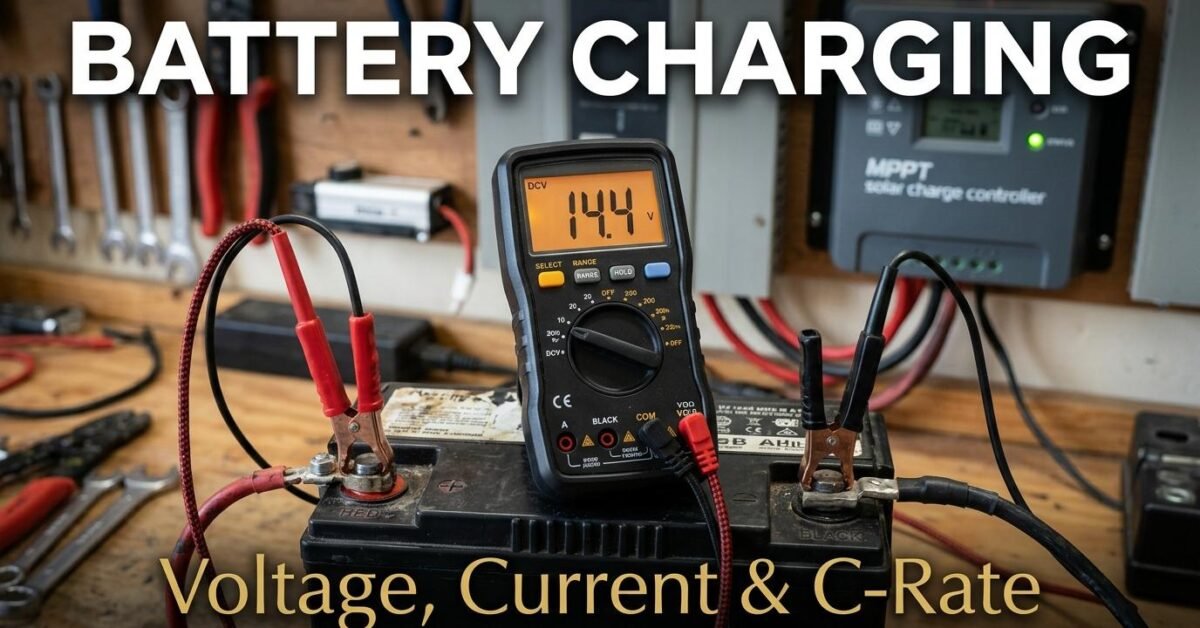
Every battery charges in the same fundamental sequence: current flows in, voltage rises, and the charger adjusts its behavior as the battery fills. But the specific voltages, currents, and timing differ by chemistry — and getting them wrong does not just slow the charge, it permanently damages the battery. This guide covers the charging process from the engineering perspective, with the exact numbers you need for LiFePO4, AGM, flooded lead-acid, and gel batteries.
The Three Charging Stages
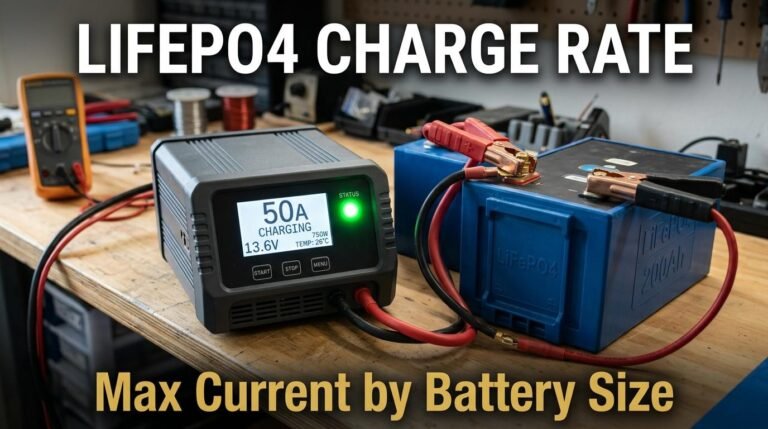
Stage 1 — Bulk charge. The charger pushes current into the battery at its maximum safe rate. The battery accepts all of it because it is well below full voltage. This stage delivers roughly 70 to 80 percent of the total charge. For a 200Ah LiFePO4 at 0.5C, bulk charge runs at 100 amps. For the same battery in AGM at 0.2C, bulk runs at 40 amps. The battery voltage rises steadily throughout bulk charge. This is the stage where solar panels and large chargers do their most productive work.
Stage 2 — Absorption (constant voltage). When the battery reaches its target charge voltage (14.6V for LiFePO4, 14.4V for AGM at 12V), the charger holds that voltage constant and the current gradually tapers as the battery’s internal resistance increases near full. LiFePO4 batteries have a very short absorption phase — sometimes only 10 to 15 minutes — because their internal resistance profile is different from lead-acid. Lead-acid batteries need a longer absorption phase, typically 30 to 120 minutes, to fully desulfate the plates and equalize cell voltages.
Stage 3 — Float (maintenance). Once the battery is full, the charger drops to a lower float voltage to maintain 100 percent without overcharging. LiFePO4 float is typically 13.6V, AGM is 13.5V, flooded is 13.2V. At float, current draw is minimal — just enough to offset the battery’s self-discharge. Some LiFePO4 systems skip float entirely because LiFePO4’s self-discharge is negligible, and prolonged float at elevated voltage offers no benefit.
See how kVA converts to real watts in our kVA to Watts Converter.
C-Rate: The Speed Limit
C-rate expresses charge or discharge current as a fraction of the battery’s capacity. 1C on a 200Ah battery means 200 amps. 0.5C means 100 amps. 0.1C means 20 amps. Each chemistry has safe C-rate limits:
| Chemistry | Standard Charge | Maximum Charge | 200Ah Example |
|---|---|---|---|
| LiFePO4 | 0.5C | 1C | 100A std / 200A max |
| AGM | 0.2C | 0.3C | 40A std / 60A max |
| Flooded | 0.1C | 0.2C | 20A std / 40A max |
| Gel | 0.1C | 0.2C | 20A std / 40A max |
Exceeding the maximum C-rate generates excess heat, which accelerates chemical degradation inside the cells. For lead-acid chemistries, chronic overcharging also boils electrolyte and warps plates. For LiFePO4, exceeding the BMS’s current limit triggers a protective shutdown — safe but inconvenient. The practical takeaway: size your charger and solar array to stay within the standard C-rate, and never exceed the maximum.
Charge Voltage Settings by Chemistry
| Chemistry | Bulk/Absorb (12V) | Float (12V) | Never Exceed |
|---|---|---|---|
| LiFePO4 | 14.4 – 14.6V | 13.6V | 15.0V |
| AGM | 14.4 – 14.6V | 13.5V | 14.8V |
| Flooded | 14.4 – 14.8V | 13.2V | 15.5V |
| Gel | 14.0 – 14.2V | 13.5V | 14.4V |
For 24V systems, double these values. For 48V, multiply by four. Gel batteries are the most voltage-sensitive — even 0.3V above the absorption limit damages the gel electrolyte permanently. This is why every quality MPPT charge controller has chemistry-specific presets, and why selecting the wrong preset is one of the most common system configuration errors.
Equalization Charging (Lead-Acid Only)
Flooded lead-acid batteries benefit from periodic equalization — a controlled overcharge at 15.5 to 16.0V for 2 to 4 hours that boils the electrolyte, mixes stratified acid layers, and forces lagging cells to catch up. Equalization is typically done every 30 to 90 days or when cell voltages diverge by more than 0.1V. AGM and gel batteries should never be equalized — the sealed construction cannot vent the gas produced, and the excess voltage damages the internal structure. LiFePO4 does not need equalization because the BMS handles cell balancing electronically during every charge cycle.
If your charge controller has an equalization setting, enable it only for flooded batteries. For AGM, gel, and LiFePO4, ensure it is disabled — a single equalization cycle on a gel battery can permanently reduce its capacity by 10 to 20 percent.
Temperature Compensation
Lead-acid charge voltage should be adjusted for temperature: add 0.005V per cell per degree below 25°C, subtract 0.005V per cell per degree above 25°C. A 12V battery (6 cells) at 10°C needs 6 × 0.005 × 15 = 0.45V added to the bulk voltage — 14.4V becomes 14.85V. At 40°C, subtract 0.45V — 14.4V becomes 13.95V. Most quality MPPT controllers include a temperature sensor that adjusts automatically. LiFePO4 batteries do not need temperature compensation for charging voltage, but they do need cold-weather protection: most LiFePO4 BMS units disable charging below 0°C to prevent lithium plating, which permanently reduces capacity.
Why This Matters for Solar
Solar charging is unique because the available current varies throughout the day — low in the morning, peak at noon, tapering in the afternoon, plus interruptions from clouds. A good MPPT controller manages all three charge stages automatically, transitioning from bulk to absorption to float as the battery fills, regardless of how the available solar current fluctuates. A PWM controller does not manage these transitions as effectively, which is one reason MPPT controllers harvest 15 to 30 percent more energy from the same panels.
Our Battery Charge & Discharge Calculator shows the exact charge voltage, current, and time for any battery you specify — enter your Ah, voltage, and chemistry, and it outputs every number your charge controller needs to be set to. If you are selecting a controller, our MPPT charge controller comparison covers the best options by amperage range.