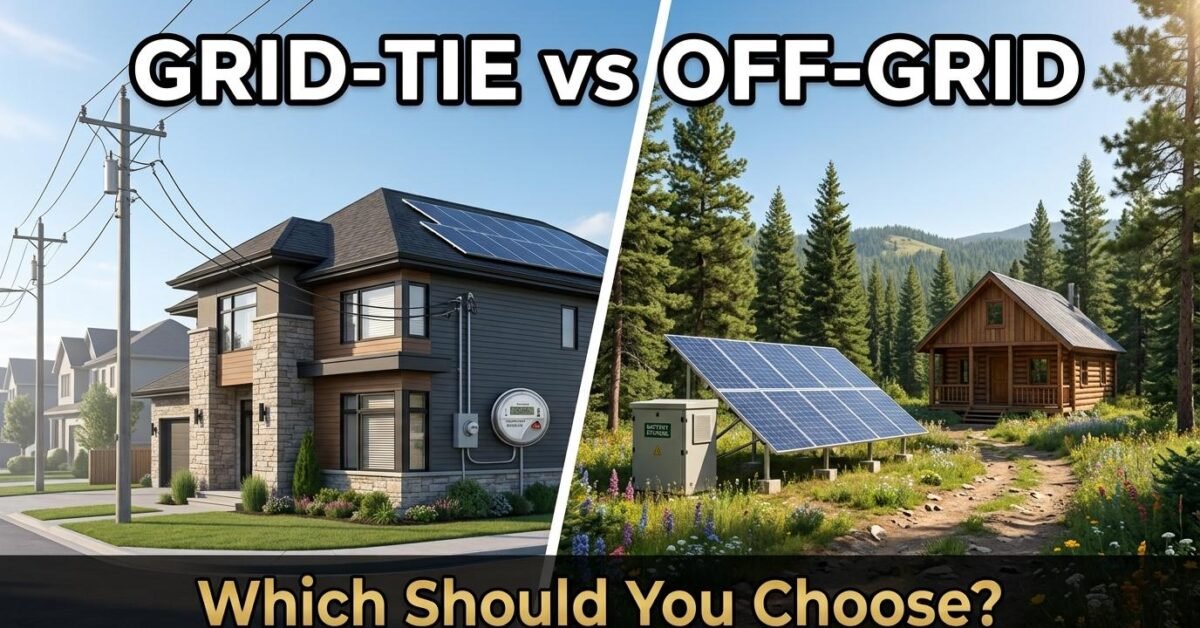
Choosing between grid-tie and off-grid solar is the first fork in the road for every solar buyer. It determines whether you need batteries at all, how much the system costs, how independent you are from the utility, and what happens when the grid goes down. This guide compares both approaches honestly — including the hybrid middle ground that most homeowners in 2026 actually choose — so you can pick the right architecture before sizing a single panel.
Grid-Tie Solar: Simplest and Cheapest
A grid-tie system connects your solar panels to the utility grid through an inverter. When your panels produce more than you use, excess flows to the grid and your meter spins backward (net metering). When you use more than the panels produce — at night or on cloudy days — you draw from the grid normally. There are no batteries.
The advantages are significant. Grid-tie is the cheapest system type because batteries are the most expensive component, and you skip them entirely. Installation is simpler with fewer components. Maintenance is minimal — panels and a grid-tie inverter, nothing else. And net metering effectively uses the grid as an infinite, free battery: you bank credits during the day and spend them at night.
The critical limitation is equally significant: when the grid goes down, your solar system shuts off. Grid-tie inverters are required by law to disconnect during outages to prevent feeding power into lines that utility workers are repairing. So even on a sunny day with panels on your roof, a grid-tie system provides zero power during a blackout. For homeowners in areas with reliable grid service and favorable net metering policies, this trade-off is acceptable. For those with frequent outages, it is not.
Off-Grid Solar: Full Independence
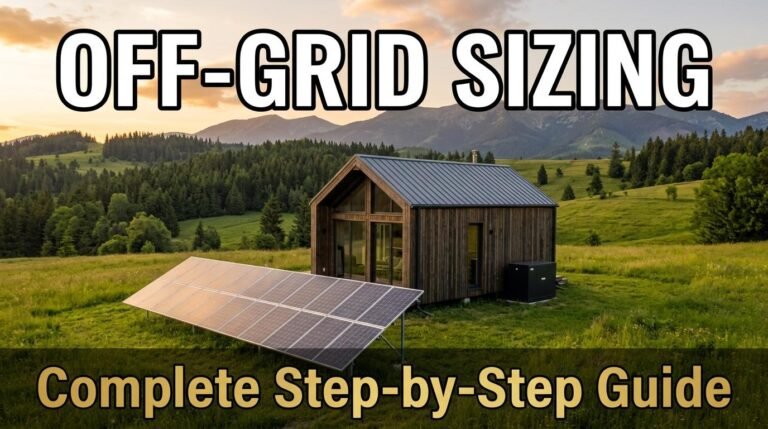
An off-grid system has no connection to the utility grid whatsoever. Your panels charge a battery bank, the battery bank powers your loads through an inverter, and a charge controller manages the charging process. You are completely energy-independent. No electricity bill, no net metering, no utility relationship at all.
The advantage is total autonomy. Power outages do not affect you. Utility rate increases do not affect you. You can build in locations with no grid access — remote cabins, farms, islands, developing regions. For a comprehensive walkthrough of sizing every component, see our off-grid solar system sizing guide.
The disadvantages are cost and complexity. Batteries alone can double the system cost compared to grid-tie. You need enough battery capacity to carry your loads through multiple cloudy days (1 to 3 days of autonomy), which requires a large bank. A backup generator is recommended for extended bad weather. And you must manage your energy use more carefully — there is no grid to fall back on if you exceed your system’s capacity on a high-usage day.
Hybrid Solar: The 2026 Sweet Spot
A hybrid system is grid-connected but includes a battery bank for backup. During normal operation, it works like a grid-tie system — panels power your home and excess goes to the grid. During an outage, the hybrid inverter disconnects from the grid and switches to battery power, keeping your essential loads running.
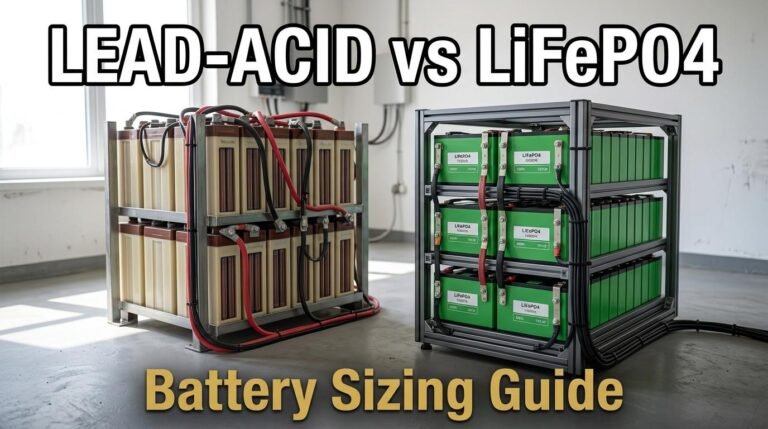
This is the most popular choice for US, UK, and Australian homeowners in 2026, and for good reason. You get the cost efficiency of grid-tie (smaller battery bank since the grid handles overnight most of the time), the safety net of battery backup during outages, and the independence to ride through blackouts without losing refrigerated food or internet access. The battery bank is sized for essentials-only backup — typically 8 to 12 hours — rather than the multi-day autonomy an off-grid system requires.
Our Solar System Calculator is designed around this hybrid approach. It lets you mark which appliances are backup-essential and size the battery bank on those loads for your chosen backup duration (hours or days), rather than forcing you to size for full off-grid autonomy.
Cost Comparison
For a typical 3 to 4 bedroom home using 30 kWh per day with 585-watt panels: a grid-tie system (panels plus grid inverter, no batteries) costs roughly 4,000 to 6,000 dollars for hardware. A hybrid system (panels, hybrid inverter, LiFePO4 essentials backup) costs 8,000 to 14,000 dollars. A full off-grid system (panels, off-grid inverter, large LiFePO4 bank for 2-day autonomy, charge controllers, backup generator) costs 18,000 to 30,000 dollars or more.
The jump from grid-tie to hybrid is mostly the battery cost. The jump from hybrid to full off-grid is the much larger battery bank plus the redundancy components (generator, additional charge controllers, heavier wiring). For most grid-connected homeowners, hybrid delivers 90 percent of the independence at 50 percent of the off-grid cost. For a full breakdown, see our solar system cost guide.
Net Metering: The Policy That Changes Everything
Net metering policies vary dramatically by location and are changing rapidly. In states with full retail net metering (you get credited at the full retail rate for excess), grid-tie and hybrid systems offer the best financial return. In states that have moved to reduced net metering or time-of-use rates, batteries become more valuable because storing your own solar for evening use saves more than exporting it for a low credit. Check your utility’s current policy — it is the single biggest factor in the financial case for each system type.
Which Should You Choose?
Choose grid-tie if you have reliable grid service, favorable net metering, and outages are rare and short. Choose hybrid if you want blackout protection for essentials without the cost and complexity of going fully off-grid — this is the right choice for most homeowners. Choose off-grid if you have no grid access, or if energy independence is a non-negotiable priority regardless of cost.
Whichever path you choose, the sizing process starts the same way: calculate your daily energy use, size your panels, and if batteries are involved, size them properly. The Solar System Calculator handles all three system types — enter your loads, choose your backup approach (none for grid-tie, essentials for hybrid, whole-load for off-grid), and get a complete component list with cost.