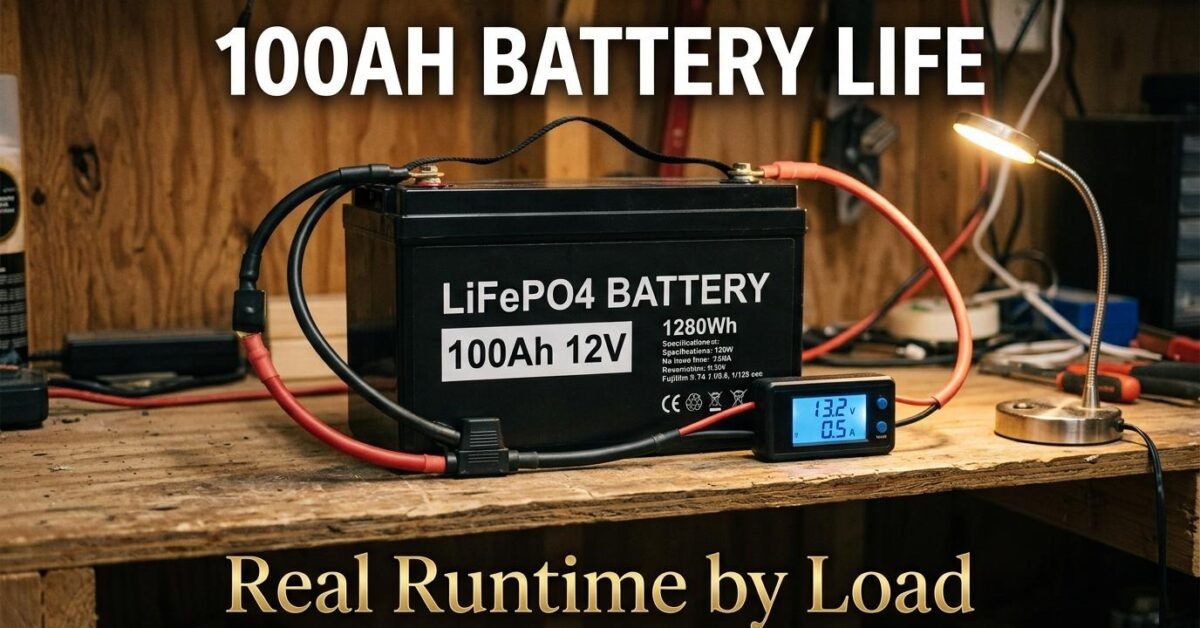
A 100Ah battery at 12V stores 1,200 watt-hours of energy, but you never get all 1,200. After accounting for depth of discharge and inverter losses, a LiFePO4 100Ah battery delivers about 1,020 usable watt-hours, and a lead-acid delivers about 540. The runtime from there depends on what you are running — and the answer ranges from over 24 hours for LED lights to barely one hour for an air conditioner.
The Runtime Formula
Runtime in hours = Usable watt-hours divided by load in watts. Usable Wh = Ah × Voltage × DoD × Inverter efficiency. For a 12V 100Ah LiFePO4 battery: 100 × 12 × 0.90 × 0.95 = 1,026 Wh usable. For lead-acid: 100 × 12 × 0.50 × 0.95 = 570 Wh usable. Our Battery Backup Calculator runs this formula automatically for any battery configuration and any load.
Runtime Table: 100Ah LiFePO4 at 12V
| Appliance | Watts | Runtime |
|---|---|---|
| LED lights (4 bulbs) | 40W | ~25 hours |
| Wi-Fi router | 15W | ~68 hours |
| Laptop | 65W | ~15 hours |
| Ceiling fan | 75W | ~13 hours |
| LED TV (50″) | 70W | ~14 hours |
| Refrigerator | 150W | ~6.5 hours |
| Desktop PC | 200W | ~5 hours |
| Washing machine | 400W | ~2.5 hours |
| Water pump 1HP | 750W | ~1.3 hours |
| AC 1-ton | 1,200W | ~50 minutes |
These figures assume a single load running alone. Combined loads divide the runtime proportionally: a refrigerator (150W) plus lights (40W) plus router (15W) draws 205W, giving about 5 hours on one 100Ah LiFePO4. Check your exact combination in the Battery Backup Calculator.
LiFePO4 vs Lead-Acid: The Runtime Gap
The same 100Ah battery gives nearly twice the runtime in LiFePO4 compared to lead-acid because of depth of discharge. LiFePO4 safely discharges to 90 percent of capacity (some to 95) while maintaining cycle life. Lead-acid should not be discharged below 50 percent or its lifespan drops dramatically. This means a lead-acid 100Ah runs that refrigerator for only about 3.5 hours versus 6.5 hours from LiFePO4. When you factor in cycle life — LiFePO4 lasts 4,000 to 6,000 cycles versus 300 to 500 for lead-acid — the cost per usable watt-hour over the battery’s life is actually lower for LiFePO4 despite the higher purchase price.
Multiple Batteries: Scaling the Runtime
Two 100Ah batteries in parallel double the capacity and double the runtime at any load. Three batteries triple it. The math is linear for parallel configurations. For series configurations (two 12V in series for a 24V system), the Ah stays the same but the voltage doubles — 100Ah at 24V is 2,400Wh total, giving the same runtime as two parallel 12V batteries. Our Solar System Calculator sizes the battery bank to match your specific load and desired backup duration, so you know exactly how many batteries to buy.
100Ah at 24V and 48V
The same 100Ah rating at a higher voltage stores proportionally more energy. A 100Ah 24V LiFePO4 battery stores 2,400 Wh raw and delivers about 2,050 Wh usable — double the 12V version. A 100Ah 48V battery stores 4,800 Wh and delivers about 4,100 usable. So when someone says “I have a 100Ah battery,” the voltage matters enormously: that refrigerator that lasts 6.5 hours on 100Ah at 12V lasts 13 hours on 100Ah at 24V and 26 hours on 100Ah at 48V. Always specify voltage when discussing battery capacity — Ah alone is meaningless without it.
Temperature and Age Effects
Cold temperatures reduce effective capacity. A LiFePO4 battery at 0 degrees Celsius delivers roughly 80 to 85 percent of its rated capacity. At minus 10, it drops to 60 to 70 percent and most LiFePO4 batteries should not be charged below freezing without a heated BMS. Lead-acid handles cold slightly better for discharge but suffers even more from reduced capacity. If you are planning backup power for winter outages, size your bank for the cold-weather derating, not the label rating.
Age also reduces capacity. A LiFePO4 battery retains about 80 percent of its original capacity after 4,000 cycles — so your 100Ah battery effectively becomes an 80Ah battery after roughly 10 years of daily cycling. Lead-acid degrades much faster, losing significant capacity within 300 to 500 cycles. Our Panel Degradation Calculator models panel output decline over time — apply the same thinking to your battery: size for the capacity you will have in year five, not year one.
What Drains a 100Ah Battery Fastest
Motor-driven loads with startup surge are the biggest consumers. An air conditioner at 1,200W drains the battery in under an hour of runtime, and its 3x startup surge stresses the inverter. Water pumps are similar — the runtime is short and the surge is harsh. If you need to run these loads on battery, you almost certainly need more than 100Ah. The sweet spot for a single 100Ah battery is lights, fans, electronics, router, and phone charging — the essentials during a power outage, comfortably covered for 4 to 8 hours. Add a refrigerator and you need two batteries. Add AC and you need a fundamentally different system — size it in our Solar System Calculator.