Learning how to calculate solar energy savings is the first step toward knowing whether solar makes financial sense for your home. The calculation is not complicated, but most guides oversimplify it by ignoring electricity rate increases and panel degradation — two factors that compound over 25 years and dramatically change the real savings number. This guide walks through the complete formula, then shows you how to run it instantly in our Solar Savings Calculator.
The Solar Savings Formula
At its core, solar savings equal the electricity costs you avoid by generating your own power. The annual savings in year one are straightforward: Monthly bill × 12 × Solar offset percentage. If your bill is 150 dollars per month and solar covers 100 percent of your usage, year one savings are 1,800 dollars. But this is only the starting point — the real value comes from compounding over time.
Electricity rates increase every year. The US national average has risen about 3 to 5 percent annually over the past decade, and many markets see 6 to 8 percent. A bill of 150 dollars per month today becomes about 250 dollars per month in 10 years at a 5 percent annual increase, and over 400 dollars per month by year 25. Solar locks in your energy cost at zero (or near-zero), so the savings grow every year as the rate you are avoiding gets higher.
Step 1: Know Your Monthly Consumption
Check your electricity bill for two numbers: your monthly bill amount in dollars and your electricity rate per kWh. Divide the bill by the rate to get your monthly consumption in kWh. For example, a 150-dollar bill at 0.15 dollars per kWh means you use 1,000 kWh per month. This consumption figure is what your solar system needs to match.
Step 2: Calculate Your Net System Cost
The net system cost is what you actually pay after incentives. In the US, the federal Investment Tax Credit covers 30 percent of the total installed cost. A system costing 12,000 dollars has a net cost of 8,400 dollars after the ITC. Some states offer additional rebates that reduce this further. The UK offers the Smart Export Guarantee for excess production, and Australian states have various rebate programs. Our solar system cost guide breaks down every cost component in detail.
Step 3: Model the 25-Year Savings
This is where most simple calculations fail. A proper 25-year model accounts for three compounding factors. First, electricity rate inflation — your avoided cost rises each year. Second, panel degradation — solar panels lose about 0.5 percent of their output per year, so by year 25 they produce about 87.5 percent of their original output. Third, the time value of money — a dollar saved in year 20 is worth less than a dollar saved today, though for a simple comparison, nominal savings are what most homeowners care about.
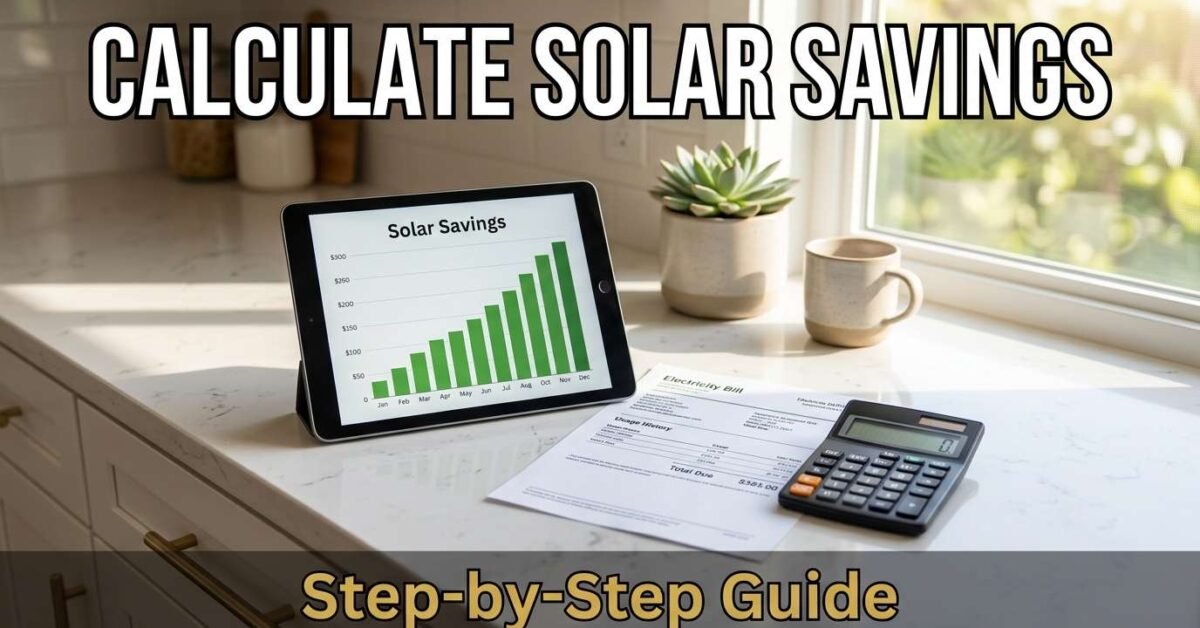
Our Solar Savings Calculator models all three factors year by year, with an expandable table showing every year’s bill, savings, cumulative total, and net position (profit or loss) so you can see exactly when the system crosses into positive territory.
Step 4: Find Your Payback Period
The payback period is the month when your cumulative savings equal your net system cost — the break-even point. After that month, every dollar of savings is pure profit. For a typical US home with a 150-dollar monthly bill, a 12,000-dollar system with the 30 percent ITC, and a 5 percent annual rate increase, the payback period is roughly 4 to 6 years. After payback, the system generates free electricity for the remaining 19 to 21 years of its warranted life.
Step 5: Calculate Your ROI
Return on investment for solar is: (25-year cumulative savings minus net system cost) divided by net system cost, times 100. Using the example above, if 25-year cumulative savings total 65,000 dollars and the net system cost was 8,400 dollars, the ROI is (65,000 – 8,400) / 8,400 × 100 = 674 percent. That is not a typo — solar ROI is extraordinarily high because the “investment” is a one-time purchase while the “returns” compound annually for 25 years with zero additional input.
What Changes the Numbers Most
Three inputs have the largest impact on your savings calculation. The electricity rate increase percentage has the biggest effect — at 3 percent annual increase, 25-year savings might be 45,000 dollars; at 7 percent, they could reach 95,000 dollars. The tax credit or rebate percentage has the second-largest impact because it directly reduces the net cost you need to recoup. And the system cost itself matters for the payback period but less for the total savings, since a more expensive system that covers more of your bill also saves more each year.
If you are comparing quotes from different installers, run each system cost through the Solar Savings Calculator at the same rate and inflation assumptions. The one with the shortest payback at your actual electricity rate is the best financial choice — not necessarily the cheapest system.
Calculate Your Solar Savings Now
Our Solar Savings Calculator does everything above in seconds. Enter your monthly bill, electricity rate, annual rate increase, system cost, and tax credit — see your payback period, 25-year net savings, ROI, and a full year-by-year breakdown. All inputs are editable for any currency and any market. If you also need to size the system itself, our Solar System Calculator walks you through panels, batteries, inverter, and cost.