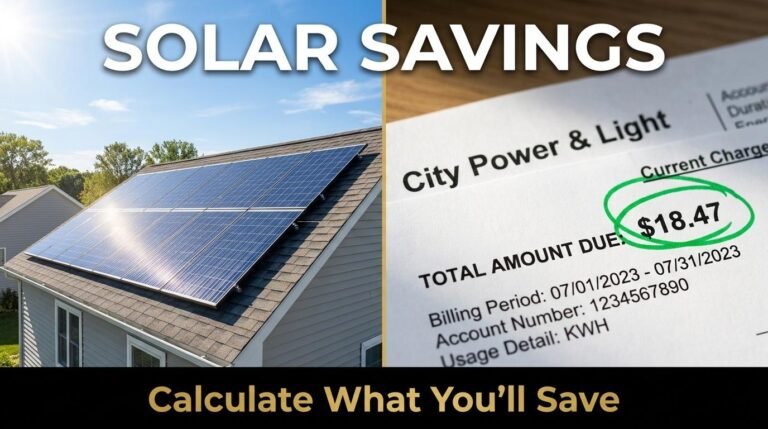
How much do solar panels save per month? The short answer: most homeowners save 80 to 100 percent of their electricity bill if the system is sized correctly. The dollar amount depends on what you currently pay. This guide gives you real monthly savings figures by bill size, then shows you how to calculate your exact number.
Monthly Savings by Current Bill Size
If your current monthly electricity bill is 100 dollars and solar covers 100 percent of your usage, you save 100 dollars per month in year one — and more each subsequent year as electricity rates rise. At a 5 percent annual rate increase, that 100-dollar monthly savings becomes 128 dollars per month by year 5, 163 dollars by year 10, and 339 dollars by year 25.
For a 200-dollar monthly bill, year-one savings are 200 dollars per month, growing to 339 dollars by year 10. For a 300-dollar bill, savings start at 300 dollars per month and grow to 508 dollars by year 10. The higher your bill, the more you save — and the faster your system pays for itself.
Monthly Savings vs Monthly Loan Payment
Many homeowners finance their solar system with a solar loan rather than paying cash. The key metric is whether your monthly loan payment is less than your monthly electricity savings. If your savings are 150 dollars per month and your loan payment is 120 dollars per month, you are cash-flow positive from day one — you save 30 dollars per month even while paying for the system. After the loan is paid off, the full 150 dollars (and growing) is pure savings.
Most solar loans in the US are structured so monthly payments are deliberately lower than expected savings, creating immediate positive cash flow. This makes the effective cost of going solar negative — you spend less total per month with solar plus a loan than you did with just an electricity bill.
What Reduces Monthly Savings
Partial offset reduces savings proportionally — if solar covers 80 percent of your bill instead of 100 percent, you save 80 percent of your bill amount. Shading, poor roof orientation, or an undersized system reduce the solar offset percentage. In areas without net metering, excess daytime production is wasted unless you have battery storage, reducing your effective offset. And electricity rate decreases (rare but possible in some markets) would reduce future savings growth, though rates have historically only increased.
Monthly Savings in Year 1 vs Year 10 vs Year 25
The beauty of solar savings is that they grow every year while your system cost stays fixed. At a 5 percent annual electricity rate increase, a homeowner saving 150 dollars per month in year one saves 244 dollars per month by year 10 and 508 dollars per month by year 25. A homeowner saving 200 dollars per month in year one saves 326 dollars by year 10 and 677 dollars by year 25. Over the full 25 years, the cumulative savings from a 150-dollar monthly bill exceed 85,000 dollars — against a one-time system cost of 8,000 to 12,000 dollars after incentives.
This compounding effect is the core reason solar is such a strong financial decision. You are not just saving today’s rate — you are locking in protection against 25 years of rate increases that you would otherwise pay with no alternative.
Savings with Battery Storage vs Without
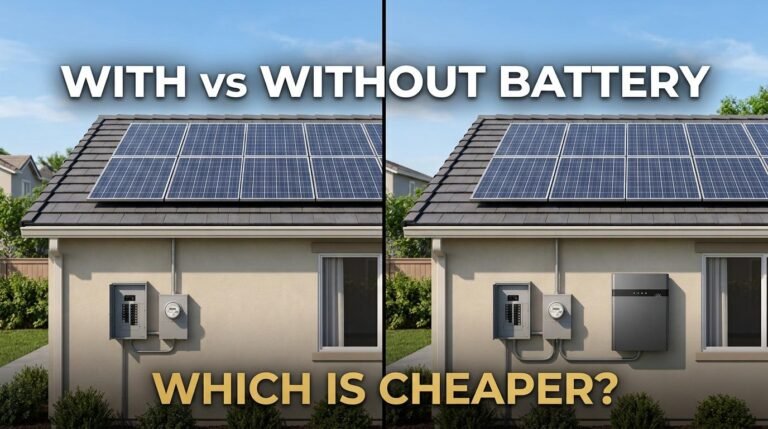
Monthly savings with battery storage depend heavily on your utility’s net metering policy. If your utility offers full retail net metering — meaning you get credited at the same rate for excess solar you export as you pay for electricity you import — then batteries do not increase your savings at all. The grid acts as a free battery. You export surplus during the day, import at night, and the credits cancel out.
If your utility has reduced net metering, time-of-use rates, or no net metering, batteries increase savings by letting you self-consume more of your production instead of exporting it at a low rate and importing at a high rate. In these scenarios, batteries can increase your effective monthly savings by 20 to 40 percent compared to a grid-only solar system. However, the battery cost (typically 4,000 to 8,000 dollars for a residential LiFePO4 unit) must be weighed against this incremental savings — in many cases, the battery payback period is longer than the panel payback period.
Does Solar Eliminate Your Bill Completely?
In most cases, solar reduces your bill by 80 to 100 percent but does not eliminate it entirely. Most utilities charge a fixed monthly connection fee of 10 to 25 dollars regardless of your consumption. Some charge demand charges based on your peak usage. And if your system covers less than 100 percent of your consumption (common during high-use summer months with AC), you will have a small variable charge. The realistic expectation is a bill reduction of 80 to 95 percent, with a residual monthly charge of 10 to 40 dollars for the grid connection and any uncovered usage.
Calculate Your Monthly Savings
Our Solar Savings Calculator shows your exact monthly savings in year one and how they grow over 25 years. Enter your monthly bill, your rate, and your system cost — see the payback period, ROI, and full year-by-year projection. If you need to know what system to install, our Solar System Calculator sizes everything from your appliances or your bill.
Calculate your monthly savings now →
☀️ Get Free Solar Quotes
Tell us about your home — get matched with qualified solar installers in your area. Free, no obligation.
By submitting you consent to being contacted by solar professionals regarding your inquiry. See our privacy policy.
⚡ Free Solar Sizing Cheat Sheet
Get our one-page guide to sizing panels, batteries and inverters — plus weekly solar tips. No spam, unsubscribe anytime.
By subscribing you agree to our privacy policy. We'll email your guide and occasional solar tips — never spam.