Calculating solar power savings comes down to one question: how much of your electricity bill can solar eliminate, and how long does it take to recoup the system cost? The answer depends on three inputs — your electricity rate, how that rate will increase over time, and what you pay for the solar system after incentives. This guide walks through the calculation and our Solar Savings Calculator runs it in seconds.
The Solar Savings Formula
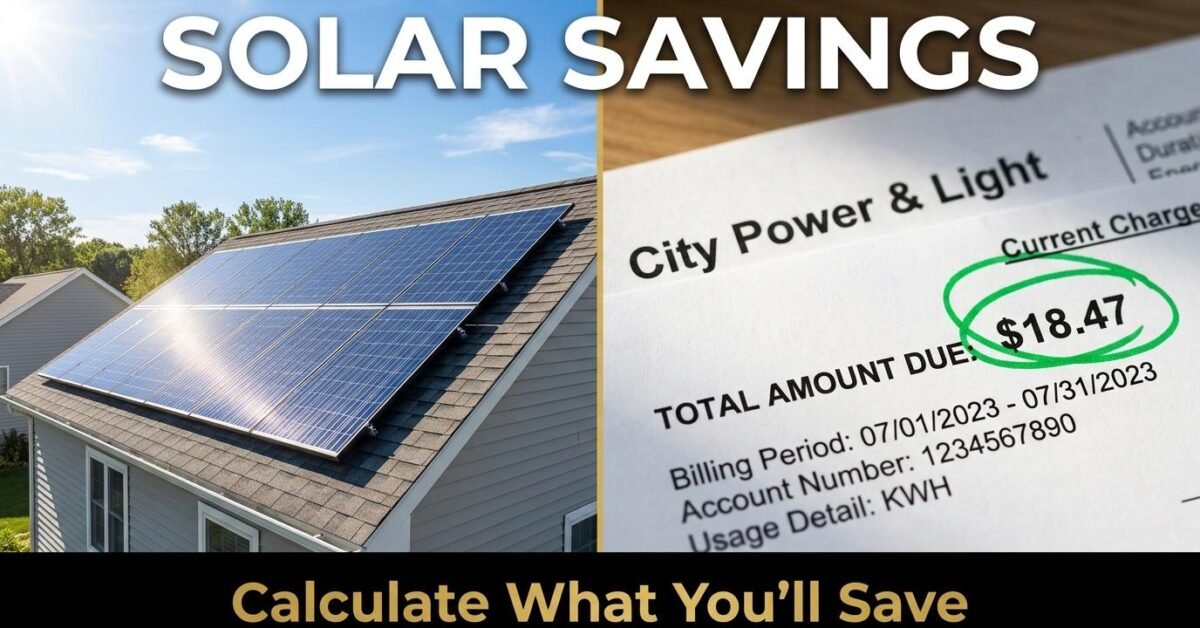
Annual savings in year one equal your monthly electricity bill times 12 times the percentage your solar system offsets. If your bill is 150 dollars per month and solar covers 100 percent of your consumption, year one savings are 1,800 dollars. But this is only the starting point — electricity rates rise every year, which means your savings grow every year too.
At a 5 percent annual rate increase, that 1,800 dollars becomes 2,330 dollars by year 5, 2,930 dollars by year 10, and 6,100 dollars by year 25. The cumulative savings over 25 years at 5 percent annual rate increase exceed 86,000 dollars from a 150-dollar monthly bill — against a net system cost of roughly 8,400 dollars (12,000 dollar system minus the 30 percent federal ITC). That is a net profit of over 77,000 dollars and an ROI above 900 percent.
What Inputs Matter Most
The electricity rate increase percentage has the largest impact on total savings. At 3 percent annual increase, 25-year savings from the same system total about 65,000 dollars. At 7 percent, they reach 120,000 dollars. The difference between conservative and aggressive rate assumptions is 55,000 dollars — which is why our Solar Savings Calculator lets you adjust this slider and see the impact in real time.
The system cost is the second biggest factor for the payback period (how fast you break even), but not for total savings. A more expensive system that covers more of your bill produces higher annual savings. The tax credit percentage directly reduces the net cost — the US 30 percent ITC turns a 15,000 dollar system into a 10,500 dollar investment. Every dollar of incentive shortens the payback by reducing the amount you need to recoup.
Step-by-Step Calculation
Step 1: Find your monthly electricity bill and your rate per kWh (both are on your utility bill). If you are not sure of your rate, use our Electricity Bill Calculator to calculate it from your appliances.
Step 2: Determine your net system cost. Take the total installed cost (get quotes from 2 to 3 installers, or estimate with our Installation Cost Calculator), subtract the federal tax credit (30 percent in the US through 2032), and subtract any state or local rebates.
Step 3: Enter both numbers into the Solar Savings Calculator along with your expected annual rate increase (US average is 3 to 5 percent, many developing markets see 6 to 10 percent). The calculator models every year for 25 years with rate inflation and panel degradation, showing you the exact payback month, cumulative savings, ROI percentage, and a year-by-year breakdown.
Solar Savings by Bill Size
Here is what a typical US homeowner saves over 25 years at a 5 percent annual rate increase, assuming 100 percent solar offset and a 12,000 dollar system with the 30 percent ITC (8,400 dollar net cost):
| Monthly Bill | Year 1 Savings | Payback | 25-Year Net Profit | ROI |
|---|---|---|---|---|
| $100/month | $1,200 | ~6 years | ~$49,000 | ~580% |
| $150/month | $1,800 | ~4.5 years | ~$77,000 | ~920% |
| $200/month | $2,400 | ~3.5 years | ~$106,000 | ~1,260% |
| $300/month | $3,600 | ~2.5 years | ~$163,000 | ~1,940% |
These numbers look extraordinary because the “return” compounds annually for 25 years while the “investment” is a one-time cost. No other home improvement produces this kind of return — not kitchen renovations, not new roofing, not landscaping.
Solar Savings in Other Countries
The savings equation works the same globally, but the inputs change dramatically. In Pakistan and India, electricity rates have been rising 8 to 15 percent annually, which means the 25-year savings curve is steeper — a system that costs 500,000 PKR pays for itself in 2 to 3 years at current rate trajectories. In Australia, high retail rates of 0.30 to 0.40 AUD per kWh combined with strong solar resources produce some of the fastest paybacks globally — under 3 years in Queensland and Western Australia. In the UK and Northern Europe, lower solar hours (3 to 4 peak hours versus 5 to 6 in sunnier regions) extend the payback by 1 to 2 years, but rising electricity rates still produce strong returns over 25 years.
Factors That Reduce Savings
Low electricity rates (below 0.10 dollars per kWh) extend the payback period because each kWh of solar production saves less money. Partial offset (solar covering 60 to 80 percent of your bill instead of 100 percent) reduces savings proportionally. Poor net metering policies mean excess daytime production is exported at low rates instead of offsetting nighttime consumption at full retail. And panel degradation of 0.5 percent per year means your system produces about 12.5 percent less energy at year 25 than at year 1 — our calculator models this automatically.
Calculate Your Solar Power Savings Now
Our Solar Savings Calculator does everything above in seconds. Enter your monthly bill, electricity rate, annual rate increase, system cost, and tax credit — see your payback period, 25-year net savings, ROI, and a full year-by-year breakdown. If you need to know what system size to install, start with the Solar System Calculator to size panels, battery, and inverter from your appliance list.
Calculate your solar power savings now →
☀️ Get Free Solar Quotes
Tell us about your home — get matched with qualified solar installers in your area. Free, no obligation.
By submitting you consent to being contacted by solar professionals regarding your inquiry. See our privacy policy.
⚡ Free Solar Sizing Cheat Sheet
Get our one-page guide to sizing panels, batteries and inverters — plus weekly solar tips. No spam, unsubscribe anytime.
By subscribing you agree to our privacy policy. We'll email your guide and occasional solar tips — never spam.