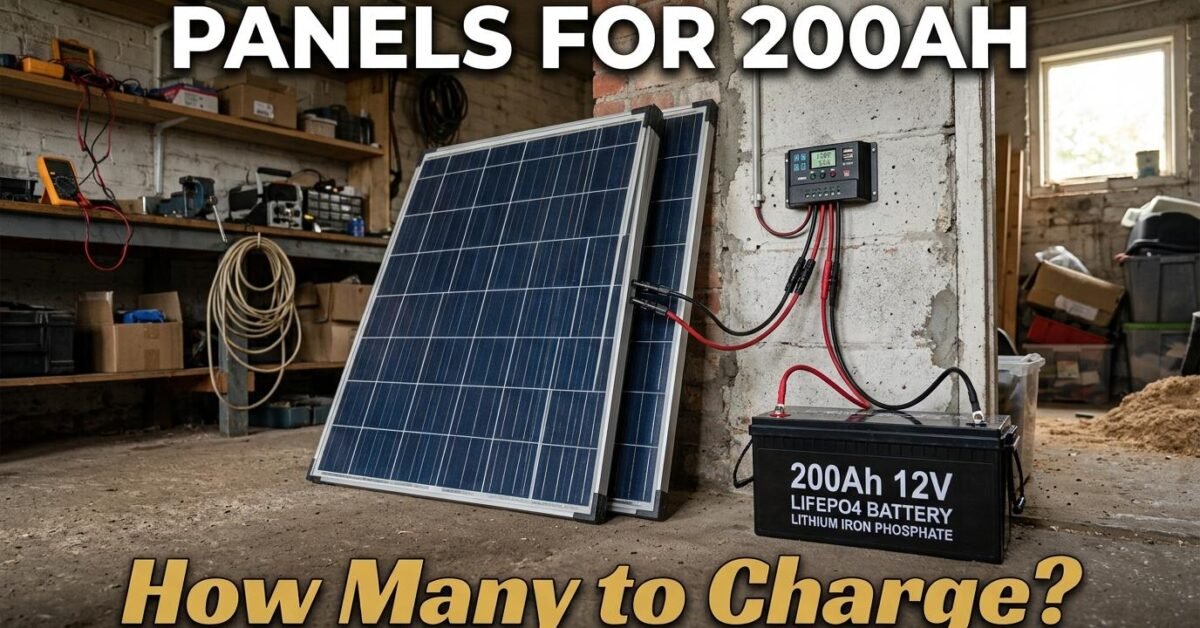
To charge a 200Ah 12V LiFePO4 battery from empty in one sunny day, you need roughly 400 to 800 watts of solar panels — that is two to four standard 200W panels, or one to two larger 400W panels. The exact number depends on how deeply you discharge the battery each day, how many sun hours your location gets, and what system losses you account for. This guide shows the complete calculation, step by step, with the real engineering factors that most quick answers skip.
The Calculation: Step by Step
Step 1: How much energy needs replacing? A 200Ah 12V battery stores 2,400 Wh. If you use 50 percent each day (1,200 Wh consumed), that is the energy your panels need to replace. At 80 percent daily discharge, you need to replace 1,920 Wh. The deeper you discharge, the more solar you need. Our Battery Charge & Discharge Calculator computes this from your actual load.
Step 2: Account for charging losses. Not every watt from the panel reaches the battery. LiFePO4 charge efficiency is about 98 percent, MPPT controller efficiency is 97 percent, and wiring plus dust losses take another 5 to 8 percent. The combined system derating is roughly 0.82 — meaning you need to produce about 22 percent more energy than the battery actually stores. At 50 percent DoD: 1,200 Wh ÷ 0.82 = 1,463 Wh from the panels.
Step 3: Divide by sun hours. If your location gets 5 peak sun hours per day: 1,463 Wh ÷ 5 hours = 293 watts of array. With a 25 percent safety margin (for cloudy days and non-optimal tilt): 293 × 1.25 = 366 watts. Round up to 400W — that is two 200W panels.
Step 4: At 80 percent daily DoD (heavier use): 1,920 Wh ÷ 0.82 ÷ 5 hours × 1.25 = 585W — three 200W panels. At lower sun hours (4 hours — UK, northern US): the same 50 percent DoD becomes 1,463 ÷ 4 × 1.25 = 457W — either two 250W or three 200W panels.
Quick Reference Table
| Daily DoD | 5 Sun Hours | 4 Sun Hours | 3 Sun Hours |
|---|---|---|---|
| 30% (light use) | 1× 200W | 2× 200W | 2× 200W |
| 50% (moderate) | 2× 200W | 2-3× 200W | 3× 200W |
| 80% (heavy) | 3× 200W | 4× 200W | 5× 200W |
| 100% (full cycle) | 4× 200W | 5× 200W | 6× 200W |
MPPT Charge Controller Sizing
The charge controller must handle both the current from the panels and the voltage of the panel string. For a 400W array on a 12V bank: controller amps = 400W ÷ 12V × 1.25 safety = 42A — you need a 50A MPPT controller. For 600W: 63A — a 60A or 80A controller. The controller’s PV input voltage must exceed the panel string’s open-circuit voltage at the coldest temperature your installation will experience. Two 200W panels in series have a combined Voc of roughly 49V at room temperature and up to 54V in cold weather — a 100V input controller handles this comfortably. Our MPPT controller guide compares the best options by size.
Different Battery Voltages: 24V and 48V
The same 200Ah capacity at 24V stores twice the energy (4,800 Wh), so it needs twice the solar array to charge. At 50 percent DoD with 5 sun hours: 2,400 Wh ÷ 0.82 ÷ 5 × 1.25 = 732W — four 200W panels. The advantage: the MPPT controller handles this at half the current (732 ÷ 24 × 1.25 = 38A instead of 76A), so you need a cheaper 40A controller instead of an 80A unit, and thinner cables throughout the DC side. At 48V the same 200Ah stores 9,600 Wh and needs roughly 1,465W of panels — but the controller current is only 38A, and the cable from controller to battery can be remarkably thin for the power being transferred.
Charge Time in Real Conditions
The calculation above sizes the array to replace daily usage over a full day of sun. But the actual charge time — how many hours of sun to go from empty to full — depends on the charge rate the battery accepts. A 200Ah LiFePO4 at 0.5C accepts 100A of charge current. A 400W array on 12V produces about 28A through the MPPT controller (400W ÷ 14.4V). At 28A, charging 200Ah from 20 percent to 100 percent (160Ah to refill) takes 160 ÷ 28 ÷ 0.98 = approximately 5.8 hours of peak sun. An 800W array produces 56A and cuts that to about 2.9 hours. More panels means faster charging — but only up to the battery’s C-rate limit. Beyond 100A (0.5C) for LiFePO4, additional panel capacity cannot be absorbed during bulk charge and sits idle until the battery drops back below the absorption threshold.
What About Lead-Acid?
The same 200Ah battery in AGM or flooded lead-acid changes the calculation in two ways. First, you can only safely discharge to 50 percent, so a “200Ah lead-acid” delivers the same usable energy as a 100Ah LiFePO4. Second, charge efficiency drops from 98 to 85 percent, meaning more panel energy is wasted as heat during charging. The result: lead-acid needs about 30 percent more solar panel capacity than LiFePO4 for the same daily cycle.
Wire Sizing for Panel-to-Controller
At 12V, charge currents are high. A 400W array through an MPPT controller produces about 35A of charge current into the battery. The cable from controller to battery must handle this continuously — use our Wire Gauge Calculator to determine the correct AWG for your run length. Undersized wire wastes energy as heat and creates fire risk. On a 12V system, this is often the thickest and most expensive cable in the entire installation.
Enter your exact battery, load, and sun hours into our Battery Charge & Discharge Calculator — it runs the complete calculation including panel count, MPPT sizing, charge time, and runtime, with all formulas shown so you understand every number.