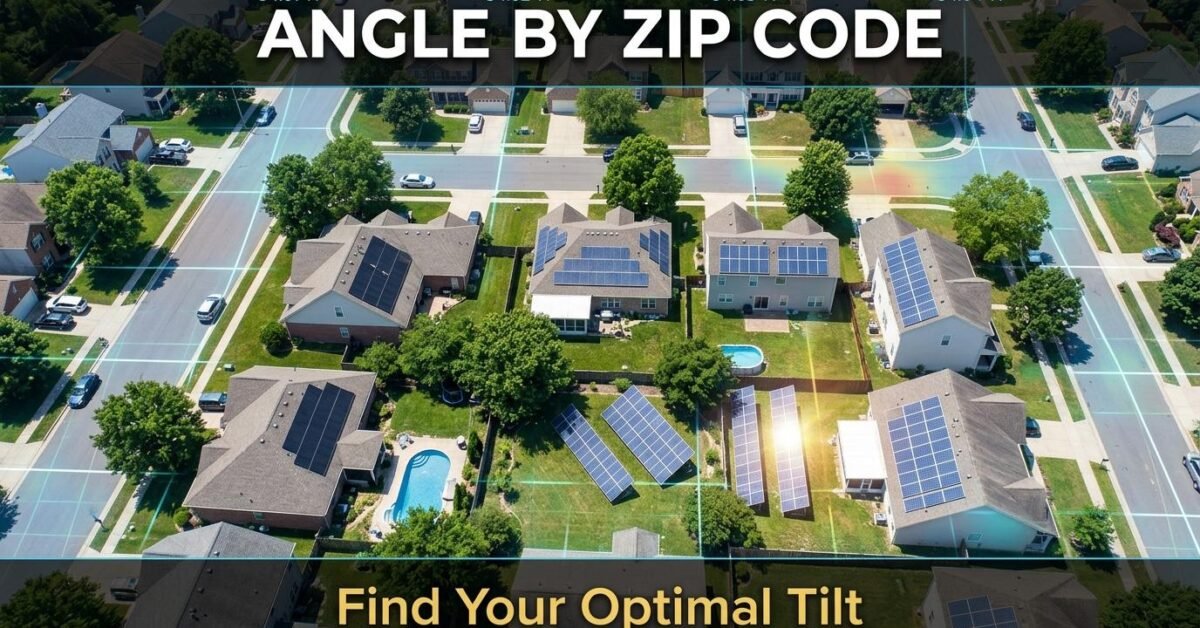
Your optimal solar panel angle depends on your latitude, which is determined by your zip code. Every location in the US falls between 25 and 49 degrees latitude, which means the optimal panel tilt ranges from 25 degrees (South Florida, South Texas) to 49 degrees (northern Washington, northern Minnesota). Our Solar Panel Angle Calculator finds the exact angle for any location worldwide — enter your latitude or select a city and get the optimal fixed tilt plus seasonal adjustments.
Solar Panel Angle by US Region
| Region | Latitude Range | Optimal Fixed Tilt | Example Cities |
|---|---|---|---|
| Deep South (FL, TX, LA, HI) | 19° – 31° | 19° – 31° | Miami (26°), Houston (30°), Honolulu (21°) |
| Sun Belt (AZ, NM, CA, GA, SC) | 31° – 35° | 31° – 35° | Phoenix (33°), LA (34°), Atlanta (34°) |
| Mid-Atlantic / Midwest (VA, OH, IN, MO) | 36° – 41° | 36° – 41° | DC (39°), St. Louis (39°), Columbus (40°) |
| Northeast / Upper Midwest (NY, MA, MN, WI) | 41° – 45° | 41° – 45° | NYC (41°), Boston (42°), Minneapolis (45°) |
| Pacific NW / Northern (WA, OR, MT, ND) | 45° – 49° | 45° – 49° | Seattle (48°), Portland (46°), Fargo (47°) |
How to Find Your Latitude From Your Zip Code
The easiest method: type your zip code into Google Maps, right-click on your location, and the latitude appears at the top of the menu. The first number is your latitude. Alternatively, search “latitude of [your city]” and Google displays it directly. Round to the nearest whole number — that is your optimal fixed tilt angle. For more precision with seasonal adjustments and monthly angles, enter the latitude into our Solar Panel Angle Calculator.
Does a Few Degrees Really Matter?
Within 5 degrees of optimal, the energy loss is under 2 percent — effectively negligible. Within 10 degrees, the loss is 3 to 5 percent. Within 15 degrees, 5 to 10 percent. Most residential roofs have a pitch between 18 and 35 degrees (4:12 to 8:12 slope), which falls within the optimal range for the majority of US latitudes. Unless your roof pitch is more than 15 degrees away from your latitude, flush-mounting panels on the existing roof slope is the most cost-effective approach.
The exception is flat roofs (0 degrees) and very steep roofs (above 45 degrees). On a flat roof, tilted racking that raises panels to the optimal angle gains 15 to 35 percent more energy — a significant improvement that justifies the extra racking cost. On a very steep roof, the loss from over-tilt is 5 to 15 percent depending on latitude, and mounting panels at a shallower angle than the roof requires specialized racking that may not be worth the cost.
International Angles
The latitude-equals-tilt rule works globally. Pakistan (24-37 degrees latitude) should tilt panels to 24-37 degrees facing south. Australia (12-43 degrees latitude) should tilt to 12-43 degrees facing north. The UK (50-58 degrees latitude) should tilt to 50-58 degrees facing south — steeper than most UK roof pitches, which is why ground-mount and adjustable racking systems produce meaningfully more energy in Northern Europe than flush-mounted rooftop systems.
Flat Roof Solar Panel Angle
Flat commercial roofs are the one case where tilt optimization makes a big difference. A panel lying flat on a 0-degree roof at 40 degrees latitude produces roughly 25 percent less energy annually than the same panel tilted to 40 degrees. On a flat roof, ballasted tilt racking is standard — weighted frames hold panels at the correct angle without penetrating the roof membrane. The tradeoff is inter-row spacing: tilted panels cast shadows behind them, so rows must be spaced apart to avoid shading. This spacing reduces the total number of panels that fit compared to a flush layout. The optimal compromise for most flat roofs is a tilt of 10 to 15 degrees — enough to gain 10 to 15 percent over flat, with minimal inter-row spacing requirements and good self-cleaning (rain washes dust off tilted panels more effectively than flat ones).
Snow, Wind, and Tilt Considerations
In snowy climates, steeper tilt angles help panels shed snow faster. A panel at 35 degrees clears snow within hours of a storm ending; a panel at 15 degrees may hold snow for days, blocking production entirely. If you live in a region with heavy snowfall, adding 5 to 10 degrees beyond the latitude-optimal angle specifically to improve snow shedding is a common and justified practice — the small loss in summer production is more than offset by the weeks of winter production recovered from faster snow clearing.
Wind loading is the opposite consideration. Steeper panels catch more wind, creating higher uplift forces on the racking and roof structure. Building codes in high-wind zones (coastal areas, hurricane regions) may limit maximum tilt angle or require engineering certification for tilt racking. If your area is subject to high winds, verify that your planned tilt angle meets local wind load requirements before installation. Our Roof Space Calculator estimates panel count for any roof, and the Angle Calculator provides the optimal tilt to aim for.
Adjustable vs Fixed: What the Data Shows
A fixed mount at the optimal annual tilt captures about 71 percent of the total solar energy available at your location (the rest is lost to weather, hours of darkness, and non-perpendicular sun angles at dawn and dusk). A seasonal adjustment (twice a year) captures about 75 percent. A single-axis tracker captures about 82 percent. A dual-axis tracker captures about 85 percent — the theoretical maximum for a flat-plate collector.
For most residential and commercial installations, the 4 percent gain from seasonal adjustment and the 11 percent gain from tracking do not justify the added cost and complexity. Fixed tilt at latitude is the standard recommendation for rooftop systems. Ground-mount systems with seasonal adjustment are the sweet spot for off-grid and rural installations where the labor cost of adjustment is minimal.
Find your exact angle, seasonal adjustments, and monthly tilt schedule in our Solar Panel Angle Calculator. Then size your complete system in the Solar System Calculator.