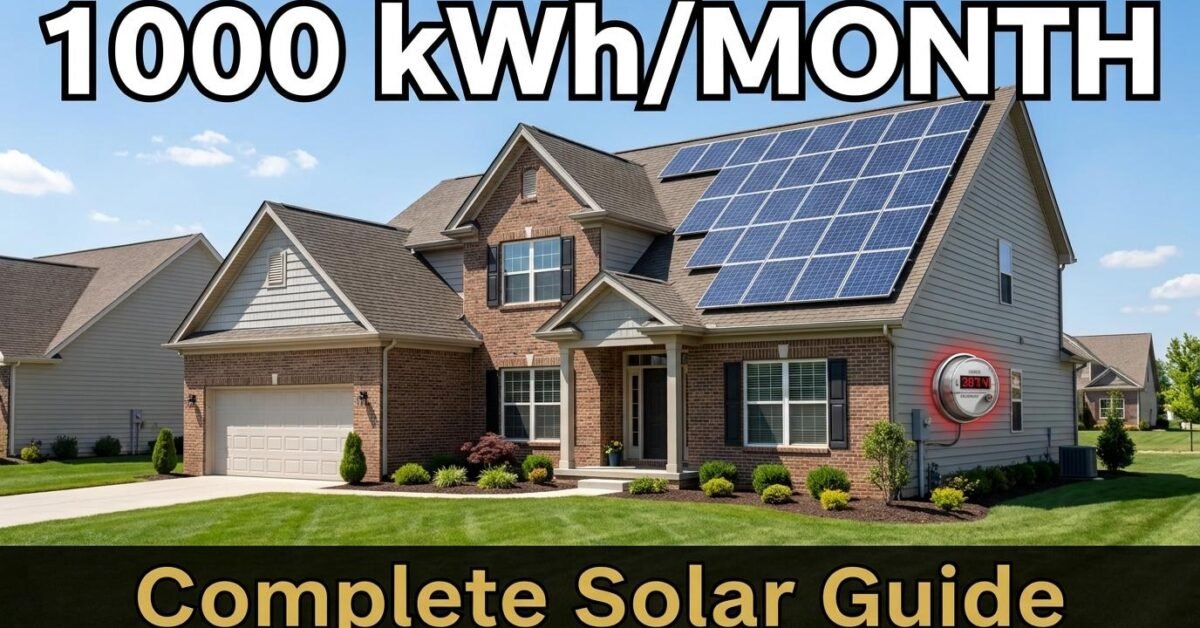
If your electricity bill shows around 1,000 kWh per month, you are slightly above the US average and well within the range where solar makes strong financial sense. A solar system for 1000 kWh per month needs to produce roughly 33 kWh per day — and this guide walks you through every component needed to get there: panels, batteries, inverter, charge controller, and cost.
Breaking Down 1000 kWh Per Month
One thousand kWh per month works out to about 33.3 kWh per day. That is a typical consumption level for a 3 to 4 bedroom home running air conditioning, a refrigerator, washing machine, multiple televisions, computers, and general lighting. In the US, this puts you about 10 percent above the national average of 900 kWh. In the UK, where the average is around 300 kWh per month, 1,000 kWh is a large home. In Australia at roughly 540 kWh average, it is a high-usage household.
Understanding your daily figure — 33 kWh — is the key input for everything that follows. If you do not know your monthly consumption, check your electricity bill or enter your bill amount in our Solar System Calculator and it converts automatically.
How Many Solar Panels for 1000 kWh?
The panel count depends on your location’s sun hours and the panel wattage you choose. Using the standard formula with a 20 percent loss buffer: panels needed = (33 × 1,200) ÷ (panel watts × sun hours).
In the US South with 5 peak sun hours and 585-watt panels: (33 × 1,200) ÷ (585 × 5) = 39,600 ÷ 2,925 = 14 panels for a 8.2 kW array. In the US Midwest with 4.5 sun hours: 15 panels at 8.8 kW. In the UK with 4 sun hours: 17 panels at 9.9 kW. With higher-wattage 670-watt panels, these counts drop to 12, 13, and 15 respectively.
For a detailed breakdown of how many solar panels you need based on your exact location and preferred wattage, see our dedicated guide.
Battery Bank for 1000 kWh Systems
If you want battery backup, the sizing depends on what you are covering and for how long. For essential-only backup (refrigerator, lights, router, fans — roughly 8 kWh per day) for 8 overnight hours, you need battery capacity of about 8 × (8÷24) ÷ (0.9 × 0.85) = 3.5 kWh usable with LiFePO4. That is just 2 units of 200 Ah on a 24-volt system.
For whole-load backup covering the full 33 kWh daily use for one complete day with lead-acid batteries: 33 ÷ (0.5 × 0.85) = 77.6 kWh rated capacity — about 16 batteries at 200 Ah on a 48-volt system. With LiFePO4: 33 ÷ (0.9 × 0.85) = 43.1 kWh, or 8 batteries. The chemistry choice alone halves the battery count and footprint. See our lead-acid vs LiFePO4 comparison for the full 10-year cost analysis.
Inverter and Charge Controller
A home consuming 1,000 kWh per month typically has a continuous load of 2,000 to 3,000 watts with surge peaks reaching 6,000 to 8,000 watts when the air conditioner and refrigerator start simultaneously. A 5 kVA hybrid inverter handles this comfortably for most configurations. Larger homes with multiple AC units may need a 7.5 or 10 kVA inverter. For detailed inverter sizing with surge calculations, see our guide.
The MPPT charge controller for an 8 to 10 kW array on a 48-volt system needs about (9,000 ÷ 48) × 1.25 = 234 amps. That typically means two 150-amp controllers or a hybrid inverter with dual MPPT inputs.
Total Cost for a 1000 kWh System
At 2026 prices, a complete system for 1,000 kWh per month with LiFePO4 batteries and 8-hour essential backup typically costs 8,000 to 14,000 dollars for hardware, depending on component quality and battery capacity. With lead-acid batteries, the upfront hardware cost is 5,500 to 9,000 dollars — but the 10-year total often exceeds the LiFePO4 build due to two battery replacements. Professional installation adds 2,000 to 5,000 dollars. The US federal 30 percent ITC reduces the effective cost significantly.
For a precise cost breakdown with your local prices, the Solar System Calculator lets you set currency, adjust every component price, and see both upfront and 10-year totals. Read our full solar system cost guide for more detail on each cost layer.
Roof Space Required
Fourteen 585-watt panels need approximately 37 square meters (about 400 square feet) of unshaded roof space. Seventeen panels for a lower-sun region need about 45 square meters. If your roof is tight, moving to 670-watt panels saves 2 to 3 panels and 5 to 8 square meters. Ground-mounted arrays are an option if roof space is insufficient, though they add mounting structure costs.
Calculate Your 1000 kWh System Now
The numbers above are reference figures for a 1,000 kWh per month home. Your actual system depends on your specific appliances, location, backup needs, and budget. The Solar System Calculator builds the complete system from your inputs in five steps — enter 1,000 in the bill quick-start field and the tool does the rest, including panel count, battery bank across four chemistries, inverter with surge sizing, charge controller, and cost comparison.