When you are shopping for an inverter, generator, or UPS, the rating is almost always in kVA — but your appliances are rated in watts. These are not the same number, and the difference (power factor) can mean buying equipment that is 20 to 30 percent too small. Our free kVA to Watts Converter handles the conversion instantly in both directions, with amps calculated at both 120V and 230V.
kVA vs Watts: What Is the Difference?
kVA (kilovolt-amperes) measures apparent power — the total electrical demand a device places on the supply, including both the useful work and the reactive power that flows back and forth in AC circuits without doing work. Watts measure real power — the electricity that actually performs work (runs motors, heats elements, lights LEDs). The relationship is simple: Watts = kVA × 1,000 × Power Factor.
Power factor is the ratio between real and apparent power. A purely resistive load like a heater or incandescent bulb has a power factor of 1.0 — all the power does useful work. A motor-driven load like an air conditioner, pump, or compressor has a power factor of 0.7 to 0.85 — some power is consumed by the magnetic field in the motor and does not produce useful output. The lower the power factor, the bigger the gap between kVA and watts.
How to Use the Converter
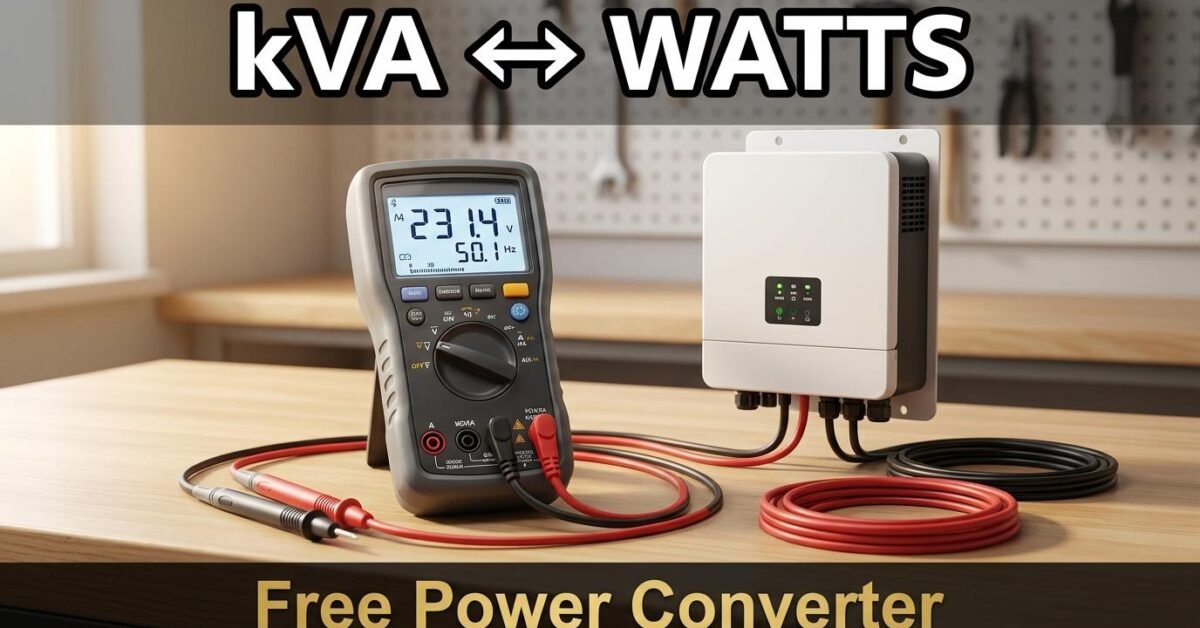
The tool has two modes. In kVA to Watts mode, enter the kVA rating of your inverter or generator and the power factor of your load. The tool shows the real power in watts and kilowatts, plus the current in amps at both 230V (international standard) and 120V (US standard). In Watts to kVA mode, enter your total load in watts and the power factor, and the tool shows what kVA rating your inverter or generator needs.
For example, a 5 kVA inverter at a typical residential power factor of 0.8 delivers 4,000 watts of real power — not 5,000. If your appliances total 4,500 watts, a 5 kVA inverter is not enough. You need 4,500 ÷ (1,000 × 0.8) = 5.63 kVA, so a 6 kVA or larger unit. This is the mistake that causes inverters to trip under load, and it is the single most common sizing error in solar and backup systems.
Common Power Factor Values
Resistive loads like electric heaters, incandescent lights, toasters, and irons have a power factor of 1.0. Residential mixed loads (typical home with a mix of everything) average about 0.85. General commercial loads average about 0.80. Motor-heavy loads like workshops, pumps, and air compressors run at 0.70 to 0.75. And welding equipment operates at 0.50 to 0.60 — meaning a welder rated at 4,000 watts needs an 8 kVA generator, not a 4 kVA one.
The converter includes a built-in reference table with these values so you do not have to memorize them. Select the closest match to your load type and the tool applies it automatically.
Why This Matters for Solar Inverters
Solar hybrid inverters are rated in kVA, but the loads they power are measured in watts. When our Solar System Calculator sizes your inverter at 5 kVA, it already accounts for the gap — it sizes on your actual watt load plus surge headroom, then recommends the kVA rating that covers both. But if you are buying an inverter separately or checking whether your existing unit is big enough, this converter gives you the quick answer.
A related sizing consideration is the difference between continuous and surge kVA. Motors draw 3 to 6 times their running watts at startup, and your inverter must survive that spike even if it only lasts a few seconds. Our inverter sizing guide explains how to account for surge loads in detail.
kVA to Amps: The Bonus Calculation
The converter also shows amps at both 120V and 230V because this determines your wiring and breaker requirements. A 5 kVA load at 230V draws 21.7 amps — well within a standard 30-amp circuit. The same 5 kVA at 120V draws 41.7 amps — requiring heavier wiring and a larger breaker. If you are installing a solar system or generator, knowing the amp draw at your local voltage tells you whether your existing electrical panel can handle it.
Three-Phase vs Single-Phase kVA
The converter handles single-phase calculations, which cover most residential and small commercial solar installations. For three-phase systems (common in larger commercial and industrial settings), the formula adds a square root of 3 factor: Watts = kVA × 1,000 × Power Factor for single-phase, and Watts = kVA × 1,000 × Power Factor × √3 for three-phase. A 10 kVA three-phase generator at 0.8 power factor delivers about 13,856 watts — roughly 73 percent more than a single-phase unit of the same kVA rating. If you are sizing a three-phase system, multiply the single-phase result by 1.732 (√3) for the correct real-power figure.
Convert Your Numbers Now
Whether you are spec’ing a solar inverter, sizing a backup generator, or checking whether your UPS can handle your server rack, the kVA to Watts Converter gives you the answer in one step. Both directions, with power factor, with amps at both voltages. No sign-up, no formulas to remember.
Open the kVA ↔ Watts Converter →
⚡ Free Solar Sizing Cheat Sheet
Get our one-page guide to sizing panels, batteries and inverters — plus weekly solar tips. No spam, unsubscribe anytime.
By subscribing you agree to our privacy policy. We'll email your guide and occasional solar tips — never spam.