How much do solar panels actually save on your electricity bill? The answer in 2026 depends on three things: what you pay for electricity, how much sun your location gets, and whether you have battery storage or net metering. This guide gives you real numbers by region, then shows you how to calculate your exact savings with our Solar Savings Calculator.
Average Solar Panel Savings by Country
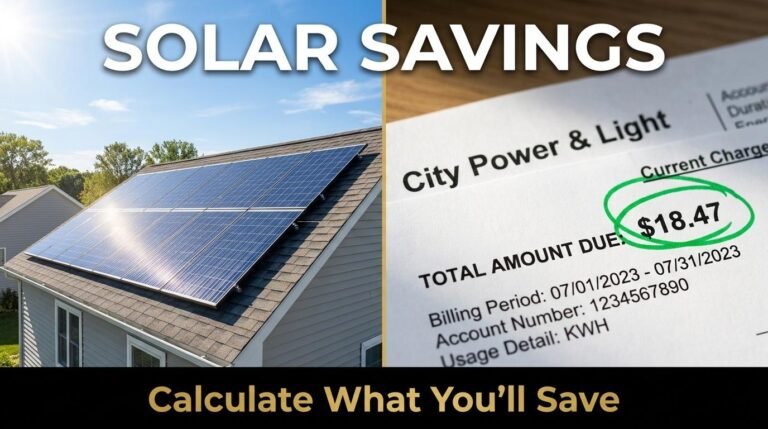
In the United States, the average homeowner saves 100 to 200 dollars per month on electricity with a properly sized solar system. That works out to 1,200 to 2,400 dollars per year in year one. With electricity rates rising 3 to 5 percent annually, the annual savings grow each year — by year 10, the same system saves 1,600 to 3,100 dollars per year because the rate you are avoiding has increased.
In the United Kingdom, average savings are lower in absolute terms because bills are smaller, but the percentage reduction is similar. A typical UK home saves 50 to 100 pounds per month, or 600 to 1,200 pounds per year. However, UK electricity rates have risen sharply in recent years (over 60 percent since 2021), making the rate-increase factor particularly powerful for UK solar savings projections.
In Australia, savings are among the highest in the world due to strong sunlight and rising electricity costs. Average savings range from 120 to 220 Australian dollars per month, or 1,440 to 2,640 dollars per year. Queensland, South Australia, and Western Australia see the highest savings due to excellent sun hours and above-average electricity rates.
Solar Savings by US State
Solar savings vary dramatically by state because electricity rates differ by more than three to one across the country. California homeowners paying 0.30 dollars per kWh save roughly twice as much as Texas homeowners paying 0.14 dollars per kWh for the same system size. The highest-savings states are California, Connecticut, Massachusetts, New York, and Hawaii — all with electricity rates above 0.25 dollars per kWh. The lowest-savings states are Louisiana, Arkansas, and Oklahoma, where rates are below 0.10 dollars per kWh. However, even low-rate states see positive ROI because system costs have dropped dramatically.
The 25-Year Savings Picture
Solar panels are warranted for 25 years, and the cumulative savings over that period are what make the investment compelling. A US home saving 1,800 dollars in year one with a 5 percent annual rate increase accumulates roughly 86,000 dollars in total savings over 25 years — against a net system cost of 8,400 dollars (12,000 dollars minus the 30 percent ITC). That is a net profit of over 77,000 dollars. Even at a conservative 3 percent rate increase, the 25-year total exceeds 60,000 dollars.
This is why solar has one of the highest ROIs of any home improvement. A kitchen renovation returns 50 to 80 percent of its cost. A solar system returns 500 to 700 percent or more, because the “return” is not resale value but avoided costs that compound for two and a half decades.
What Affects Your Savings
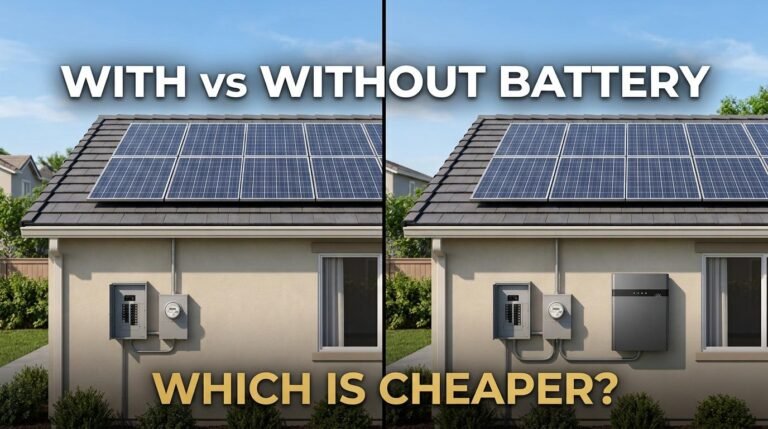
Your electricity rate is the single biggest factor — higher rates mean higher savings per kWh generated. The annual rate increase percentage is the second biggest factor because it compounds over 25 years, turning modest year-one savings into substantial long-term wealth. System size matters — a system that covers 100 percent of your bill saves more than one covering 80 percent, but the incremental cost of the last 20 percent may not be justified if net metering credits are available. Battery storage affects savings differently depending on your utility’s net metering policy — in markets with full retail net metering, batteries add cost without increasing savings; in markets with poor export rates, batteries let you self-consume more of your production and avoid expensive grid imports.
Net Metering vs Battery Storage
If your utility offers full retail net metering (you get credited at the full retail rate for excess solar exported to the grid), batteries are not necessary for maximum savings — the grid acts as a free infinite battery. If your utility has reduced net metering, time-of-use rates, or no net metering at all, battery storage lets you store daytime solar production for evening use, increasing your self-consumption percentage and your savings. Check your utility’s current policy before deciding on batteries — it is the single most important variable in the financial case.
☀️ Get Free Solar Quotes
Tell us about your home — get matched with qualified solar installers in your area. Free, no obligation.
By submitting you consent to being contacted by solar professionals regarding your inquiry. See our privacy policy.
Calculate Your Exact Savings
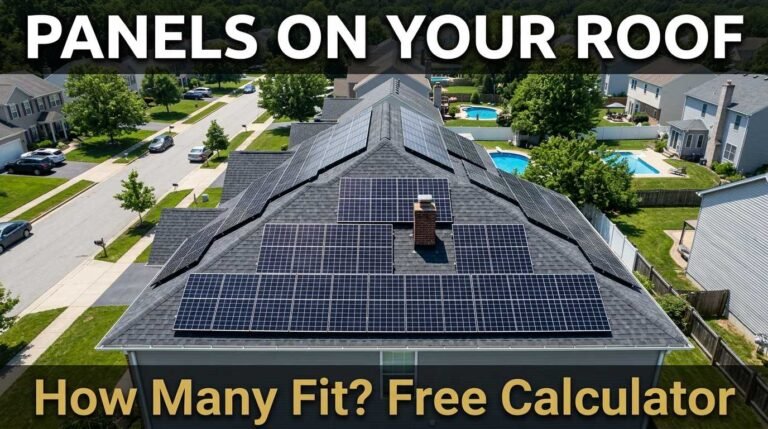
Average figures are useful for context, but your savings depend on your specific bill, rate, location, and system. Our Solar Savings Calculator lets you enter your actual numbers and see the payback period, 25-year net savings, ROI percentage, and a year-by-year breakdown with rate inflation and panel degradation modeled. For system sizing, our Solar System Calculator tells you exactly how many panels you need to cover your bill.
Calculate your solar panel savings →
☀️ Get Free Solar Quotes
Tell us about your home — get matched with qualified solar installers in your area. Free, no obligation.
By submitting you consent to being contacted by solar professionals regarding your inquiry. See our privacy policy.
⚡ Free Solar Sizing Cheat Sheet
Get our one-page guide to sizing panels, batteries and inverters — plus weekly solar tips. No spam, unsubscribe anytime.
By subscribing you agree to our privacy policy. We'll email your guide and occasional solar tips — never spam.