Before you buy solar panels, you need to know one number: how many kWh will they actually produce? Not the laboratory rating on the datasheet — the real-world output after heat, dust, wiring, and inverter losses are deducted. Our free Solar Panel Output Calculator gives you that number per panel, per array, per month, and per year, for any wattage and any location.
How the Panel Output Calculator Works
The calculator uses the standard solar production formula: daily kWh = panel wattage × peak sun hours × (1 minus system losses) ÷ 1,000. You set three inputs. Panel wattage — choose from presets (330W through 795W) or enter any custom value from your panel’s datasheet. Number of panels — from a single panel to a 200-panel commercial array. Your location’s peak sun hours — choose a region preset or enter a custom value. The system loss slider defaults to 20 percent, covering heat, dust, wiring resistance, and inverter conversion. All results update live as you adjust any input.
What the Results Tell You
The calculator shows six outputs. Per panel per day — the kWh one panel generates in your location. This is the building block for all other calculations. Whole array per day — total daily production from all your panels combined. Per month — daily output multiplied by 30, giving you the number you compare against your electricity bill. Per year — daily multiplied by 365, useful for ROI and payback calculations. Array size in kW — your total installed capacity. And roof area needed in both square meters and square feet.
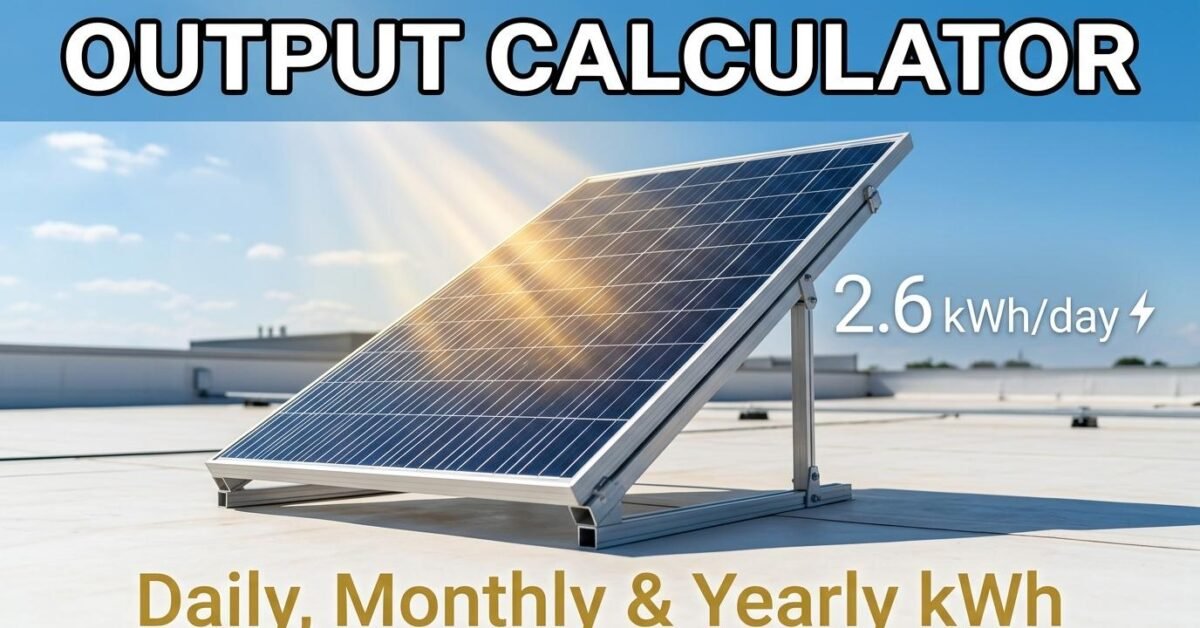
A plain-language note below the results explains the math: “Each 585W panel at 5.5 sun hours produces approximately 2.6 units per day after 20 percent losses. 10 panels = 25.7 units per day, approximately 772 units per month.” One unit equals one kWh — the same unit your electricity bill uses.
Output by Panel Wattage (Real Numbers)
Using 5 peak sun hours and 20 percent system losses, here is what each panel wattage produces. A 330W panel generates 1.32 kWh per day. A 450W panel generates 1.80 kWh per day. A 585W panel generates 2.34 kWh per day. A 610W panel generates 2.44 kWh per day. A 670W panel generates 2.68 kWh per day. And a 795W commercial panel generates 3.18 kWh per day.
Over a month, a single 585W panel produces about 70 kWh — enough to run a refrigerator. A 10-panel array produces about 700 kWh per month, which covers the electricity use of an average UK home or roughly 78 percent of an average US home. For a detailed comparison of how wattage affects panel count and cost, see our panel wattage comparison guide.
How Location Changes Everything
The same 585W panel produces dramatically different output depending on where it is installed. In the US Southwest or Middle East at 6 peak sun hours: 2.81 kWh per day, or 1,025 kWh per year. In South Asia or Australia at 5.5 hours: 2.57 kWh per day, or 940 kWh per year. In the US South at 5 hours: 2.34 kWh per day, or 854 kWh per year. In the UK at 4 hours: 1.87 kWh per day, or 683 kWh per year. In Northern Europe at 3 hours: 1.40 kWh per day, or 513 kWh per year.
The difference between the sunniest and cloudiest regions is roughly double. This is why how many panels you need varies so much by location — a UK home needs about 70 percent more panels than an Arizona home for the same energy target.
What the Loss Percentage Covers
The 20 percent default loss accounts for several real-world factors. Temperature is the biggest — panels lose about 0.3 to 0.5 percent efficiency per degree Celsius above 25 degrees, which on a 40-degree rooftop day means 5 to 7 percent less output. Dust and pollen accumulation costs 2 to 5 percent depending on cleaning frequency. Wiring resistance in cables between panels, controller, and inverter loses 1 to 3 percent. Inverter conversion from DC to AC loses 3 to 8 percent depending on inverter quality. And panel mismatch in a string — slight manufacturing differences between panels — costs another 1 to 2 percent.
If your panels are in a dusty environment, increase losses to 25 percent. If they are in a cool climate with a high-efficiency inverter and short cable runs, you can reduce to 15 percent. The slider lets you fine-tune for your specific situation.
From Output to System Sizing
Once you know your per-panel output, sizing a system is simple division. If your home uses 900 kWh per month and each 585W panel produces 70 kWh per month, you need 900 ÷ 70 = 13 panels. The calculator shows this visually — adjust the panel count until the monthly output meets or exceeds your bill.
For a complete system that goes beyond panels to include batteries, inverter, charge controller, and cost, use the Solar System Calculator. It uses the same output formula this tool does, plus it sizes every other component and shows a 10-year cost comparison.
Calculate Your Panel Output Now
Our Solar Panel Output Calculator gives you the production numbers you need to make an informed decision — per panel, per array, per month, and per year, with real losses applied. No sign-up, no sales calls. Enter your panel wattage and location and see exactly what your panels will produce.
Open the Panel Output Calculator →
⚡ Free Solar Sizing Cheat Sheet
Get our one-page guide to sizing panels, batteries and inverters — plus weekly solar tips. No spam, unsubscribe anytime.
By subscribing you agree to our privacy policy. We'll email your guide and occasional solar tips — never spam.